
Visto un uccello? Identificalo all'istante con l'app Birdby
Apri l'appInformazioni
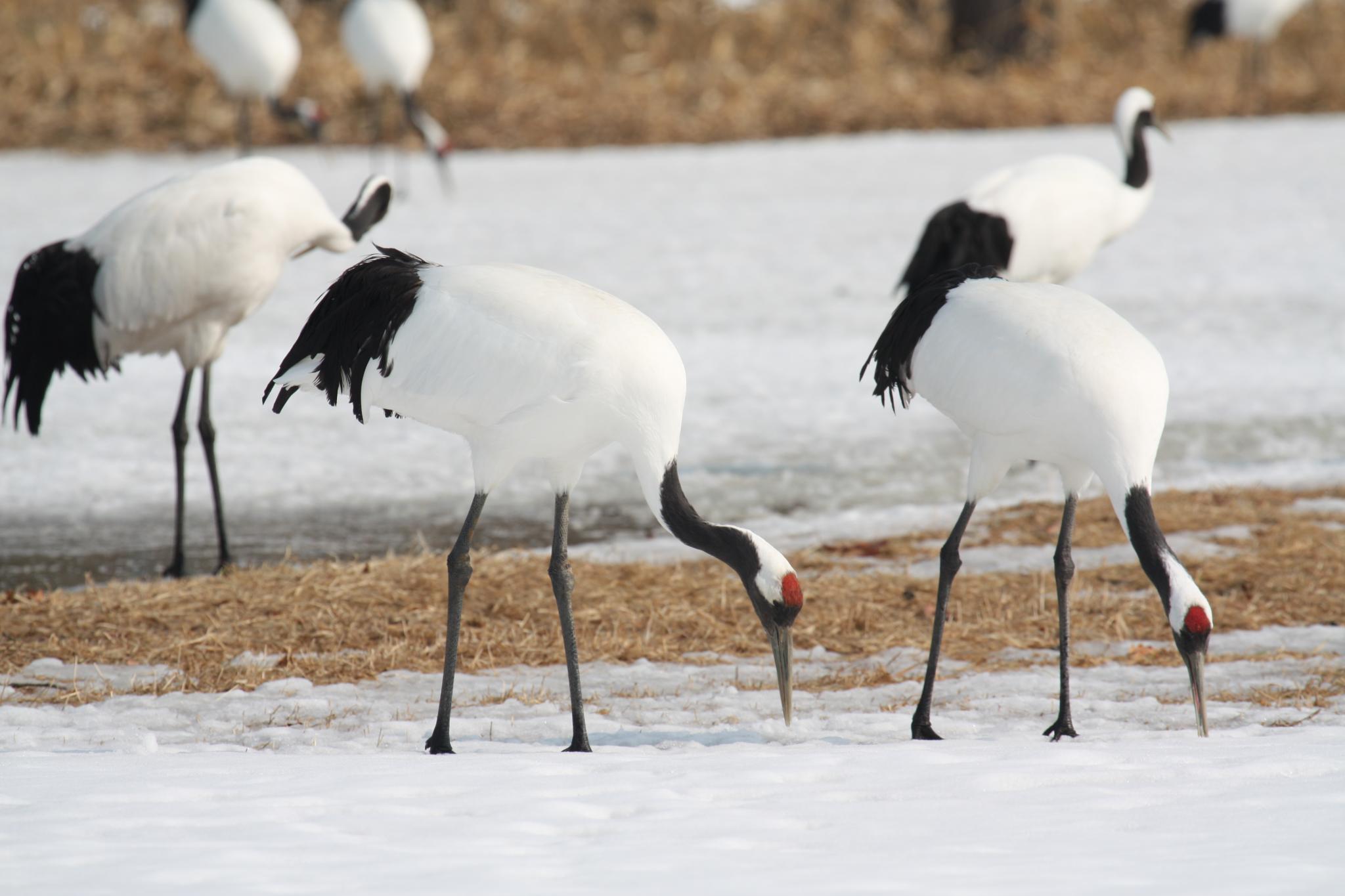
The Red-crowned Crane, also known as the Japanese Crane or Manchurian Crane, is a large East Asian crane among the rarest cranes in the world. It is revered as a symbol of luck, longevity, and fidelity in several Asian cultures. Known for its striking black and white plumage and a distinctive patch of red bare skin on its crown, it inhabits wetlands and marshes.
Dimensioni e longevità
- Lunghezza
- 140-158 cm (55-62 in)
- Apertura alare
- 220-250 cm (87-98 in)
- Peso
- 7-10 kg (15-22 lb)
- Longevità
- 30-40 years in the wild, up to 60-70 years in captivity
- Dieta
- Omnivore
Caratteristiche fisiche
- Piumaggio
- Predominantly white body plumage. The primary and secondary flight feathers, as well as the neck and face, are black. A distinctive patch of bare red skin is present on the crown, which becomes brighter and more prominent during breeding season or when the bird is excited.
- Forma del becco
- Long, straight, and pointed, dark olive-green to blackish in color.
- Colore degli occhi
- Dark brown.
- Colore delle zampe
- Dark grey to black.
- Caratteristiche distintive
- The combination of pure white body, black neck and primaries, and the prominent red crown patch is unmistakable. Its large size and elegant posture are also key features.
- Aspetto giovanile
- Juveniles have a mottled white and cinnamon-brown plumage, particularly on the head and neck, which gradually whitens with age. The red crown patch is absent or very dull in juveniles, developing fully after several years. Their flight feathers are often brownish-black rather than pure black.
- Cambiamenti stagionali
- No significant seasonal plumage changes beyond the intensity of the red crown patch, which can vary with excitement or breeding condition.
- Dimorfismo sessuale
- Males and females are generally similar in plumage. Males tend to be slightly larger than females, but this difference is not easily discernible in the field. The red crown patch may appear slightly larger and more intense in males during courtship displays.
Come identificare
- 1
Plumage
Look for the striking contrast of pure white body feathers against the jet-black neck, face, and primary/secondary flight feathers. This pattern is unique among cranes in its range.
- 2
Red Crown
The most distinctive feature is the patch of bare red skin on the crown. Its intensity can vary, but it's always present in adults. In juveniles, it's absent or very dull.
- 3
Size and Stature
It is one of the largest crane species, with an imposing height and wingspan. Its elegant, upright posture is characteristic.
- 4
Vocalizations
Listen for its loud, trumpeting calls, especially the synchronized unison call of a pair, which is a key identifier in its habitat.
- 5
Behavior
Observe its elaborate courtship dances, involving bowing, jumping, and wing flapping, which are unique and highly visible.
Habitat e areale
- Biomi
- Wetlands, marshes, shallow lakes, rivers, and agricultural fields (especially rice paddies) during non-breeding season.
- Areale geografico
- Eastern Asia. Breeding populations are found in southeastern Russia, northeastern China, and Hokkaido, Japan. Non-breeding (wintering) populations are found in coastal areas of Japan, the Korean Peninsula, and parts of China.
- Fascia altitudinale
- Typically found in low-lying wetland areas, from sea level up to a few hundred meters.
- Ambienti preferiti
- Extensive freshwater marshes, reed beds, wet grasslands, and agricultural lands (especially rice paddies and stubble fields) for foraging. Requires undisturbed areas for nesting.
Comportamento
- Periodo di attività
- Diurnal.
- Abitudini alimentari
- Forages by walking slowly through shallow water or fields, probing with its bill. Diet includes aquatic invertebrates (insects, snails, crabs), fish, amphibians, small rodents, reeds, grasses, seeds, and waste grain. They are opportunistic feeders.
- Comportamento sociale
- Highly social, especially outside the breeding season, forming large flocks during migration and wintering. During the breeding season, they are territorial and typically found in pairs.
- Tipo di volo
- Powerful and graceful flight, with slow, deliberate wing beats. They fly with their necks and legs extended. Often soar on thermals. Known for their elaborate and synchronized courtship dances, which involve bowing, jumping, and calling.
- Migrazione
- Northern populations (Russia, China) are migratory, moving south to wintering grounds in Korea and China. The Japanese population (Hokkaido) is largely resident, though some individuals may make short-distance movements.
- Territorialità
- Highly territorial during the breeding season, with pairs defending their nesting sites. They use vocalizations and displays to deter intruders.
Canto e richiami
- Canto
- The 'unison call' is a distinctive and complex duet performed by mated pairs. It consists of a series of synchronized calls, with the female typically emitting two notes for every one note from the male. This call is used for pair bonding and territorial defense.
- Richiamo
- Loud, trumpeting calls, often described as a 'kroo-kroo-kroo' sound. These calls are resonant and can carry over long distances, used for communication within flocks, alarm calls, and territorial declarations.
- Quando vocalizza
- Most vocal during the breeding season, especially during courtship and territorial defense. Also vocal during migration and when disturbed.
Riproduzione
- Stagione riproduttiva
- Typically April to June, varying slightly by geographic location.
- Abitudini di nidificazione
- Nests are large platforms built from reeds, sedges, and other aquatic vegetation, usually in shallow water or on small islands within extensive wetlands. Both parents participate in nest construction.
- Dimensione della covata
- 1-2 eggs
- Descrizione dell'uovo
- Usually 1-2 eggs, rarely 3. Eggs are oval, dull olive-brown to greenish-brown, often with darker spots or blotches.
- Periodo di incubazione
- 29-34 days, primarily by the female, but both parents share duties.
- Periodo di involo
- Chicks are precocial and leave the nest within a few days of hatching. They fledge (become capable of flight) at around 95-100 days.
- Cure parentali
- Both parents are highly involved in raising the young, guarding the nest, incubating eggs, and feeding and protecting the chicks until they are independent, often for up to a year.
Dove trovarlo
Wetland Reserves
Major wetland reserves in Hokkaido (Japan), the Korean Demilitarized Zone (DMZ), and protected areas in northeastern China and southeastern Russia are prime locations.
Agricultural Fields
During winter, they often forage in rice paddies and other agricultural fields adjacent to wetlands, particularly in Japan and Korea.
Coastal Marshes
Wintering populations frequently utilize coastal marshes and estuaries.
Consigli sul campo
- Timing. The best time to observe them is during the breeding season (spring/early summer) in their nesting grounds or during winter in their wintering areas, when they often congregate in larger numbers.
- Binoculars/Scope. Due to their shy nature and preference for open wetlands, a good pair of binoculars or a spotting scope is essential for detailed observation without disturbance.
- Patience and Stealth. Approach quietly and maintain a respectful distance to avoid flushing the birds, especially during nesting. They are sensitive to human disturbance.
- Listen for Calls. Their loud calls can often be heard before the birds are seen, helping to locate them in dense wetland vegetation.
Specie simili
Common Crane
Grus grus
The Common Crane is predominantly grey, lacking the pure white body and black neck/primaries of the Red-crowned Crane. It has a black face and throat with a white stripe extending from behind the eye down the neck, and a red patch on the crown (less prominent than Red-crowned Crane's). Its overall coloration is much duller.
White-naped Crane
Antigone vipio
The White-naped Crane is primarily grey with a white nape and hindneck, and a red patch around the eye. It lacks the extensive black on the neck and primaries, and the pure white body of the Red-crowned Crane. Its legs are pinkish-red, contrasting with the dark legs of the Red-crowned Crane.
Fatti rapidi
- Symbolism:
- Symbol of luck, longevity, and fidelity in East Asian cultures.
- Diet Type:
- Omnivorous, feeding on a wide range of aquatic and terrestrial items.
- Migration:
- Northern populations are migratory; Japanese population is largely resident.
- Nesting:
- Large platform nests in shallow water of wetlands.
- Conservation:
- Vulnerable, primarily due to habitat loss and degradation.
Curiosità
- The Red-crowned Crane is one of the world's rarest crane species, with an estimated global population of around 2,700 individuals in the wild.
- Their elaborate courtship dances are a spectacular display, involving synchronized movements, leaps, and calls, strengthening pair bonds.
- In Japan, it is known as 'Tancho' and is a national symbol, often depicted in art and folklore, representing good fortune and a long life.
- They are monogamous and form strong pair bonds that can last for many years, often for life.
- The red patch on their crown is not feathers but bare skin, which can change in intensity depending on the bird's emotional state.
Classificazione scientifica
- Regno
- Animalia
- Phylum
- Chordata
- Classe
- Aves
- Ordine
- Gruiformes
- Famiglia
- Gruidae
- Genere
- Grus
- Specie
- Grus japonensis
Esplora Red-crowned Crane
Identifica uccelli ovunque
Gratis su iOS, Android e Web. Identificazione per foto e suono, database completo e la tua lista personale.