
Visto un uccello? Identificalo all'istante con l'app Birdby
Apri l'appInformazioni
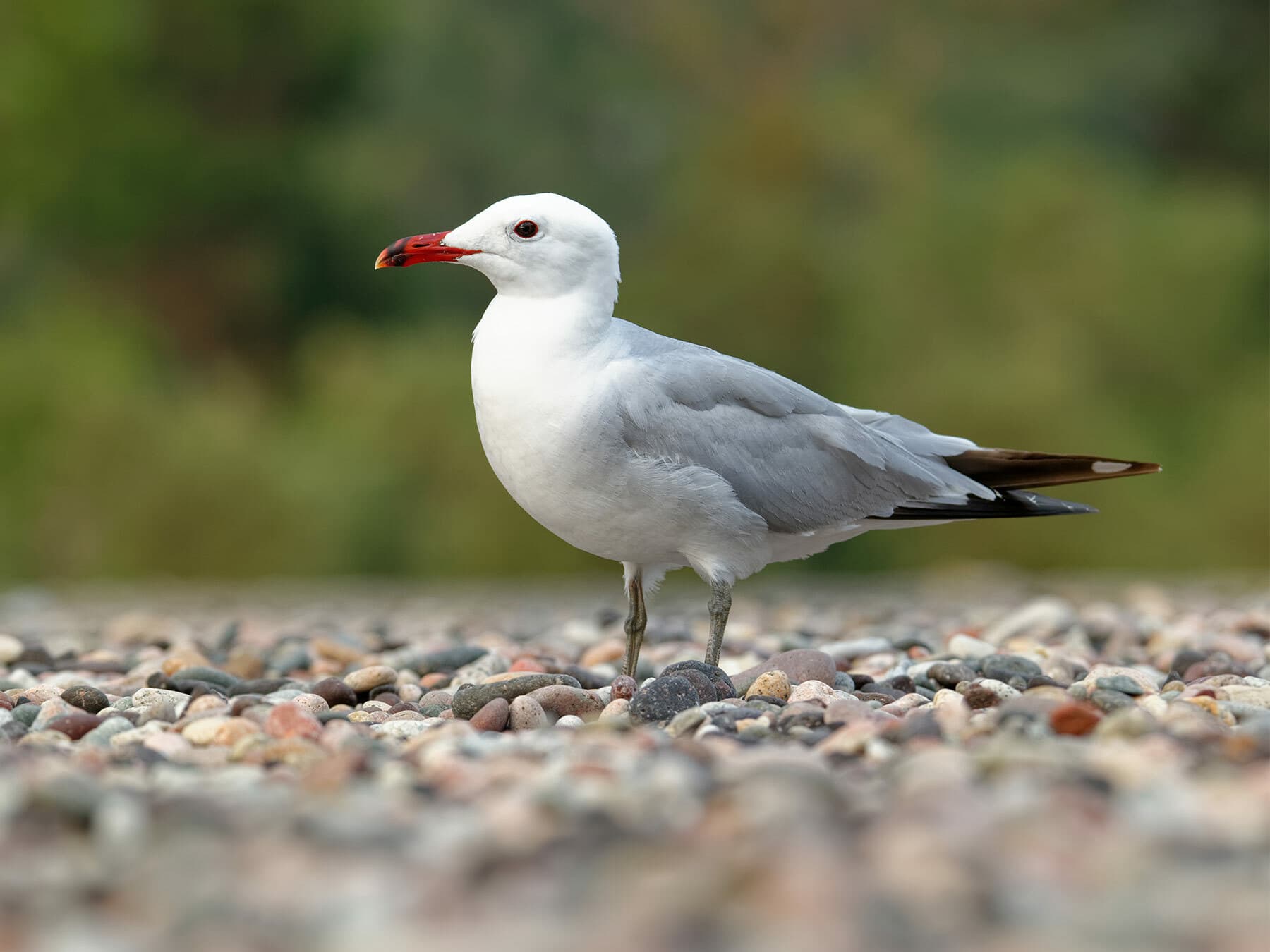
The Audouin's Gull is a medium-sized gull, endemic to the Mediterranean Sea and adjacent Atlantic coasts. It is characterized by its distinctive dark red bill with a black band and pale grey upperparts. It is primarily a fish-eating species, often foraging offshore.
Dimensioni e longevità
- Lunghezza
- 48-52 cm
- Apertura alare
- 125-138 cm
- Peso
- 500-800 g
- Longevità
- Up to 20 years in the wild
- Dieta
- Carnivore (primarily piscivorous)
Caratteristiche fisiche
- Piumaggio
- Adult breeding plumage: Pale grey mantle and upperwings, white head, neck, underparts, and tail. Primary feathers are black with white tips, forming a distinctive 'string of pearls' pattern on the trailing edge of the wing. Non-breeding plumage: Similar to breeding, but with faint dusky streaking on the head and nape.
- Forma del becco
- Relatively slender, dark red with a black subterminal band and a yellowish tip. The bill color is a key identification feature.
- Colore degli occhi
- Dark brown, with a narrow red orbital ring.
- Colore delle zampe
- Dull greenish-grey to dark grey, sometimes appearing blackish.
- Caratteristiche distintive
- Dark red bill with black band and yellowish tip, pale grey upperparts, dark legs, and the 'string of pearls' pattern on the primaries. Its overall elegant and slender appearance compared to other gulls.
- Aspetto giovanile
- First-winter birds have a mottled brown and grey plumage, with a dark bill and dark legs. The head and underparts are streaked and mottled. The upperparts are brownish-grey with dark feather centers. Second-winter birds show a gradual transition towards adult plumage, with more grey on the mantle and a paler head, but still retain some brown mottling and a darker bill.
- Cambiamenti stagionali
- Adults show very subtle seasonal changes. Breeding plumage is slightly cleaner and brighter white on the head and underparts. Non-breeding plumage may have faint dusky streaking on the head and nape, and the bill color might be slightly duller.
- Dimorfismo sessuale
- Minimal; males are typically slightly larger than females, but plumage is identical.
Come identificare
- 1
Bill Color and Pattern
Look for the distinctive dark red bill with a prominent black subterminal band and a yellowish tip. This is the most reliable field mark for adults.
- 2
Leg Color
Observe the legs, which are dull greenish-grey to dark grey, contrasting with the yellow legs of many other large gulls.
- 3
Mantle Color
Note the pale grey mantle (upperparts), which is lighter than that of Yellow-legged Gulls but darker than Slender-billed Gulls.
- 4
Primary Pattern
In flight, look for the black primary feathers with distinct white tips, creating a 'string of pearls' effect on the trailing edge of the wing.
- 5
Overall Structure and Flight
Audouin's Gull has a more elegant, slender build and a graceful, buoyant flight compared to the heavier, more robust Yellow-legged Gull.
- 6
Juvenile Plumage
First-winter birds are mottled brown and grey with a dark bill and dark legs. Look for the overall shape and flight, and note the habitat preference.
Habitat e areale
- Biomi
- Coastal and marine environments, particularly rocky islets, sandy beaches, and offshore waters.
- Areale geografico
- Primarily Mediterranean Sea, with breeding colonies concentrated in Spain (especially the Ebro Delta), Italy, Greece, Turkey, and North Africa. Non-breeding range extends to the Atlantic coasts of North Africa and occasionally West Africa.
- Fascia altitudinale
- Sea level to low coastal elevations for breeding; primarily marine during foraging.
- Ambienti preferiti
- Remote, undisturbed coastal islands and islets for breeding, often with sparse vegetation. Forages in open marine waters, often over continental shelves.
Comportamento
- Periodo di attività
- Diurnal, active during daylight hours for foraging and social interactions.
- Abitudini alimentari
- Primarily piscivorous, feeding on small to medium-sized fish, often caught by surface-plunging or dipping. Also takes cephalopods, crustaceans, and occasionally insects or carrion. Often forages solitarily or in small groups, sometimes associating with fishing boats.
- Comportamento sociale
- Colonial breeder, forming dense colonies on islands and coastal areas. Outside the breeding season, they can be found in small to large flocks, often roosting communally. Less prone to scavenging in urban areas than other large gulls.
- Tipo di volo
- Graceful and buoyant flight, with relatively shallow wing beats. Often glides effortlessly over the water. Can be seen soaring on thermals. When foraging, it performs agile dives and swoops.
- Migrazione
- Partial migrant. Northern populations (e.g., Spain, Italy) are largely migratory, moving south to the Atlantic coasts of North Africa and West Africa for the winter. Southern populations may be more sedentary or undertake shorter movements. Migration occurs mainly from August to October and February to April.
- Territorialità
- Highly territorial during the breeding season, defending a small area around the nest site within the colony. Outside breeding, they are less territorial.
Canto e richiami
- Canto
- Audouin's Gull does not have a complex song. Its vocalizations are typical gull calls.
- Richiamo
- A distinctive, rather deep, nasal 'kwa-aah' or 'kwa-kwa-kwa', often given in a series. Also a shorter, sharper 'kyow' or 'kya'. Calls are generally less harsh and higher-pitched than those of Yellow-legged Gulls.
- Quando vocalizza
- Most vocal during the breeding season, especially within colonies, for communication between mates, territorial defense, and alarm calls. Also vocal during foraging and in flight.
Riproduzione
- Stagione riproduttiva
- Typically from April to July, with peak egg-laying in May.
- Abitudini di nidificazione
- Nests colonially on remote, undisturbed islands, islets, or coastal cliffs, often on sandy or rocky ground, sometimes among sparse vegetation. The nest is a shallow scrape lined with plant material, feathers, or pebbles.
- Dimensione della covata
- 2-3 eggs
- Descrizione dell'uovo
- Typically 2-3 eggs (rarely 1 or 4), olive-buff to pale brown, heavily marked with dark brown spots and blotches. Average size is about 60 x 42 mm.
- Periodo di incubazione
- 27-33 days, incubated by both parents.
- Periodo di involo
- 35-40 days after hatching. Young are fed by both parents until they are able to fly and forage independently.
- Cure parentali
- Both parents share incubation duties and care for the chicks, providing food and protection until fledging and for a period thereafter.
Dove trovarlo
Breeding Colonies
Remote, undisturbed islands and islets in the Mediterranean Sea, particularly in the Ebro Delta (Spain), Sardinia (Italy), and parts of Greece and Turkey. Access to these sites is often restricted to protect the birds.
Coastal Areas
During non-breeding seasons, they can be found along the Mediterranean and Atlantic coasts of North Africa and West Africa, often roosting on sandy beaches or rocky shores.
Offshore Waters
Often seen foraging in open marine waters, sometimes following fishing boats, especially over continental shelves.
Consigli sul campo
- Focus on Bill and Leg Color. These are the most crucial identification features for adult Audouin's Gulls. A red bill with a black band and dark legs are diagnostic.
- Observe Flight and Structure. Its more elegant flight and slender build can help distinguish it from bulkier gulls, even at a distance.
- Check Habitat. While other gulls might be found in urban areas, Audouin's Gulls prefer undisturbed coastal and marine environments, especially for breeding.
- Listen for Calls. Familiarize yourself with its distinctive nasal 'kwa-aah' call, which is different from the harsher calls of other large gulls.
- Visit Key Breeding Sites (Responsibly). If possible, visit designated birdwatching areas near known breeding colonies during the breeding season, but always respect protected areas and avoid disturbance.
Specie simili
Yellow-legged Gull
Larus michahellis
Audouin's Gull is generally more slender and elegant. Key differences include the bill color (Audouin's has a dark red bill with a black band, Yellow-legged has a yellow bill with a red spot), leg color (Audouin's has dark grey legs, Yellow-legged has bright yellow legs), and a paler mantle. Audouin's also has a more distinctive 'string of pearls' pattern on the primaries.
Slender-billed Gull
Chroicocephalus genei
Slender-billed Gull is smaller, has a much more slender, all-dark red bill (without a black band), and lacks the dark primaries of Audouin's Gull. Its mantle is also paler, and it has a more delicate appearance overall.
Common Gull (Mew Gull)
Larus canus
Common Gull is smaller, has a yellowish-green bill with a dark band (not red), and yellowish-green legs. Its primary pattern is also different, lacking the distinct 'string of pearls' of Audouin's Gull.
Fatti rapidi
- Primary Diet:
- Fish
- Habitat Preference:
- Coastal and marine
- Breeding Strategy:
- Colonial
- Migration Status:
- Partial migrant
- Key ID Feature:
- Red bill with black band and dark legs
Curiosità
- The Audouin's Gull is the only gull species almost entirely restricted to the Mediterranean Sea for breeding.
- It was once considered one of the rarest gulls in the world, with its population plummeting to just a few thousand pairs in the 1960s. Conservation efforts have led to a significant recovery, though it remains 'Vulnerable'.
- Unlike many other gulls, it rarely scavenges in human-dominated environments, preferring to hunt live fish offshore.
- Its scientific name, Ichthyaetus audouinii, means 'fish eagle of Audouin', referring to its piscivorous diet and named after the French naturalist Jean Victor Audouin.
Classificazione scientifica
- Regno
- Animalia
- Phylum
- Chordata
- Classe
- Aves
- Ordine
- Charadriiformes
- Famiglia
- Laridae
- Genere
- Ichthyaetus
- Specie
- Ichthyaetus audouinii
Esplora Audouin's Gull
Identifica uccelli ovunque
Gratis su iOS, Android e Web. Identificazione per foto e suono, database completo e la tua lista personale.