
Visto un uccello? Identificalo all'istante con l'app Birdby
Apri l'appInformazioni
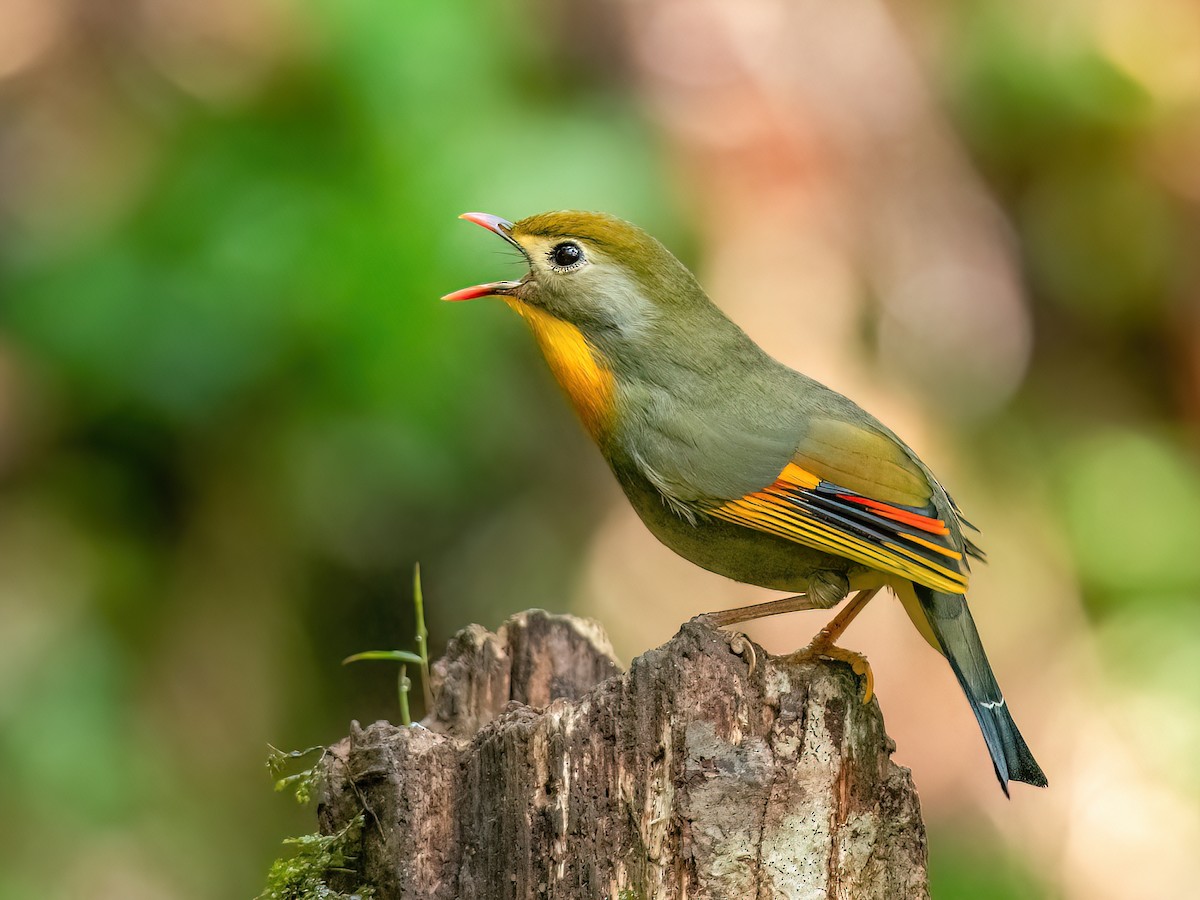
The Red-billed Leiothrix, also known as the Pekin Robin or Japanese Nightingale (though not a true nightingale), is a small, colorful passerine bird native to the Himalayas and Southeast Asia. It is highly prized for its melodious song and vibrant plumage, leading to its introduction as an ornamental bird in various parts of the world, where it has established feral populations.
Dimensioni e longevità
- Lunghezza
- 13-16 cm
- Apertura alare
- 18-20 cm
- Peso
- 19-29 g
- Longevità
- 5-10 years in the wild, up to 15 years in captivity
- Dieta
- Omnivore (primarily insects and fruits)
Caratteristiche fisiche
- Piumaggio
- Adults have a bright olive-green back, a yellow throat transitioning to orange on the breast, and a bright red bill. The wings are dark with a prominent yellow patch and a red-orange speculum. The tail is forked and dark, often with white tips on the outer feathers. A distinctive yellow eye-ring is present.
- Forma del becco
- Conical, pointed, and bright coral-red.
- Colore degli occhi
- Dark brown, surrounded by a prominent yellow eye-ring.
- Colore delle zampe
- Orange-yellow to reddish-brown.
- Caratteristiche distintive
- The combination of the bright red bill, yellow eye-ring, olive-green back, and yellow-orange breast with a yellow and red wing patch is unique.
- Aspetto giovanile
- Juveniles are duller overall, with a less vibrant red bill (often brownish or dusky), paler yellow-orange on the breast, and less distinct wing coloration. The yellow eye-ring is also less pronounced.
- Cambiamenti stagionali
- No significant seasonal changes in plumage. The vibrant colors are maintained year-round.
- Dimorfismo sessuale
- Males and females are very similar in plumage. Males may have slightly brighter coloration, particularly on the breast and wing patches, and a more robust song, but these differences are subtle and not reliable for field identification.
Come identificare
- 1
Bill Color
Look for the unmistakable bright coral-red bill. This is a primary field mark.
- 2
Plumage Colors
Note the combination of olive-green back, yellow throat, orange breast, and the distinctive yellow and red patches on the dark wings.
- 3
Eye-ring
The prominent yellow eye-ring around a dark eye is a key identifier.
- 4
Behavior
Observe its active foraging style in dense undergrowth, often hopping and flitting. Listen for its rich, melodious song.
- 5
Habitat
Look in dense shrubbery, bamboo thickets, and forest edges, especially in areas where it has been introduced.
Habitat e areale
- Biomi
- Subtropical and tropical moist lowland forests, subtropical and tropical moist montane forests, shrubland, and plantations.
- Areale geografico
- Native to the Himalayas (from Pakistan to Northeast India, Nepal, Bhutan), Myanmar, southern China, and northern Vietnam. Introduced and established feral populations exist in Japan, Hawaii, parts of Europe (e.g., France, Italy, Spain, Portugal), and Australia.
- Fascia altitudinale
- Typically found at elevations between 700 and 2,500 meters, but can occur lower in introduced ranges.
- Ambienti preferiti
- Dense undergrowth, thickets, bamboo forests, forest edges, and secondary growth with abundant shrubs and small trees. They prefer areas with good cover for foraging and nesting.
Comportamento
- Periodo di attività
- Diurnal, most active during the early morning and late afternoon.
- Abitudini alimentari
- Forages actively in the undergrowth and lower to middle canopy. Its diet consists mainly of insects (beetles, ants, flies, caterpillars) and their larvae, as well as a variety of fruits (berries, figs) and seeds. They often glean insects from foliage and bark, and will also catch insects in flight. They are known to visit bird feeders for soft fruits and mealworms.
- Comportamento sociale
- Typically seen in pairs or small, loose flocks, especially outside the breeding season. They are quite active and vocal, often moving through the undergrowth in search of food. They can be quite tame in areas where they are accustomed to human presence.
- Tipo di volo
- Short, undulating flights between dense cover. Not a strong, sustained flyer, preferring to hop and flit through vegetation.
- Migrazione
- Generally resident throughout its native range, with some altitudinal movements in winter to lower elevations. Introduced populations are also largely resident.
- Territorialità
- Pairs defend a breeding territory during the nesting season, but are more gregarious outside of this period.
Canto e richiami
- Canto
- A rich, varied, and melodious song, often described as a series of clear, fluty whistles and warbles, sometimes with mimicry of other birds. It is complex and can be quite loud for its size, often delivered from a prominent perch. The song is a key characteristic that earned it the 'Japanese Nightingale' moniker.
- Richiamo
- Common calls include a sharp 'tseet' or 'tsip', a soft 'churr', and a rapid, chattering alarm call when disturbed.
- Quando vocalizza
- Most vocal during the breeding season (spring and early summer), but can be heard year-round, especially in the morning and evening.
Riproduzione
- Stagione riproduttiva
- Typically from April to August, varying slightly by geographic location.
- Abitudini di nidificazione
- Nests are cup-shaped, well-hidden, and usually built low in dense bushes, shrubs, or bamboo thickets, often within 2 meters of the ground. Constructed from fine grasses, moss, leaves, and rootlets, lined with finer materials.
- Dimensione della covata
- 2-4 eggs, usually 3.
- Descrizione dell'uovo
- 2-4 eggs, typically pale blue or greenish-blue, sometimes with fine reddish-brown speckles, particularly at the larger end. Eggs measure approximately 19 x 14 mm.
- Periodo di incubazione
- 13-14 days, primarily by the female, though the male may assist.
- Periodo di involo
- 12-15 days after hatching, the young leave the nest.
- Cure parentali
- Both parents participate in feeding and caring for the nestlings and fledglings.
Dove trovarlo
Dense Undergrowth
Focus on areas with thick bushes, shrubs, and bamboo, particularly near forest edges or clearings.
Forest Edges
They often frequent the transition zones between dense forest and more open areas, where food and cover are abundant.
Gardens and Parks (Introduced Range)
In areas where they are introduced (e.g., Japan, parts of Europe), they can be found in well-vegetated gardens, parks, and urban green spaces.
Bird Feeders
In some introduced areas, they may visit feeders offering soft fruits or mealworms.
Consigli sul campo
- Listen for their song. Their loud, melodious song is often the first indication of their presence, especially in dense vegetation where they can be hard to spot visually.
- Be patient and quiet. They are active but can be shy. Remain still and observe the undergrowth. They often move in small groups, so if you see one, others may be nearby.
- Look for movement in dense foliage. Their constant foraging activity often causes leaves to rustle, which can help pinpoint their location.
- Use binoculars. Their small size and preference for dense cover make binoculars essential for a good view of their intricate plumage.
Specie simili
Silver-eared Mesia
Leiothrix argentauris
The Silver-eared Mesia has distinct silver ear-coverts, a black cap, and a red throat, contrasting with the Red-billed Leiothrix's yellow eye-ring, olive-green back, and yellow-orange breast. The bill of the Mesia is also red, but the overall plumage pattern is very different.
Blue-winged Minla
Actinodura cyanouroptera
While also a colorful babbler, the Blue-winged Minla has prominent blue wings and tail, a streaked crown, and lacks the bright red bill and yellow-orange breast of the Leiothrix. Its overall shape is also more slender.
Fatti rapidi
- Native Range:
- Himalayas, Southeast Asia
- Introduced Populations:
- Japan, Hawaii, parts of Europe
- Diet:
- Insects and fruits
- Song:
- Melodious, fluty whistles and warbles
- Key ID Mark:
- Red bill, yellow eye-ring, yellow-orange breast
Curiosità
- Despite its common name 'Japanese Nightingale', it is not a true nightingale (family Luscinia) but a member of the Old World babbler family.
- It is a popular cage bird due to its beautiful song and vibrant colors, which has led to its widespread introduction outside its native range.
- In some introduced regions, particularly in Japan, it is considered an invasive species due to potential competition with native birds for resources.
- The genus name 'Leiothrix' comes from Greek, meaning 'smooth hair', referring to the soft plumage.
Classificazione scientifica
- Regno
- Animalia
- Phylum
- Chordata
- Classe
- Aves
- Ordine
- Passeriformes
- Famiglia
- Leiothrichidae
- Genere
- Leiothrix
- Specie
- Leiothrix lutea
Esplora Red-billed Leiothrix
Identifica uccelli ovunque
Gratis su iOS, Android e Web. Identificazione per foto e suono, database completo e la tua lista personale.