
Visto un uccello? Identificalo all'istante con l'app Birdby
Apri l'appInformazioni
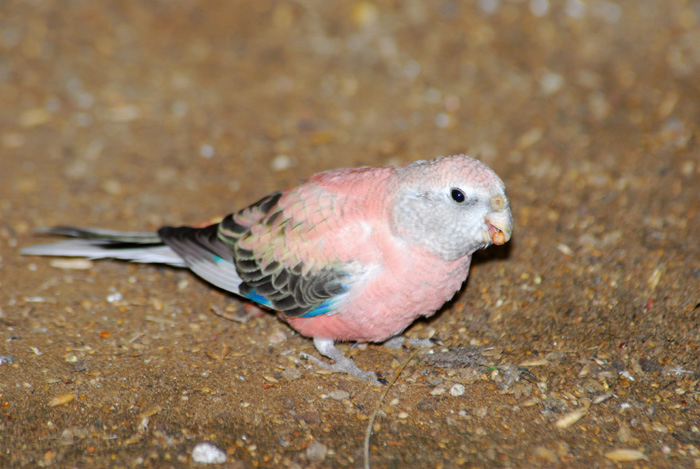
The Bourke's Parrot, also known as the Bourke Parrot or Bourke's Grass Parrot, is a small, nocturnal parrot native to Australia. It is known for its soft, muted plumage, primarily pinkish-brown with blue and pink accents, and its gentle disposition. Unlike many parrots, it is crepuscular and nocturnal, feeding primarily at dawn, dusk, and during the night.
Dimensioni e longevità
- Lunghezza
- 18-23 cm
- Apertura alare
- 30-34 cm
- Peso
- 40-50 g
- Longevità
- Up to 10-15 years in the wild, longer in captivity
- Dieta
- Herbivore (granivore)
Caratteristiche fisiche
- Piumaggio
- Overall dull pinkish-brown, with a blue rump and blue primary flight feathers. The belly is pinkish, fading to white on the undertail coverts. Males have a distinct blue band above the cere on the forehead, which is absent or much reduced in females. The wing coverts are brownish with pale blue edges, and the tail feathers are blue-grey with pinkish-brown bases.
- Forma del becco
- Small, hooked, greyish-horn colored beak.
- Colore degli occhi
- Dark brown with a pale orbital ring.
- Colore delle zampe
- Greyish-pink.
- Caratteristiche distintive
- Its small size, predominantly pinkish-brown plumage, blue rump, and crepuscular/nocturnal activity are key distinguishing features. The blue forehead band in males is also a good identifier.
- Aspetto giovanile
- Juveniles resemble adult females but have duller plumage, less distinct blue markings, and a shorter tail. The blue forehead band in young males is either absent or very faint and develops with maturity.
- Cambiamenti stagionali
- No significant seasonal plumage changes. Plumage remains consistent throughout the year.
- Dimorfismo sessuale
- Males typically have a distinct blue band on the forehead above the cere, which is absent or very faint/pale in females. Females may also have slightly duller overall plumage and less intense blue on the wings and rump.
Come identificare
- 1
Plumage Coloration
Look for the overall soft pinkish-brown body, contrasting with blue on the rump, primary flight feathers, and sometimes wing edges. The pink belly is also distinctive.
- 2
Size and Shape
It is a small, slender parrot, noticeably smaller than many other Australian parrots. Its relatively long tail contributes to its streamlined appearance.
- 3
Activity Pattern
Observe its behavior at dawn, dusk, or even under moonlight. If you see a small parrot foraging quietly on the ground during these times, it's likely a Bourke's Parrot.
- 4
Male Forehead Band
In males, a distinct blue band above the cere on the forehead is a reliable field mark. This band is absent or very faint in females and juveniles.
- 5
Vocalizations
Listen for its soft, warbling 'chu-wee' calls, which are much quieter and more melodious than the harsh calls of many other parrot species.
Habitat e areale
- Biomi
- Arid and semi-arid grasslands, scrublands, acacia woodlands, and mulga country.
- Areale geografico
- Inland Australia, primarily across the central and western parts of the continent, including parts of Western Australia, South Australia, Northern Territory, Queensland, and New South Wales.
- Fascia altitudinale
- Typically found in low-lying areas, from sea level up to approximately 500 meters.
- Ambienti preferiti
- Open, sparsely vegetated plains with scattered trees and shrubs, particularly acacia and mulga. They prefer areas with access to water sources, especially during dry periods.
Comportamento
- Periodo di attività
- Crepuscular and nocturnal. Most active at dawn, dusk, and throughout the night. They rest during the hottest parts of the day in the shade of trees or shrubs.
- Abitudini alimentari
- Primarily ground feeders, foraging for seeds of grasses and herbaceous plants. They also consume some leaves, buds, and occasionally insects. They feed most actively at dawn and dusk, and often during the night, especially under moonlight.
- Comportamento sociale
- Typically seen in pairs or small flocks, especially outside the breeding season. Flocks can sometimes number in the hundreds at waterholes during dry periods. They are generally quiet and non-aggressive.
- Tipo di volo
- Direct and swift flight, often low to the ground. They can be quite agile when navigating through sparse vegetation.
- Migrazione
- Generally nomadic rather than migratory, moving in response to rainfall and food availability. They may undertake local movements to find suitable foraging grounds and water sources.
- Territorialità
- Not highly territorial, especially outside the breeding season. Breeding pairs may defend a small area around their nest site.
Canto e richiami
- Canto
- The Bourke's Parrot does not have a complex song. Its vocalizations are generally soft and melodious.
- Richiamo
- A soft, warbling 'chu-wee' or 'chew-chew' call, often given in flight or when foraging. They also emit a soft, chattering contact call. Their calls are generally quiet and pleasant, not harsh like many other parrots.
- Quando vocalizza
- Most vocal at dawn and dusk, and occasionally during the night, particularly when communicating within a flock or with a mate.
Riproduzione
- Stagione riproduttiva
- Typically after good rains, usually between August and December, but can breed opportunistically at other times if conditions are favorable.
- Abitudini di nidificazione
- Nests in hollows of trees, often in mulga or acacia, or in fence posts. They do not add nesting material, laying eggs directly on the wood dust or debris at the bottom of the hollow.
- Dimensione della covata
- 3-6 eggs, typically 4-5.
- Descrizione dell'uovo
- Small, white, and oval-shaped. Approximately 19-22 mm long and 16-18 mm wide.
- Periodo di incubazione
- Approximately 18-19 days, primarily by the female.
- Periodo di involo
- Chicks fledge around 28-30 days after hatching.
- Cure parentali
- Both parents care for the young. The female incubates and broods, while the male feeds her and later helps feed the chicks once they hatch.
Dove trovarlo
Arid and Semi-Arid Woodlands
Focus on areas with mulga (Acacia aneura) and other acacia species, particularly where there are open grassy understories.
Waterholes and Dams
During dry periods, Bourke's Parrots will congregate at water sources, especially at dawn and dusk, making these excellent places for observation.
Roadsides and Tracks
They are often seen foraging on the ground along dirt roads and tracks in suitable habitat, particularly in the early morning or late afternoon.
Consigli sul campo
- Timing is Key. Plan your birdwatching for dawn, dusk, or even after dark with a spotlight (used responsibly and without disturbing the birds), as they are most active during these periods.
- Look on the Ground. Bourke's Parrots are primarily ground feeders. Scan the ground under trees and shrubs, especially in open areas, for foraging individuals or small flocks.
- Listen Carefully. Their calls are soft. Listen for the gentle 'chu-wee' or chattering sounds, which can help pinpoint their location before you see them.
- Be Patient and Quiet. These birds are generally shy. Approach slowly and quietly to avoid flushing them. Binoculars are essential for good views.
Fatti rapidi
- Activity:
- Crepuscular/Nocturnal
- Diet:
- Seeds, some leaves and buds
- Habitat:
- Arid/semi-arid woodlands and grasslands
- Sociality:
- Pairs or small flocks
- Vocalization:
- Soft, warbling calls
Curiosità
- Unlike most parrots, the Bourke's Parrot is primarily active during twilight hours and often feeds at night, earning it the nickname 'Night Parrot' in some regions, though it is distinct from the true Night Parrot (Pezoporus occidentalis).
- They are highly valued in aviculture due to their gentle nature, quiet vocalizations, and attractive, muted coloration, making them popular as pet birds.
- The species was named after Sir Richard Bourke, a former Governor of New South Wales, by John Gould in 1841.
- Their soft, camouflaged plumage helps them blend into their arid environment, especially when foraging on the ground.
Classificazione scientifica
- Regno
- Animalia
- Phylum
- Chordata
- Classe
- Aves
- Ordine
- Psittaciformes
- Famiglia
- Psittaculidae
- Genere
- Neopsephotus
- Specie
- Neopsephotus bourkii
Esplora Bourke's Parrot
Identifica uccelli ovunque
Gratis su iOS, Android e Web. Identificazione per foto e suono, database completo e la tua lista personale.