
Visto un uccello? Identificalo all'istante con l'app Birdby
Apri l'appInformazioni
The Eurasian Golden Oriole is a medium-sized passerine bird, renowned for the striking golden-yellow plumage of the male. It is a shy, arboreal species, often heard before it is seen, inhabiting broadleaf woodlands and orchards across its breeding range in Europe and Asia, and migrating to tropical Africa for the non-breeding season. Its melodious, fluty song is a characteristic sound of spring and early summer in its breeding grounds.
Dimensioni e longevità
- Lunghezza
- 22-25 cm
- Apertura alare
- 44-47 cm
- Peso
- 60-90 g
- Longevità
- Up to 8-10 years in the wild
- Dieta
- Omnivore (primarily insectivorous during breeding season, frugivorous during migration and non-breeding season)
Caratteristiche fisiche
- Piumaggio
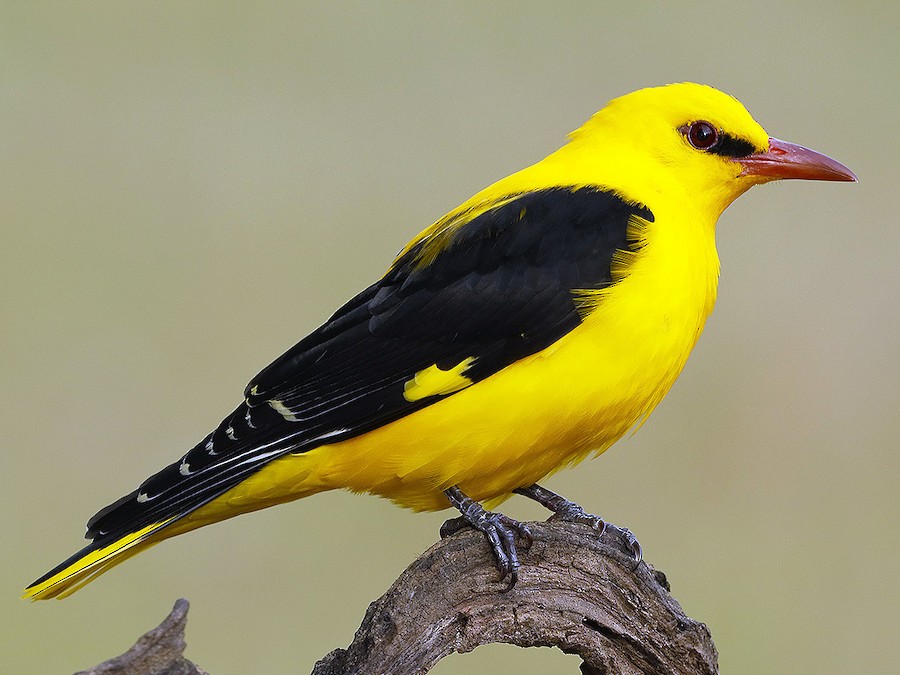
- Adult male: Bright golden-yellow body plumage, contrasting with black wings and a black tail with yellow tips. Adult female: Duller, greenish-yellow upperparts, whitish underparts with fine dark streaking, and dusky wings. Both sexes have a small black mask through the eye.
- Forma del becco
- Moderately stout, conical, and slightly decurved. Reddish-brown to reddish-pink in adults, duller in juveniles.
- Colore degli occhi
- Red in adults, dark brown in juveniles
- Colore delle zampe
- Bluish-grey
- Caratteristiche distintive
- The male's brilliant golden-yellow and black plumage is unmistakable. Females and juveniles are more cryptic but can be identified by their overall greenish-yellow tones, streaked underparts, and the characteristic shape and flight pattern.
- Aspetto giovanile
- Juveniles resemble females but are generally duller, with more extensive streaking on the underparts, and often have a brownish tinge to the wings. Their beak is duller, and eyes are dark brown.
- Cambiamenti stagionali
- No significant seasonal plumage changes in adults, beyond typical wear and tear. Juveniles gradually acquire adult plumage over their first year.
- Dimorfismo sessuale
- Pronounced. Males are bright golden-yellow with black wings and tail. Females are much duller, with greenish-yellow upperparts and streaked whitish underparts. Juveniles resemble females but are even duller.
Come identificare
- 1
Plumage (Male)
Look for the unmistakable brilliant golden-yellow body contrasting sharply with jet-black wings and a black tail with yellow tips. The small black mask through the eye is also a key feature.
- 2
Plumage (Female/Juvenile)
Identify by the overall greenish-yellow upperparts, duller yellowish-white underparts with fine dark streaking, and dusky wings. The reddish bill and red eye (in adults) are also helpful.
- 3
Song
Listen for the distinctive, loud, fluty, and melodious 'weela-wee-o' whistle. This is often the first and sometimes only indication of its presence, as the bird is shy and stays high in the canopy.
- 4
Flight
Observe its strong, undulating flight pattern, especially when moving between distant trees. It often flies high in the canopy.
- 5
Habitat
Search in mature deciduous woodlands, riverine forests, and large parks with tall trees. They prefer areas with a good canopy cover.
Habitat e areale
- Biomi
- Temperate broadleaf and mixed forests, tropical moist lowland forests (wintering grounds)
- Areale geografico
- Breeds across most of Europe (excluding northern Scandinavia and parts of the UK) and temperate Asia, east to western Siberia and northern India. Winters in tropical Africa, south of the Sahara.
- Fascia altitudinale
- Typically found from sea level up to 1,500 meters, occasionally higher in some parts of its range.
- Ambienti preferiti
- Mature deciduous woodlands, riverine forests, orchards, large parks, and avenues with tall trees. Prefers areas with a mosaic of open spaces and dense canopy cover. Avoids dense coniferous forests.
Comportamento
- Periodo di attività
- Diurnal. Most active during the early morning and late afternoon.
- Abitudini alimentari
- Arboreal feeder, foraging primarily in the canopy for insects (caterpillars, beetles, grasshoppers) and other invertebrates. During migration and in wintering grounds, they consume a significant amount of fruit, especially figs and berries. They can be quite acrobatic when foraging for insects among leaves.
- Comportamento sociale
- Solitary or found in pairs during the breeding season. During migration, they may form loose flocks, especially when feeding on abundant fruit sources. They are generally secretive and not highly gregarious.
- Tipo di volo
- Strong, undulating flight over long distances during migration. Within their breeding territories, their flight is often direct and swift between trees, but they can also be seen gliding. They are generally shy and tend to stay within the canopy.
- Migrazione
- Long-distance migratory. Breeds in the Palearctic and winters in sub-Saharan Africa. They undertake a nocturnal migration, often crossing large bodies of water and deserts. Spring migration occurs from April to May, and autumn migration from August to October.
- Territorialità
- Males establish and defend breeding territories with their distinctive song. They can be aggressive towards intruders of the same species.
Canto e richiami
- Canto
- A distinctive, rich, fluty, and melodious whistle, often transcribed as 'weela-wee-o' or 'oriole-oriole'. It is clear, unhurried, and carries well through the forest. Often repeated several times.
- Richiamo
- A harsh, scolding 'kweee-oh' or 'kyaaa' call, often given when alarmed or disturbed. Also a softer 'churr' call.
- Quando vocalizza
- Males sing frequently during the breeding season, particularly in the early morning and late afternoon, to attract mates and defend territory. Calls are given year-round, especially when disturbed or communicating with a mate.
Riproduzione
- Stagione riproduttiva
- May to July in Europe, slightly earlier in southern parts of its range.
- Abitudini di nidificazione
- Monogamous. The nest is a beautifully crafted, deep cup-shaped structure, woven from grass, bark strips, wool, and spider silk, suspended like a hammock from a horizontal fork of a branch, typically high in a deciduous tree (e.g., oak, poplar, birch). Both sexes participate in nest building, though the female does most of the work.
- Dimensione della covata
- 3-5 eggs
- Descrizione dell'uovo
- Typically 3-5 eggs, glossy white or creamy-white, sparsely spotted and blotched with dark brown or black, often concentrated at the broader end. Approximately 30 x 21 mm.
- Periodo di incubazione
- 15-18 days, primarily by the female.
- Periodo di involo
- 14-17 days after hatching. Young are fed by both parents.
- Cure parentali
- Both parents feed the nestlings and fledglings. The female primarily incubates, while the male often brings food to her and helps feed the young once hatched.
Dove trovarlo
Deciduous Woodlands
Look in mature oak, poplar, and birch forests, especially those with an open understory.
Riverine Forests
Areas along rivers and streams with tall, established trees are prime habitats.
Orchards and Parks
Large, old orchards and extensive parks with mature trees can also host breeding pairs.
Consigli sul campo
- Listen for the song. The Eurasian Golden Oriole is notoriously shy and often remains hidden in the dense canopy. Learning its distinctive fluty song is the most effective way to locate it. Once heard, try to pinpoint the source.
- Scan the canopy. Use binoculars to carefully scan the upper canopy of tall deciduous trees. Look for movement or flashes of yellow. They often perch motionless for extended periods.
- Visit early morning or late afternoon. These are the most active times for singing and foraging, increasing your chances of hearing or seeing them.
- Be patient and quiet. Their secretive nature requires patience. Minimize disturbance and move slowly through potential habitats.
Specie simili
African Golden Oriole
Oriolus auratus
The African Golden Oriole has more yellow in the wing and less black on the primary coverts. Its eye-stripe is less extensive, and the bill is typically paler. Its range is restricted to Africa.
Indian Golden Oriole
Oriolus kundoo
Formerly considered a subspecies of the Eurasian Golden Oriole, the Indian Golden Oriole has a more extensive black eye-stripe that extends behind the eye, and the yellow on the tail is more restricted. Its breeding range is primarily in the Indian subcontinent.
Green-backed Oriole
Oriolus sagittatus
Found in Australia and New Guinea, this species is generally greener on the back and has more extensive streaking on the underparts in both sexes. Its calls and song are also distinct.
Fatti rapidi
- Key Identification:
- Male: Golden-yellow body, black wings/tail. Female: Greenish-yellow, streaked underparts. Fluty 'weela-wee-o' song.
- Habitat:
- Mature deciduous woodlands, riverine forests, orchards.
- Diet:
- Insects (breeding), fruits (migration/winter).
- Migration:
- Long-distance migrant, breeding in Europe/Asia, wintering in Africa.
- Conservation Status:
- Least Concern (stable population).
Curiosità
- The name 'oriole' comes from the Latin 'aureolus', meaning 'golden', referring to the male's striking plumage.
- Despite its bright coloration, the Eurasian Golden Oriole is remarkably difficult to spot due to its shy nature and preference for dense canopy cover.
- Its nest is a true architectural marvel, woven like a basket and suspended from a tree fork, making it very secure.
- The species is a significant consumer of caterpillars during the breeding season, playing an important ecological role in pest control.
Classificazione scientifica
- Regno
- Animalia
- Phylum
- Chordata
- Classe
- Aves
- Ordine
- Passeriformes
- Famiglia
- Oriolidae
- Genere
- Oriolus
- Specie
- Oriolus oriolus
Esplora Eurasian Golden Oriole
Identifica uccelli ovunque
Gratis su iOS, Android e Web. Identificazione per foto e suono, database completo e la tua lista personale.