
Visto un uccello? Identificalo all'istante con l'app Birdby
Apri l'appInformazioni
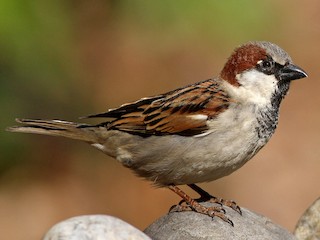
The House Sparrow is a small, robust passerine bird of the sparrow family Passeridae. It is one of the most widespread and abundant birds globally, primarily associated with human habitation. Known for its adaptability and opportunistic feeding habits, it thrives in urban, suburban, and agricultural environments.
Dimensioni e longevità
- Lunghezza
- 14-16 cm
- Apertura alare
- 21-25 cm
- Peso
- 24-39.5 g
- Longevità
- 3-5 years (up to 13 years in captivity)
- Dieta
- Omnivore, primarily granivorous but also insectivorous, especially when feeding young.
Caratteristiche fisiche
- Piumaggio
- Males have a distinctive grey crown, chestnut nape, black bib, and white cheeks. The back is streaked brown and black, and the underparts are greyish-white. Females and juveniles are duller, with streaked brown upperparts, plain buff-brown underparts, and a prominent buff supercilium.
- Forma del becco
- Conical, stout, and short, adapted for seed crushing. Black in breeding males, horn-colored in females and non-breeding males.
- Colore degli occhi
- Dark brown
- Colore delle zampe
- Pinkish-brown
- Caratteristiche distintive
- Males are easily identified by their grey crown, chestnut nape, and black bib. Females and juveniles are more challenging but can be identified by their plain, unstreaked underparts and buff supercilium.
- Aspetto giovanile
- Similar to adult females, but often with a softer, looser plumage and a less defined supercilium. The beak is typically yellowish with a dark tip.
- Cambiamenti stagionali
- Males show a slightly duller plumage outside the breeding season as the black bib feathers are tipped with white, which wears off to reveal the full black bib during breeding. Females show little seasonal variation.
- Dimorfismo sessuale
- Pronounced. Males are more brightly colored with distinct head patterns (grey crown, chestnut nape, black bib). Females are duller, mostly streaked brown above and plain buff-brown below.
Come identificare
- 1
Male Plumage
Look for the distinctive combination of a grey crown, chestnut nape, black bib, and white cheeks. The back is streaked brown.
- 2
Female/Juvenile Plumage
Observe the plain, unstreaked buff-brown underparts and a clear buff supercilium (eyebrow stripe) above the eye. The upperparts are streaked brown. Lack the strong head patterns of the male.
- 3
Behavior
Often seen in flocks, foraging on the ground in urban or agricultural settings. They are bold and accustomed to human presence.
- 4
Vocalization
Listen for the characteristic loud, repetitive 'cheep' or 'chirrup' calls. The song is a simple, monotonous series of these chirps.
- 5
Habitat
Their strong association with human structures and disturbed environments is a key identifier. If you see a sparrow-like bird in a city center, it's most likely a House Sparrow.
Habitat e areale
- Biomi
- Urban, suburban, agricultural, and rural areas.
- Areale geografico
- Native to Europe, the Mediterranean Basin, and much of Asia. Introduced worldwide, including the Americas, sub-Saharan Africa, Australia, and New Zealand, making it one of the most widely distributed wild birds.
- Fascia altitudinale
- Sea level up to 4,500 meters in some parts of its range (e.g., Himalayas).
- Ambienti preferiti
- Closely associated with human settlements, including cities, towns, villages, farms, and industrial areas. Requires access to food sources (grains, scraps), nesting sites (buildings, cavities), and water.
Comportamento
- Periodo di attività
- Diurnal.
- Abitudini alimentari
- Forages on the ground, often in flocks. Diet consists mainly of seeds (especially cereal grains), but also eats insects (particularly during breeding season), buds, berries, and human food scraps. Known for its opportunistic scavenging.
- Comportamento sociale
- Highly social, often forming large flocks, especially outside the breeding season. Nests colonially or semi-colonially. Can be aggressive towards other birds at feeders or nesting sites.
- Tipo di volo
- Strong, direct, and undulating flight over short distances. Often flies in small, tight flocks.
- Migrazione
- Generally resident throughout its range, with only localized movements or short-distance dispersal, particularly by juveniles. Not a migratory species.
- Territorialità
- Males defend a small territory around the nest site during the breeding season, but foraging areas are often shared.
Canto e richiami
- Canto
- The song is a monotonous series of chirps and cheeps, often described as 'cheerup', 'chissick', or 'tschilp'. It lacks musical quality and is more of a repetitive chatter.
- Richiamo
- The most common call is a loud, distinctive 'cheep' or 'chirrup', used for contact, alarm, and territorial display. Also produces a variety of softer chirps and chattering sounds.
- Quando vocalizza
- Vocalizes year-round, but most frequently and loudly during the breeding season, particularly in the mornings and evenings.
Riproduzione
- Stagione riproduttiva
- Typically March to August, but can vary geographically and may extend longer in warmer climates or with abundant food.
- Abitudini di nidificazione
- Nests are untidy, bulky structures made of grass, straw, feathers, string, and other debris. Built in cavities in buildings (e.g., eaves, holes in walls), tree holes, dense bushes, or sometimes in the abandoned nests of other birds. Often nests in colonies.
- Dimensione della covata
- 3-7 eggs, commonly 4-5.
- Descrizione dell'uovo
- 3-7 eggs per clutch, typically whitish, greyish-white, or pale green, heavily speckled or blotched with grey and brown. Size: approximately 22 x 15 mm.
- Periodo di incubazione
- 10-14 days, primarily by the female, but males may assist.
- Periodo di involo
- 14-17 days after hatching. Young are fed by both parents.
- Cure parentali
- Both parents participate in nest building, incubation (female primarily), and feeding of the young. Can raise 2-3 broods per year, sometimes up to 4-5 in favorable conditions.
Dove trovarlo
Urban Areas
Parks, gardens, city streets, building eaves, and any area with human habitation.
Suburban Areas
Backyards, residential streets, shopping centers, and cultivated gardens.
Agricultural Areas
Farmyards, barns, grain storage facilities, and fields, especially near human structures.
Industrial Zones
Factories, warehouses, and other industrial buildings provide nesting and foraging opportunities.
Consigli sul campo
- Look near human activity. House Sparrows are almost always found in close proximity to people. Check around buildings, outdoor cafes, and bird feeders.
- Listen for their calls. Their distinctive 'cheep' calls are often the first indication of their presence, even before you see them.
- Observe feeding behavior. They are ground feeders and will readily visit bird feeders. Watch for small flocks pecking at seeds or crumbs.
- Check building crevices. Look for nests or roosting birds in holes in walls, under eaves, or in dense climbing plants on buildings.
Specie simili
Eurasian Tree Sparrow
Passer montanus
The Eurasian Tree Sparrow has a chestnut crown (not grey), a distinct black spot on its white cheek, and two prominent white wing bars. Both sexes look alike, unlike the House Sparrow. It is generally less associated with dense urban centers than the House Sparrow.
Italian Sparrow
Passer italiae
Often considered a hybrid or subspecies of House Sparrow and Spanish Sparrow. Males have a chestnut crown (like Spanish Sparrow) but a black bib (like House Sparrow), and white cheeks. Females are very similar to House Sparrow females. Found primarily in Italy and surrounding regions.
Spanish Sparrow
Passer hispaniolensis
Males have a fully chestnut crown and nape, and more extensive black streaking on the flanks compared to the House Sparrow. Females are very similar to House Sparrow females, but often slightly more streaked. Found in southern Europe and North Africa.
Fatti rapidi
- Global Distribution:
- One of the most widespread bird species globally.
- Dietary Flexibility:
- Highly adaptable omnivore, thriving on seeds, insects, and human scraps.
- Social Nature:
- Typically found in flocks, especially outside the breeding season.
- Nesting Sites:
- Prefers cavities in human structures for nesting.
Curiosità
- The House Sparrow was intentionally introduced to North America in the mid-19th century and rapidly spread across the continent.
- Despite its commonness, House Sparrow populations have declined significantly in some parts of its native range, particularly in Western Europe, for reasons that are not fully understood but may include changes in agricultural practices and urban environments.
- They are known to take dust baths, rolling in dry soil to clean their feathers and remove parasites.
- House Sparrows have been observed to learn complex tasks, such as activating automatic doors to enter buildings for food.
Classificazione scientifica
- Regno
- Animalia
- Phylum
- Chordata
- Classe
- Aves
- Ordine
- Passeriformes
- Famiglia
- Passeridae
- Genere
- Passer
- Specie
- Passer domesticus
Esplora House Sparrow
Identifica uccelli ovunque
Gratis su iOS, Android e Web. Identificazione per foto e suono, database completo e la tua lista personale.