
Visto un uccello? Identificalo all'istante con l'app Birdby
Apri l'appInformazioni
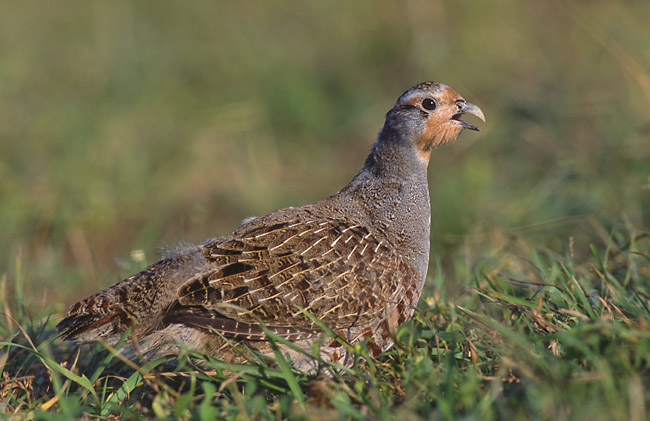
The Grey Partridge, also known as the English Partridge, is a medium-sized game bird native to Europe and parts of Asia. It is characterized by its plump, rounded body, short neck, and small head. It is primarily a ground-dwelling bird, known for its distinctive chestnut-brown face and throat, and a prominent dark horseshoe-shaped patch on its belly, particularly in males. It is a species of open agricultural landscapes and grasslands.
Dimensioni e longevità
- Lunghezza
- 28-32 cm
- Apertura alare
- 45-48 cm
- Peso
- 350-450 g
- Longevità
- 2-4 years (up to 7 years in captivity)
- Dieta
- Omnivore (primarily herbivorous, especially seeds and green vegetation; insects for chicks)
Caratteristiche fisiche
- Piumaggio
- Adults have a grey-brown back with fine barring, a grey breast, and flanks with chestnut-brown barring. The face and throat are a distinctive rufous-orange. Males typically have a prominent dark chestnut-brown horseshoe-shaped patch on the lower breast/belly, which is often smaller or absent in females. The tail is short and rufous-brown, visible in flight.
- Forma del becco
- Short, conical, and stout; greyish-horn color.
- Colore degli occhi
- Dark brown.
- Colore delle zampe
- Greyish-blue to greyish-brown.
- Caratteristiche distintive
- Rufous-orange face and throat, grey breast, chestnut-barred flanks, and the dark horseshoe-shaped belly patch (more pronounced in males). In flight, the rufous outer tail feathers are conspicuous.
- Aspetto giovanile
- Juveniles are duller and more uniformly grey-brown, lacking the rufous face and throat and the distinctive belly patch. Their plumage is streaked and mottled, and they gradually acquire adult plumage over their first autumn.
- Cambiamenti stagionali
- No significant seasonal plumage changes. Plumage remains consistent throughout the year, though wear and tear can make colors appear slightly duller towards the end of the breeding season.
- Dimorfismo sessuale
- Males generally have a larger and more distinct dark chestnut horseshoe-shaped patch on the belly. Females may have a smaller or absent patch, and their plumage can be slightly duller overall. However, this is not always a reliable distinguishing feature, and some females can have a well-developed patch.
Come identificare
- 1
Overall Shape and Size
Look for a plump, rounded, medium-sized game bird with a short neck and tail. It's smaller than a pheasant but larger than a quail.
- 2
Head and Face
Identify the distinctive rufous-orange (chestnut-brown) coloration on the face and throat. This is a key field mark.
- 3
Breast and Belly
Note the grey breast and the prominent dark chestnut-brown horseshoe-shaped patch on the lower breast/belly, especially in males. This patch can be variable in females.
- 4
Flanks
Observe the chestnut-brown barring on the flanks, which contrasts with the grey breast.
- 5
Flight
When flushed, look for rapid, whirring flight low to the ground and the conspicuous rufous-orange outer tail feathers.
- 6
Call
Listen for the harsh, grating 'kerr-ick' or 'kirr-ik' call, especially at dawn or dusk, or the excited 'rick-rick-rick' alarm call when flushed.
Habitat e areale
- Biomi
- Temperate grasslands, agricultural fields, open scrubland.
- Areale geografico
- Native to most of Europe, excluding northern Scandinavia and southern Iberia, and extending east into western Asia. Introduced to North America (especially the Great Plains and Pacific Northwest) and other regions.
- Fascia altitudinale
- Typically found from sea level up to 1,000 meters, occasionally higher in some mountainous regions.
- Ambienti preferiti
- Prefers open, arable farmland with hedgerows, field margins, and areas of rough grassland. Also found in meadows, pastures, and heathland. Requires a mosaic of cover for nesting and foraging, and open areas for feeding.
Comportamento
- Periodo di attività
- Diurnal. Most active during early morning and late afternoon, often resting during the hottest parts of the day.
- Abitudini alimentari
- Primarily forages on the ground, pecking at seeds, green shoots, leaves, and grains. Chicks consume a high proportion of insects (e.g., aphids, beetles, ants) for protein during their rapid growth phase. Adults will also eat insects, especially during the breeding season.
- Comportamento sociale
- Highly social outside the breeding season, forming coveys (flocks) of 5-20 birds, sometimes larger. During the breeding season, pairs become territorial and disperse. Coveys reform in late summer after breeding.
- Tipo di volo
- Flies with rapid, whirring wingbeats, typically low to the ground, often gliding for short distances. When flushed, they explode into flight with a characteristic 'whirr' and often call loudly. They rarely fly long distances.
- Migrazione
- Essentially resident throughout its range. Does not undertake long-distance migrations, though local movements may occur in response to severe weather or food availability.
- Territorialità
- Pairs are territorial during the breeding season, defending a nesting and foraging area. Coveys are not territorial outside of breeding.
Canto e richiami
- Canto
- The 'song' is not a melodic song in the typical sense, but rather a series of distinctive calls. The primary call, often referred to as the 'song' or 'crowing' call, is a harsh, grating, and often repeated 'kerr-ick' or 'kirr-ik', sometimes described as sounding like a rusty gate. This call is given by males to attract mates and defend territory.
- Richiamo
- In addition to the 'kerr-ick' call, they have a variety of contact calls within the covey, including soft 'chip' or 'chick' notes. When flushed, they emit a rapid, excited 'rick-rick-rick' or 'whit-whit-whit' alarm call, often accompanied by the whirring of wings.
- Quando vocalizza
- Calls are most frequent during the breeding season (late winter to spring) when males are establishing territories and attracting mates. Contact calls are heard year-round within coveys.
Riproduzione
- Stagione riproduttiva
- Typically from late March to August, with peak egg-laying in April-May.
- Abitudini di nidificazione
- Nests are shallow scrapes on the ground, usually well-concealed in dense vegetation such as hedgerows, field margins, tall grass, or under bushes. The nest is lined with grass, leaves, and feathers.
- Dimensione della covata
- Large clutches, typically 10-20 eggs, but can range from 8 to 22. This is one of the largest clutch sizes among birds.
- Descrizione dell'uovo
- Eggs are typically olive-brown to plain brown, unspotted, and relatively small for the bird's size. They have a smooth, slightly glossy texture.
- Periodo di incubazione
- 23-25 days.
- Periodo di involo
- Chicks are precocial and leave the nest shortly after hatching (within hours). They can make short flights at about 10-14 days old and are fully fledged by 3-4 weeks, though they remain with the parents for several weeks.
- Cure parentali
- Primarily the female incubates the eggs. Both parents care for the chicks, leading them to foraging areas and protecting them from predators. The male often stands guard while the female and chicks feed.
Dove trovarlo
Arable Farmland
Look in fields of cereals (wheat, barley), oilseed rape, and other crops, especially those with wide field margins and hedgerows.
Grasslands and Meadows
Areas of rough grassland, pastures, and meadows adjacent to cultivated land are good spots.
Heathland and Open Scrub
In some regions, they can be found in open heathland with scattered bushes and low vegetation.
Consigli sul campo
- Early Morning/Late Afternoon. These are the most active times for foraging. They are often seen feeding along field edges or in open areas.
- Listen for Calls. Their distinctive 'kerr-ick' call is often heard at dawn and dusk, especially during the breeding season, and can help locate them even when hidden.
- Look for Coveys. Outside the breeding season, they are usually found in coveys. Scan open fields and field margins for groups of birds. They often freeze when approached, making them hard to spot until they flush.
- Check Field Margins and Hedgerows. These areas provide cover and food. They often use these linear features for movement and concealment.
- Be Patient and Quiet. Grey Partridges are shy and well-camouflaged. Approach quietly and use binoculars to scan the landscape.
Specie simili
Red-legged Partridge
Alectoris rufa
The Red-legged Partridge has prominent red legs and beak, a white throat bordered by a black necklace, and bold black and white barring on its flanks. The Grey Partridge has grey legs, a greyish beak, a rufous face/throat, and chestnut barring on its flanks, lacking the distinct black necklace.
Chukar Partridge
Alectoris chukar
Similar to Red-legged Partridge with red legs and beak, and a black gorget. However, the Chukar has a more prominent black eye-stripe extending down the neck, and its flank barring is typically more extensive and less reddish than the Red-legged Partridge. The Grey Partridge lacks these strong facial markings and red extremities.
Fatti rapidi
- Social Structure:
- Coveys (flocks) outside breeding season, territorial pairs during breeding.
- Flight Speed:
- Fast, whirring flight, typically low to the ground.
- Dietary Shift:
- Chicks rely heavily on insects; adults primarily consume seeds and vegetation.
- Nesting:
- Ground nesters, well-concealed in dense vegetation.
- Clutch Size:
- One of the largest clutches among birds (up to 22 eggs).
Curiosità
- The Grey Partridge is often considered an indicator species for the health of agricultural ecosystems, as its population declines are linked to intensive farming practices.
- Their large clutch size is an adaptation to high predation rates on eggs and chicks, ensuring enough offspring survive to maintain the population.
- When a covey is flushed, they often scatter in all directions, making it difficult for a predator to target a single individual.
- The male Grey Partridge is known to be a very attentive father, often guarding the nest and helping to raise the young.
Classificazione scientifica
- Regno
- Animalia
- Phylum
- Chordata
- Classe
- Aves
- Ordine
- Galliformes
- Famiglia
- Phasianidae
- Genere
- Perdix
- Specie
- Perdix perdix
Esplora Grey Partridge
Identifica uccelli ovunque
Gratis su iOS, Android e Web. Identificazione per foto e suono, database completo e la tua lista personale.