
Visto un uccello? Identificalo all'istante con l'app Birdby
Apri l'appInformazioni
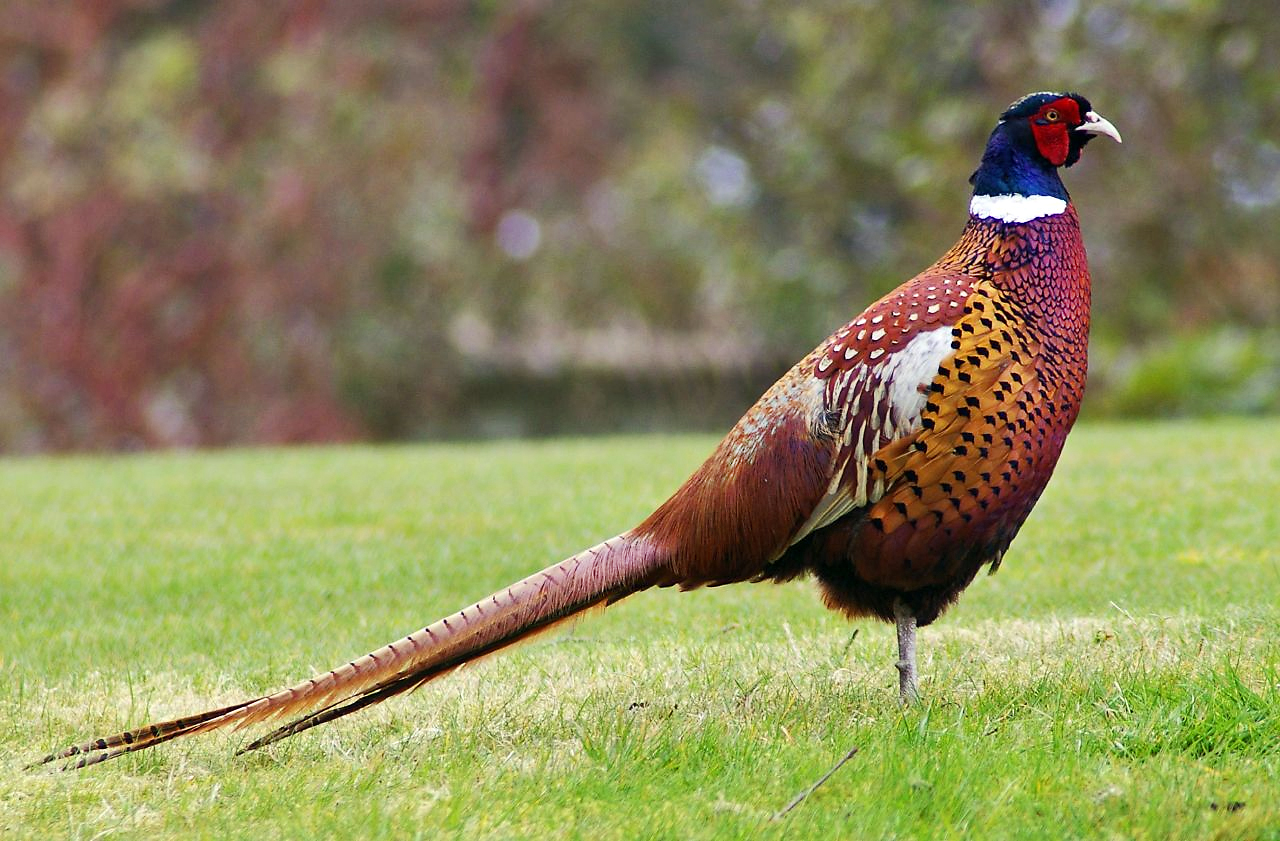
The Common Pheasant, often referred to simply as Pheasant, is a large, long-tailed game bird of the Phasianidae family. Native to Asia and parts of Europe, it has been widely introduced around the world as a game bird. Males are strikingly colorful, while females are more cryptically patterned. They are ground-dwelling birds, typically found in open woodlands, agricultural fields, and scrubland.
Dimensioni e longevità
- Lunghezza
- Male: 60-89 cm (including tail of 35-50 cm); Female: 50-63 cm (including tail of 20-25 cm)
- Apertura alare
- 70-90 cm
- Peso
- Male: 0.9-1.5 kg; Female: 0.7-1.1 kg
- Longevità
- 1-3 years in the wild, up to 7 years in captivity
- Dieta
- Omnivore, primarily consuming seeds, grains, berries, roots, leaves, and insects, especially during breeding season.
Caratteristiche fisiche
- Piumaggio
- Male: Highly variable due to extensive hybridization and subspecies. Typically features iridescent green-blue head, red wattles around the eyes, and often a white neck ring (though not all subspecies possess this). Body plumage is a mix of coppery-red, golden-brown, purple, and green, with dark scaling and barring. Long, barred tail feathers. Female: Cryptic brown and buff plumage with darker mottling and barring, providing camouflage. Shorter tail than males.
- Forma del becco
- Short, stout, conical, and yellowish-horn colored in both sexes.
- Colore degli occhi
- Yellowish-brown to dark brown.
- Colore delle zampe
- Greyish-brown, with males possessing a spur on the tarsus.
- Caratteristiche distintive
- Males are unmistakable with their vibrant, iridescent plumage, red facial wattles, and extremely long tail. Females are more challenging but can be identified by their larger size and longer tail compared to other ground-dwelling game birds like partridges.
- Aspetto giovanile
- Juveniles resemble adult females but are generally smaller and have shorter tails. Young males gradually acquire adult male plumage over their first year.
- Cambiamenti stagionali
- No significant seasonal plumage changes in adults. Plumage remains consistent year-round, though colors may appear more vibrant during breeding season due to increased blood flow to wattles in males.
- Dimorfismo sessuale
- Pronounced sexual dimorphism, with males being significantly larger, more colorful, and possessing a much longer tail and facial wattles. Females are duller and smaller.
Come identificare
- 1
Male Plumage
Look for the striking iridescent green-blue head, prominent red facial wattles, and the long, barred tail. Body plumage is a rich mix of coppery-reds and browns. A white neck ring may or may not be present depending on the subspecies.
- 2
Female Plumage
Observe the cryptic brown and buff coloration with darker mottling and barring. Note the relatively long, pointed tail, which is shorter than the male's but still distinct from other partridges.
- 3
Size and Shape
Pheasants are large, robust game birds with a distinctive long, pointed tail, especially in males. Their ground-dwelling posture is often low and horizontal.
- 4
Vocalizations
Listen for the male's characteristic harsh, explosive 'ko-KOK!' call, often accompanied by wing-whirring. Females have softer clucking calls.
- 5
Behavior
Watch for their tendency to run rather than fly when disturbed, often bursting into flight with rapid wingbeats only as a last resort. They are often seen foraging in open fields near cover.
Habitat e areale
- Biomi
- Temperate grasslands, agricultural lands, open woodlands, scrublands, hedgerows, marshes, and riparian zones.
- Areale geografico
- Native to Asia (from the Caucasus to Japan) and parts of Europe. Widely introduced and naturalized across Europe, North America, Australia, and New Zealand.
- Fascia altitudinale
- Typically found from sea level up to 3,000 meters, depending on the region, but most common in lowlands and foothills.
- Ambienti preferiti
- Prefers mosaic landscapes with a mix of cultivated fields (for food), dense cover (for roosting and nesting), and woodland edges. Avoids dense, unbroken forests or treeless plains.
Comportamento
- Periodo di attività
- Diurnal, most active during early morning and late afternoon, foraging and dust-bathing. Roosts in trees or dense cover at night.
- Abitudini alimentari
- Forages primarily on the ground, scratching with its feet to uncover food. Diet varies seasonally, with seeds and grains being staples, supplemented by insects, especially for chicks and during breeding. Will also consume berries and green vegetation.
- Comportamento sociale
- Generally solitary or found in small groups outside the breeding season. During breeding, males are polygynous, maintaining harems of several females. Females are solitary during nesting and chick-rearing.
- Tipo di volo
- Flies with rapid, whirring wingbeats, typically in short, explosive bursts when flushed. Can achieve considerable speed but is not sustained. Prefers to run or walk rather than fly. Often glides downwards from a perch.
- Migrazione
- Non-migratory; a resident species throughout its range. Local movements may occur in response to food availability or severe weather.
- Territorialità
- Males are territorial during the breeding season, defending an area and a harem of females from rival males. Displays include crowing and wing-whirring. Females are territorial around their nest sites.
Canto e richiami
- Canto
- Males produce a distinctive, loud, harsh, two-syllable 'ko-KOK!' or 'kerr-KOK!' call, often followed by a rapid whirring of wings. This is primarily a territorial and display call.
- Richiamo
- Females have a softer, clucking 'tuk-tuk-tuk' call, especially when with chicks. Alarm calls are a sharp 'cackle' or 'squawk' from both sexes when flushed.
- Quando vocalizza
- Males call most frequently during the breeding season (spring and early summer), particularly at dawn and dusk. Alarm calls can be heard year-round when disturbed.
Riproduzione
- Stagione riproduttiva
- Typically March to July, peaking in April-May.
- Abitudini di nidificazione
- Nests are shallow scrapes on the ground, often concealed in dense vegetation, under bushes, or in tall grass. Lined with leaves, grass, and feathers. Females build the nest alone.
- Dimensione della covata
- Usually 8-15 eggs, but can range from 5 to 20, especially in areas with high population density or if a first clutch is lost.
- Descrizione dell'uovo
- 8-15 eggs, typically olive-brown to pale blue-green, unspotted, and glossy. Average size is about 45x36 mm.
- Periodo di incubazione
- 23-26 days, incubated solely by the female.
- Periodo di involo
- Chicks are precocial and leave the nest shortly after hatching. They can make short flights at 12-14 days and are fully independent at 10-12 weeks.
- Cure parentali
- Only the female cares for the eggs and chicks. She leads them to foraging areas and protects them until they are independent.
Dove trovarlo
Agricultural Fields
Often found foraging in fields of corn, wheat, or other grains, especially near the edges where they can quickly retreat to cover.
Hedgerows and Field Margins
These provide crucial cover for roosting, nesting, and escape from predators. Look along the boundaries of fields.
Open Woodlands and Scrubland
Pheasants utilize the undergrowth and edges of deciduous or mixed woodlands, particularly those with dense shrubbery.
Wetlands and Riparian Zones
Areas with dense reeds, rushes, or willow thickets along rivers and ponds can provide good cover and food sources.
Consigli sul campo
- Dawn and Dusk. Pheasants are most active during the early morning and late afternoon/early evening when they are foraging. This is the best time to spot them.
- Look for Movement. Scan field edges and dense cover for movement. Their large size and distinctive shape, especially the male's tail, can make them noticeable even when partially concealed.
- Listen for Calls. The male's crowing call is loud and carries well, often giving away their presence even if they are hidden from view.
- Check Roadsides. Pheasants are frequently seen along rural roadsides, especially in agricultural areas, as they feed on spilled grains or insects.
- Be Patient and Quiet. Pheasants can be wary. Move slowly and quietly, and use binoculars to scan potential habitats from a distance.
Specie simili
Grey Partridge
Perdix perdix
Smaller, rounder body, shorter tail, and lacks the vibrant iridescent plumage and red facial wattles of the male Pheasant. Grey Partridges have a distinctive chestnut face and a dark belly patch.
Red-legged Partridge
Alectoris rufa
Smaller than the Pheasant, with a distinctive white throat bordered by a black necklace, red legs, and a barred flank pattern. Lacks the long tail and iridescent head of the male Pheasant.
Domestic Chicken
Gallus gallus domesticus
While some domestic chicken breeds might have similar body shapes, they lack the specific iridescent plumage, long pointed tail, and red facial wattles of the male Pheasant. Female Pheasants are more slender and have longer tails than most domestic hens.
Fatti rapidi
- Primary Diet:
- Seeds, grains, insects
- Habitat:
- Agricultural fields, open woodlands, scrubland
- Migration:
- Non-migratory resident
- Nesting:
- Ground nest
- Conservation Status:
- Least Concern
Curiosità
- The Common Pheasant is one of the world's most widely introduced game birds, often released in large numbers for hunting.
- Despite their vibrant plumage, male pheasants are surprisingly well-camouflaged when standing still in dense vegetation.
- The name 'colchicus' refers to Colchis, an ancient region in modern-day Georgia, from where pheasants were historically introduced to Europe.
- Pheasants are known for their 'dust-bathing' behavior, where they roll in dry soil to clean their feathers and remove parasites.
- There are numerous subspecies of Phasianus colchicus, leading to a wide variety of plumage patterns, particularly in males, including those with and without a white neck ring.
Classificazione scientifica
- Regno
- Animalia
- Phylum
- Chordata
- Classe
- Aves
- Ordine
- Galliformes
- Famiglia
- Phasianidae
- Genere
- Phasianus
- Specie
- Phasianus colchicus
Esplora Common Pheasant
Identifica uccelli ovunque
Gratis su iOS, Android e Web. Identificazione per foto e suono, database completo e la tua lista personale.