
Visto un uccello? Identificalo all'istante con l'app Birdby
Apri l'appInformazioni
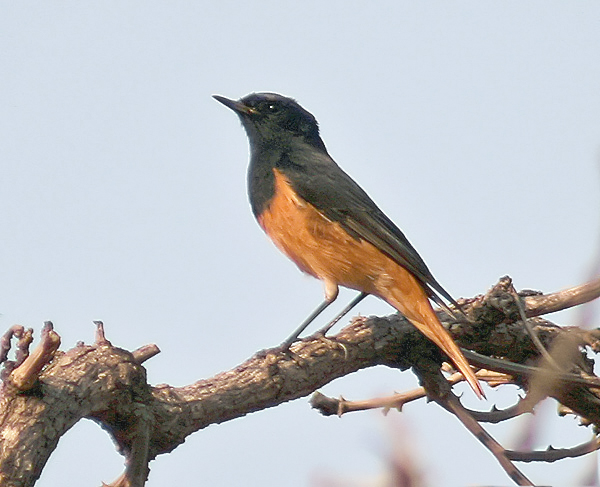
The Black Redstart is a small passerine bird in the Old World flycatcher family Muscicapidae. It is a common and widespread species across much of Europe, Asia, and North Africa, often associated with human settlements and rocky, open habitats. Known for its distinctive rusty-red tail, which it frequently quivers, and the striking black plumage of the adult male.
Dimensioni e longevità
- Lunghezza
- 13-14.5 cm
- Apertura alare
- 23-26 cm
- Peso
- 12-20 g
- Longevità
- 2-5 years (up to 10 years recorded)
- Dieta
- Insectivore, occasionally supplemented with berries and seeds
Caratteristiche fisiche
- Piumaggio
- Adult male: Sooty black overall, with a bright rusty-red tail (ochruros means 'red-tailed'), a white patch on the primary coverts (often visible as a wing patch), and a black face. Adult female: Dull grey-brown overall, paler on the underparts, with a rusty-red tail similar to the male but less vibrant. No white wing patch. First-winter male: Resembles a female but often shows some darker grey or blackish feathers, especially on the head and breast, and may have a small, indistinct white wing patch. First-winter female: Very similar to adult female, perhaps slightly duller.
- Forma del becco
- Slender, pointed, and dark (blackish)
- Colore degli occhi
- Dark brown
- Colore delle zampe
- Blackish
- Caratteristiche distintive
- The constantly quivering rusty-red tail is the most distinctive feature across all plumages. The male's sooty black body with a white wing patch is unmistakable. Females and juveniles are duller but still show the characteristic tail.
- Aspetto giovanile
- Juveniles are mottled grey-brown with pale spots, resembling a young Robin or Thrush, but always show the rusty-red tail. They lack the white wing patch and the distinct black/grey of adults.
- Cambiamenti stagionali
- No significant seasonal plumage changes in adults. First-winter birds moult into adult-like plumage by their first breeding season.
- Dimorfismo sessuale
- Pronounced. Males are distinctly black with a white wing patch, while females are grey-brown and lack the wing patch.
Come identificare
- 1
Tail color and movement
Look for the constantly quivering, rusty-red tail. This is the most reliable field mark for all ages and sexes.
- 2
Male plumage
Adult males are unmistakable: sooty black body, black face, and a prominent white patch on the wing (primary coverts).
- 3
Female plumage
Females are dull grey-brown overall, paler below, but still show the rusty-red tail. They lack the white wing patch.
- 4
Habitat
Check urban areas, industrial sites, old buildings, quarries, and rocky slopes. They often perch prominently on rooftops, walls, or rocks.
- 5
Song and calls
Listen for the distinctive scratchy, metallic song with the 'crushed glass' sound, and the sharp 'tseep' or 'tack' calls.
- 6
Behavior
Observe their foraging style: darting from a perch to catch insects on the ground or in the air, often returning to the same perch.
Habitat e areale
- Biomi
- Temperate forests (especially rocky areas), urban and suburban environments, mountainous regions, coastal cliffs.
- Areale geografico
- Breeds across most of Europe, North Africa, and central Asia. Winters in southern Europe, North Africa, and the Middle East.
- Fascia altitudinale
- From sea level up to 3000 meters in mountainous regions, particularly in the Alps and Himalayas.
- Ambienti preferiti
- Rocky outcrops, scree slopes, old quarries, industrial areas, urban centers (especially old buildings, ruins, factories), villages, and sometimes open woodlands with clearings. They prefer areas with vertical structures for perching and nesting.
Comportamento
- Periodo di attività
- Diurnal.
- Abitudini alimentari
- Primarily insectivorous, catching insects on the ground, from vegetation, or in short aerial sallies. They often perch prominently and dart down to catch prey. Diet includes beetles, ants, flies, caterpillars, spiders, and other invertebrates. In autumn and winter, they may supplement their diet with berries (e.g., elderberries, blackberries) and seeds.
- Comportamento sociale
- Generally solitary or found in pairs during the breeding season. Outside of breeding, they can be seen in loose aggregations, especially at rich feeding sites or during migration, but rarely form large flocks.
- Tipo di volo
- Direct and undulating flight, often low to the ground. When disturbed, they may fly short distances, often perching on a prominent spot. They frequently hover briefly while foraging.
- Migrazione
- Partially migratory. Northern and eastern populations are migratory, moving south to winter in the Mediterranean basin, North Africa, and the Middle East. Southern and western populations may be resident or undertake short-distance movements. Migration occurs mainly at night.
- Territorialità
- Males are highly territorial during the breeding season, defending their nesting and foraging areas with song and displays.
Canto e richiami
- Canto
- The song is a distinctive, short, scratchy, and somewhat metallic warble, often described as 'squeaky' or 'creaky', interspersed with a unique 'crushed glass' or 'shattered plate' sound. It typically starts with a few clear notes, then becomes more jumbled and ends abruptly. Often sung from a prominent perch.
- Richiamo
- Common calls include a sharp, often repeated 'tseep' or 'tack' call, and a more agitated 'churr' or 'chick-chick' when alarmed. The 'tseep' call is often given while quivering the tail.
- Quando vocalizza
- Males sing frequently from early morning throughout the day during the breeding season (March to July). Calls are given year-round.
Riproduzione
- Stagione riproduttiva
- Typically April to July, often raising two broods.
- Abitudini di nidificazione
- Nests are usually built in cavities or sheltered ledges on buildings, ruins, rock faces, or tree holes. They are cup-shaped, made of moss, grass, roots, and lined with hair, feathers, and wool. Both sexes participate in nest building, though the female does most of the work.
- Dimensione della covata
- 4-6 eggs (occasionally 3-7)
- Descrizione dell'uovo
- 4-6 eggs, pure white, sometimes with a faint bluish tinge. Smooth and slightly glossy. Approximately 19 x 14 mm.
- Periodo di incubazione
- 12-16 days, primarily by the female.
- Periodo di involo
- 12-18 days after hatching. Young are fed by both parents.
- Cure parentali
- Both parents feed the nestlings and fledglings. The male often continues to feed the first brood while the female starts a second clutch.
Dove trovarlo
Urban areas
Look on rooftops, walls of old buildings, industrial estates, and construction sites in cities and towns.
Rocky habitats
Search in quarries, scree slopes, mountainous regions, and coastal cliffs.
Ruins and historical sites
Old castles, abandoned factories, and other derelict structures provide ideal nesting and foraging grounds.
Consigli sul campo
- Look for movement. Their constantly quivering tail is often the first thing to catch the eye, even before you see the bird clearly.
- Listen for song. The male's distinctive song is a good indicator of its presence, especially during the breeding season. They often sing from high, exposed perches.
- Check prominent perches. Black Redstarts frequently perch on the highest points of buildings, rocks, or fences, making them easier to spot.
- Observe foraging behavior. Watch for birds darting down to the ground to catch insects and returning to a perch.
- Visit early morning or late afternoon. These times are often when birds are most active and vocal.
Specie simili
Common Redstart
Phoenicurus phoenicurus
The Common Redstart male has a bright orange-red breast and belly, a black face with a white forehead stripe, and a grey back. The Black Redstart male is sooty black with a white wing patch. Females of both species are duller, but the Common Redstart female is generally browner with a more rufous rump and tail, and often a paler throat, lacking the overall greyish tone of the Black Redstart female. Common Redstarts prefer more wooded habitats.
Robin
Erithacus rubecula
While juvenile Black Redstarts can be superficially similar to Robins due to mottled plumage, the Robin has a distinctive orange-red breast and face in adults, and juveniles lack the rusty-red tail of the Black Redstart. Robins are also typically found in more vegetated, garden habitats.
Rufous-tailed Rock Thrush
Monticola saxatilis
Larger and more robust. Males are strikingly blue-grey on the head and back, with an orange belly and a rufous tail. Females are mottled brown with a rufous tail. Found in higher, more open rocky habitats, less associated with human structures.
Fatti rapidi
- Scientific Name:
- Phoenicurus ochruros
- Family:
- Muscicapidae (Old World Flycatchers)
- Diet:
- Insects, spiders, berries, seeds
- Habitat:
- Urban areas, rocky slopes, mountains
- Conservation Status:
- Least Concern
- Distinguishing Feature:
- Constantly quivering rusty-red tail
Curiosità
- The Black Redstart is a pioneer species, often being one of the first birds to colonize new urban or industrial developments.
- Its scientific name 'ochruros' comes from Greek, meaning 'red-tailed', referring to its most striking feature.
- During World War II, Black Redstarts famously colonized bombed-out cities, earning them the nickname 'fire-tail' or 'phoenix bird' in some areas, as they thrived in the ruins.
- Despite its preference for human-modified landscapes, it originally evolved in rocky, mountainous environments.
- There are several recognized subspecies across its vast range, showing slight variations in plumage and size.
Classificazione scientifica
- Regno
- Animalia
- Phylum
- Chordata
- Classe
- Aves
- Ordine
- Passeriformes
- Famiglia
- Muscicapidae
- Genere
- Phoenicurus
- Specie
- Phoenicurus ochruros
Esplora Black Redstart
Identifica uccelli ovunque
Gratis su iOS, Android e Web. Identificazione per foto e suono, database completo e la tua lista personale.