
Visto un uccello? Identificalo all'istante con l'app Birdby
Apri l'appInformazioni
The Common Redstart is a small, migratory passerine bird known for its striking plumage, particularly in males, and its distinctive rufous-red tail which is constantly quivered. It is an insectivorous species found across much of Europe and Asia, breeding in temperate regions and wintering in sub-Saharan Africa.
Dimensioni e longevità
- Lunghezza
- 13-14.5 cm
- Apertura alare
- 21-24 cm
- Peso
- 11-20 g
- Longevità
- Typically 2-5 years in the wild, with records up to 8 years.
- Dieta
- Insectivore, primarily feeding on insects and other invertebrates, supplemented with berries in late summer and autumn.
Caratteristiche fisiche
- Piumaggio
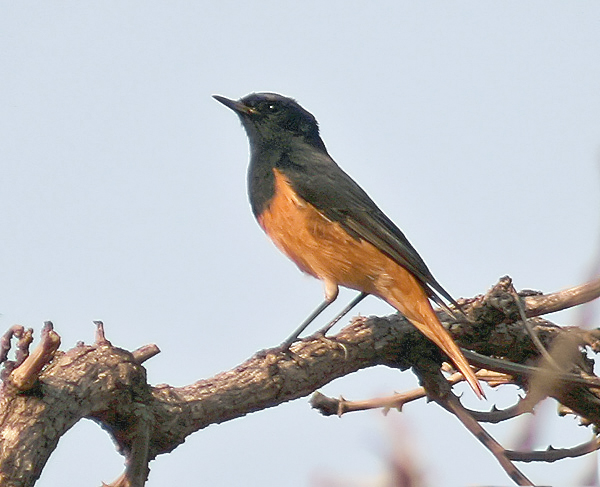
- Adult male in breeding plumage: striking black face and throat, white forehead and supercilium, slate-grey crown and mantle, bright rufous-orange breast and flanks, and a vivid rufous-red tail with dark central feathers. Adult female: duller, brownish-grey upperparts, buffy-orange underparts, and a rufous-red tail. Non-breeding males are similar to females but retain some grey on the back and a hint of black on the face.
- Forma del becco
- Small, slender, pointed, and dark (blackish) for insect catching.
- Colore degli occhi
- Dark brown.
- Colore delle zampe
- Dark grey to blackish.
- Caratteristiche distintive
- The constantly quivering rufous-red tail is the most distinctive feature for both sexes and all ages. Males have a unique combination of black face, white forehead, and grey back. Females and juveniles are identified by the rufous tail and overall warm buffy tones.
- Aspetto giovanile
- Juveniles are mottled brown above and buffy below, with a scaly appearance. They possess the characteristic rufous-red tail, which is a key identification feature even at this stage.
- Cambiamenti stagionali
- Males in non-breeding plumage (after post-breeding moult) are duller, with the black on the face obscured by pale feather fringes, making them resemble females more closely, though still retaining a greyer back and some blackish wash on the face. Females show little seasonal change beyond slight wear and tear.
- Dimorfismo sessuale
- Pronounced. Males are much more brightly colored with a distinct black, white, and grey head pattern and vibrant orange underparts. Females are much duller, predominantly brownish-grey with buffy-orange underparts.
Come identificare
- 1
Tail Color and Movement
Look for the constantly quivering, bright rufous-red tail. This is the most reliable field mark for both sexes and all ages.
- 2
Male Plumage (Breeding)
Identify males by their distinctive black face and throat, contrasting white forehead, slate-grey back, and vibrant rufous-orange breast and flanks.
- 3
Female Plumage
Females are duller, with brownish-grey upperparts and buffy-orange underparts, but still retain the diagnostic rufous-red tail.
- 4
Habitat
Search in open woodlands, parks, large gardens, and orchards with mature trees and cavities.
- 5
Behavior
Observe their flycatching behavior from an exposed perch or their hopping and running on the ground. The tail quivering is almost constant.
- 6
Song
Listen for the soft, warbling, slightly melancholic song, often with mimicry, delivered from a prominent perch.
Habitat e areale
- Biomi
- Temperate forests, woodlands, parks, gardens, orchards, open coniferous and deciduous forests, often with clearings or edges.
- Areale geografico
- Breeds across most of Europe and temperate Asia, from the UK and Scandinavia east to Siberia and Mongolia. Winters in sub-Saharan Africa, from Senegal east to Ethiopia and south to South Africa.
- Fascia altitudinale
- Typically breeds from sea level up to 2000 meters, occasionally higher in some mountain ranges.
- Ambienti preferiti
- Prefers mature trees with cavities for nesting, often in areas with sparse undergrowth and open ground for foraging. Common in old parks, large gardens, traditional orchards, and open woodlands with scattered trees.
Comportamento
- Periodo di attività
- Diurnal.
- Abitudini alimentari
- Primarily an aerial and ground insectivore. It often perches on exposed branches or wires, sallying out to catch flying insects (flycatching). It also forages on the ground, hopping and running to pick up insects, spiders, and other invertebrates. In late summer and autumn, it consumes berries (e.g., elderberries, currants) to build up fat reserves for migration.
- Comportamento sociale
- Generally solitary or found in pairs during the breeding season. Migrates in loose flocks, but not typically seen in large, cohesive groups.
- Tipo di volo
- Undulating flight over longer distances. Short, agile flights when flycatching. Often seen flitting between branches or dropping to the ground.
- Migrazione
- Long-distance migratory species. European populations migrate south to sub-Saharan Africa for the winter, typically departing in August-September and returning in April-May. Asian populations also migrate south to tropical Asia and Africa.
- Territorialità
- Males are highly territorial during the breeding season, defending their nesting and foraging areas with song and displays.
Canto e richiami
- Canto
- The song is a soft, warbling, melodious, and somewhat melancholic series of phrases, often starting with a few clear, whistled notes followed by a jumbled, hurried, and slightly scratchy warble. It often incorporates mimicry of other bird species' calls or song fragments. Delivered from an exposed perch.
- Richiamo
- Common calls include a soft, plaintive 'hoo-eet' or 'huit', a sharp 'tack' or 'chick' often repeated, and a churring 'trrr' alarm call.
- Quando vocalizza
- Males sing frequently during the breeding season, particularly in the early morning and late evening. Calls are given year-round, especially when alarmed or communicating with a mate.
Riproduzione
- Stagione riproduttiva
- Typically May to July in Europe, with some variation depending on latitude and climate. Often two broods per season.
- Abitudini di nidificazione
- Nests are built in tree cavities, old woodpecker holes, crevices in walls, rock faces, or nest boxes. The female constructs a cup-shaped nest of grass, moss, roots, and leaves, lined with fine grass, hair, and feathers.
- Dimensione della covata
- 5-7 eggs.
- Descrizione dell'uovo
- Eggs are typically 5-7, smooth, glossy, and pale blue, sometimes with a few faint reddish-brown spots, though often unspotted. Dimensions average 19 x 14 mm.
- Periodo di incubazione
- 11-14 days, primarily by the female.
- Periodo di involo
- 12-15 days after hatching. Young leave the nest before they can fly strongly.
- Cure parentali
- Both parents feed the nestlings and fledglings. The female primarily incubates, but the male brings food to her and assists significantly with feeding the young once hatched.
Dove trovarlo
Old Parks and Gardens
Areas with mature trees, especially those with old or decaying wood that provide nesting cavities.
Open Woodlands
Deciduous or mixed woodlands with clearings, sparse undergrowth, and scattered mature trees.
Traditional Orchards
Old orchards with fruit trees that offer both nesting sites and foraging opportunities.
Rural Villages and Farmsteads
Areas with old buildings, walls, or scattered trees that provide suitable nesting and foraging habitat.
Consigli sul campo
- Look for Movement. Their constantly quivering rufous tail is often the first thing to catch the eye, even before you see the full bird.
- Listen for Song. During the breeding season, males sing from prominent perches. Learning their soft, warbling song can help locate them.
- Check Exposed Perches. Redstarts often perch on the tops of trees, dead branches, or wires, especially when flycatching.
- Visit in Spring/Early Summer. They are most easily observed during the breeding season when males are singing and displaying.
- Use Nest Boxes. In suitable habitats, providing nest boxes with appropriate hole sizes can attract them to breed.
Specie simili
Black Redstart
Phoenicurus ochruros
Male Black Redstart has a sooty-black body (not grey and orange), a less prominent white forehead patch (or none), and a darker, less vibrant rufous tail. Females are greyer overall than Common Redstart females, lacking the buffy-orange tones on the underparts, and their tail is a duller rufous. Black Redstarts prefer more urban or rocky, open habitats.
Robin
Erithacus rubecula
Robins have a bright orange-red breast and face, but lack the black throat and white forehead of the male Common Redstart. Their tail is brown, not rufous-red and constantly quivering. Robins are generally more plump and have a different posture.
Whinchat
Saxicola rubetra
Whinchats have a prominent white supercilium, streaked brown upperparts, and an orange-buff breast, but their tail is dark with white sides, not entirely rufous. They also lack the black face and grey back of the male Common Redstart. Whinchats prefer open grasslands and heathlands.
Fatti rapidi
- Key Feature:
- Constantly quivering rufous-red tail
- Diet:
- Insects, spiders, berries
- Migration:
- Long-distance migrant to sub-Saharan Africa
- Nesting:
- Tree cavities, nest boxes
- Male Plumage:
- Black face, white forehead, grey back, orange breast
Curiosità
- The name 'Redstart' comes from Old English 'read stert', meaning 'red tail', referring to its most distinctive feature.
- Common Redstarts are known to mimic other bird species in their song, making their vocalizations quite varied and interesting.
- Despite their bright colors, they can be surprisingly elusive, often flitting quickly through foliage.
- They are secondary cavity nesters, meaning they rely on holes created by other species (like woodpeckers) or natural decay for their nests.
Classificazione scientifica
- Regno
- Animalia
- Phylum
- Chordata
- Classe
- Aves
- Ordine
- Passeriformes
- Famiglia
- Muscicapidae
- Genere
- Phoenicurus
- Specie
- Phoenicurus phoenicurus
Esplora Common Redstart
Identifica uccelli ovunque
Gratis su iOS, Android e Web. Identificazione per foto e suono, database completo e la tua lista personale.