
Visto un uccello? Identificalo all'istante con l'app Birdby
Apri l'appInformazioni
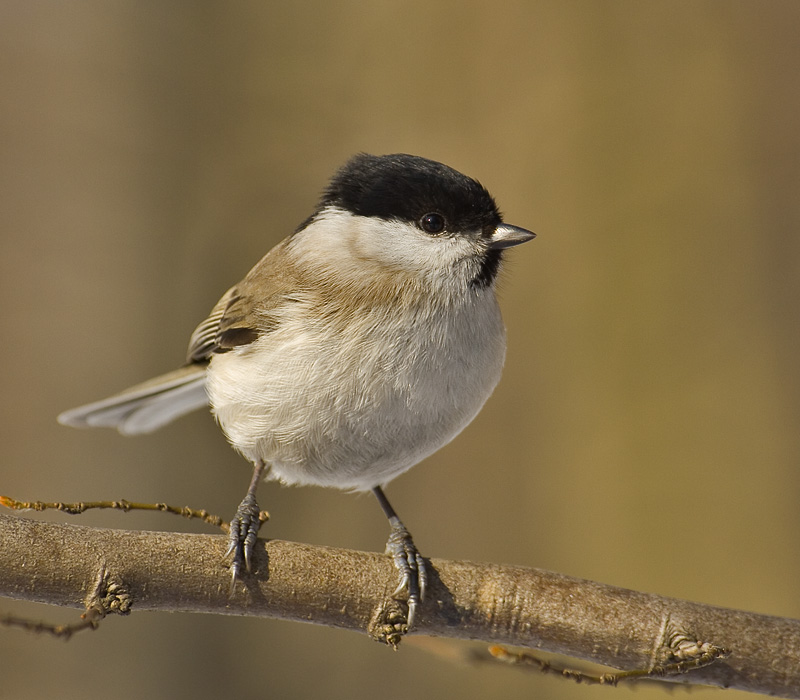
The Marsh Tit (Poecile palustris) is a small passerine bird in the tit family Paridae. It is a resident, non-migratory species found across much of temperate Europe and northern Asia. Despite its name, it is not exclusively found in marshes, preferring deciduous or mixed woodlands with dense undergrowth. It is known for its distinctive black cap and bib, and its often-confused resemblance to the Willow Tit.
Dimensioni e longevità
- Lunghezza
- 11.5-13 cm
- Apertura alare
- 19-21 cm
- Peso
- 9-12 g
- Longevità
- 2-5 years (up to 11 years recorded)
- Dieta
- Omnivore (primarily insects and spiders in summer, seeds and berries in winter)
Caratteristiche fisiche
- Piumaggio
- Adults have a glossy black cap extending from the forehead to the nape, and a small, neat black bib under the chin. The cheeks are clean white, contrasting sharply with the black cap and bib. The upperparts are dull brown, and the underparts are buffish-white, becoming slightly darker on the flanks. The wings and tail are dark brown with paler edges to the flight feathers.
- Forma del becco
- Small, conical, and sharp, dark grey to black.
- Colore degli occhi
- Dark brown.
- Colore delle zampe
- Dark grey to black.
- Caratteristiche distintive
- The combination of a glossy black cap, neat black bib, and clean white cheeks is characteristic. Crucially, it lacks the pale wing panel often seen on the similar Willow Tit, and its call is a key differentiator.
- Aspetto giovanile
- Juveniles resemble adults but have a duller, less glossy black cap and bib, and their plumage may appear slightly looser. The white cheeks may be tinged with buff.
- Cambiamenti stagionali
- No significant seasonal plumage changes. The plumage remains consistent throughout the year.
- Dimorfismo sessuale
- None; males and females are identical in plumage.
Come identificare
- 1
Head Pattern
Look for the glossy, jet-black cap that extends to the nape, and a small, neat black bib under the chin. The cheeks are pure white, creating a strong contrast.
- 2
Plumage Coloration
Upperparts are dull brown, and underparts are buffish-white. There are no prominent wing bars or pale wing panels.
- 3
Vocalization
Listen for the distinctive, explosive 'pit-CHOO' call or the clear, ringing 'chip-chip-chip' song. This is often the most reliable way to distinguish it from the Willow Tit.
- 4
Behavior
Marsh Tits tend to be more arboreal than Willow Tits, foraging higher in trees, though both can be found in similar habitats.
Habitat e areale
- Biomi
- Temperate forests, woodlands.
- Areale geografico
- Widespread across temperate Europe from Great Britain and France eastward through central Europe to Russia, and across northern Asia to Japan. Absent from northern Scandinavia, Ireland, and parts of southern Europe.
- Fascia altitudinale
- Typically found from sea level up to 1,500 meters, occasionally higher in some parts of its range.
- Ambienti preferiti
- Deciduous or mixed woodlands, especially those with a dense understory of shrubs and bushes. Also found in parks, large gardens, and orchards, often near water but not necessarily in marshy areas. Prefers mature trees for foraging and nesting.
Comportamento
- Periodo di attività
- Diurnal.
- Abitudini alimentari
- Forages actively among branches and foliage, gleaning insects, spiders, and their larvae from leaves and bark. In autumn and winter, it switches to seeds, berries, and nuts, often caching food items in crevices or under moss for later retrieval. It can hang upside down to access food.
- Comportamento sociale
- Usually seen in pairs or small family groups during the breeding season. In winter, they may join mixed-species foraging flocks, often with other tits, finches, and warblers, but tend to maintain their pair bond within these flocks.
- Tipo di volo
- Undulating flight, typical of tits, with rapid wing beats interspersed with short glides. Generally agile and direct over short distances.
- Migrazione
- Resident and largely sedentary throughout its range. Young birds may disperse short distances from their natal territories, but long-distance migration is not typical.
- Territorialità
- Pairs are territorial during the breeding season, defending their nesting and foraging areas. They maintain territories year-round, though boundaries may be less strictly enforced outside the breeding period.
Canto e richiami
- Canto
- The song is a clear, ringing 'chip-chip-chip-chip' or 'schip-schip-schip', often described as sounding like 'pitchou-pitchou-pitchou'. It is distinct from the Willow Tit's song.
- Richiamo
- The most characteristic call is a sharp, explosive 'pit-CHOO' or 'psch-CHOO', often repeated. Other calls include a soft 'tsee-tsee-tsee' and a scolding 'churr'.
- Quando vocalizza
- Vocalizes year-round, but most frequently and prominently during the breeding season (spring and early summer) to establish territories and attract mates.
Riproduzione
- Stagione riproduttiva
- April to July, with peak activity in May and June.
- Abitudini di nidificazione
- Nests in natural cavities in trees, old woodpecker holes, or sometimes in nest boxes. Unlike the Willow Tit, it rarely excavates its own nest hole, preferring existing ones. The nest is a cup-shaped structure made of moss, lined with hair, wool, and feathers.
- Dimensione della covata
- 6-9 eggs (occasionally 5-10).
- Descrizione dell'uovo
- Typically 6-9 eggs, white with fine reddish-brown spots, particularly at the broader end. Eggs are smooth and slightly glossy.
- Periodo di incubazione
- 13-15 days, primarily by the female.
- Periodo di involo
- 16-20 days after hatching. Both parents feed the young.
- Cure parentali
- Both parents participate in feeding the nestlings and fledglings. The female incubates, while the male brings her food. After fledging, the young remain dependent on their parents for several weeks.
Dove trovarlo
Deciduous Woodlands
Look in mature deciduous or mixed woodlands with a good understory of shrubs and bushes.
Parks and Gardens
Large, well-wooded parks and gardens, especially those with older trees, can host Marsh Tits.
Riverine Habitats
While not strictly marsh birds, they can be found in woodlands along rivers and streams.
Consigli sul campo
- Listen for Calls. Their distinctive 'pit-CHOO' call is often heard before the bird is seen. Learning this call is crucial for identification.
- Observe Head Markings. Pay close attention to the glossiness of the black cap and the neatness of the bib, as well as the pure white cheeks, to differentiate from similar species.
- Check for Wing Panel. Absence of a pale wing panel is a key feature distinguishing it from the Willow Tit. Look for uniform dark wings.
- Patience and Stillness. Marsh Tits can be quite active and quick-moving. Remaining still and observing their foraging behavior can provide good views.
Specie simili
Willow Tit
Poecile montanus
The Marsh Tit has a glossy black cap (vs. duller, sooty black on Willow Tit), a smaller, neater bib (vs. larger, more diffuse bib on Willow Tit), and clean white cheeks (vs. often buff-tinged cheeks on Willow Tit). Crucially, the Marsh Tit lacks the pale wing panel formed by pale edges to the secondary and tertial feathers, which is often visible on the Willow Tit. The calls are the most reliable distinction: Marsh Tit's 'pit-CHOO' vs. Willow Tit's 'zee-zoo-zee' or 'chay-chay-chay'.
Coal Tit
Periparus ater
The Coal Tit has a white patch on the nape, which the Marsh Tit lacks. Its cap is also glossy black, but its cheeks are not as starkly white, and it has a smaller bib. Its overall plumage is darker and more greyish on the back.
Fatti rapidi
- Distinguishing Feature:
- Glossy black cap, neat black bib, clean white cheeks, no pale wing panel.
- Key Call:
- 'Pit-CHOO' or 'psch-CHOO'.
- Habitat Preference:
- Deciduous/mixed woodlands with dense undergrowth.
- Migration Status:
- Resident, non-migratory.
- Dietary Shift:
- Insects in summer, seeds/berries in winter.
Curiosità
- Despite its name, the Marsh Tit is not particularly associated with marshes, preferring drier woodlands. The name likely comes from its preference for damp, boggy woodlands in some parts of its range, or perhaps a misinterpretation of its call.
- Marsh Tits are known for their excellent memory, particularly for cached food items. They can remember hundreds of hiding places for seeds and insects.
- They are one of the few tit species that do not typically excavate their own nest holes, relying instead on natural cavities or old woodpecker holes.
- The Marsh Tit and Willow Tit were once considered the same species due to their similar appearance, but their distinct calls and subtle morphological differences led to their separation.
Classificazione scientifica
- Regno
- Animalia
- Phylum
- Chordata
- Classe
- Aves
- Ordine
- Passeriformes
- Famiglia
- Paridae
- Genere
- Poecile
- Specie
- Poecile palustris
Esplora Marsh Tit
Identifica uccelli ovunque
Gratis su iOS, Android e Web. Identificazione per foto e suono, database completo e la tua lista personale.