
Visto un uccello? Identificalo all'istante con l'app Birdby
Apri l'appInformazioni
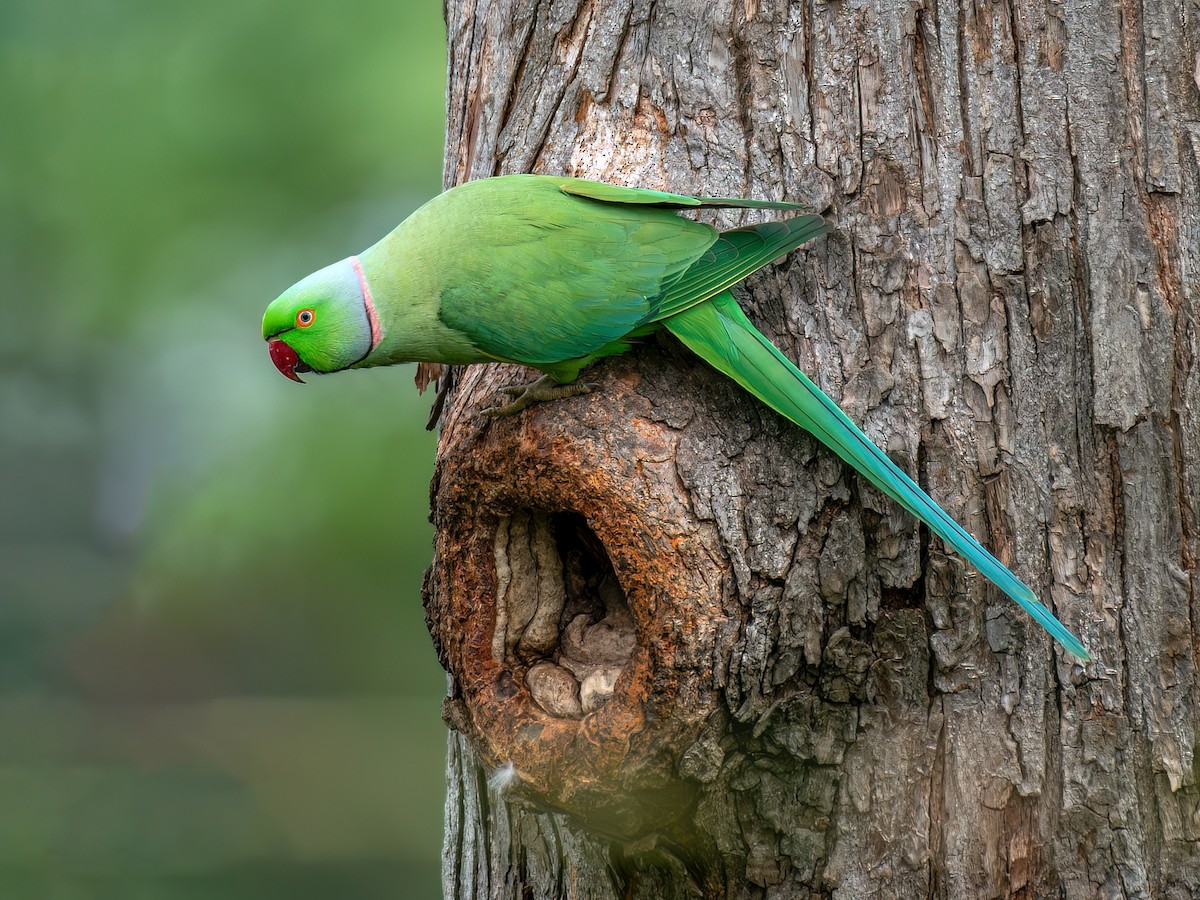
The Rose-ringed Parakeet, also known as the Ringneck Parrot, is a medium-sized, long-tailed parrot, predominantly green, with a distinctive red and black neck ring in adult males. It is native to Africa and the Indian subcontinent but has established feral populations in many urban areas worldwide due to escapes from captivity. Known for its intelligence, adaptability, and vocal nature, it thrives in a variety of habitats.
Dimensioni e longevità
- Lunghezza
- 38-42 cm (including tail)
- Apertura alare
- 42-48 cm
- Peso
- 115-140 g
- Longevità
- 20-30 years in the wild, up to 50 years in captivity
- Dieta
- Herbivore (primarily granivorous and frugivorous)
Caratteristiche fisiche
- Piumaggio
- Predominantly bright grass-green plumage. The underside is slightly paler, and the undertail coverts are yellowish-green. The flight feathers are darker green with bluish tips. The tail is long and tapered, with the central feathers being blue-green and the outer feathers green.
- Forma del becco
- Strong, hooked beak. The upper mandible is bright red with a black tip, and the lower mandible is blackish-red.
- Colore degli occhi
- Pale yellow iris with a prominent orange-red orbital ring.
- Colore delle zampe
- Greyish-pink to greyish-brown
- Caratteristiche distintive
- The most distinctive feature is the neck ring in adult males. The long, pointed tail is also characteristic.
- Aspetto giovanile
- Juveniles are duller green than adults, with a shorter tail. Their beak is pale orange-brown, gradually developing the adult coloration. They lack the neck ring of the adult male and the faint collar of the adult female. The iris is darker, becoming paler with age.
- Cambiamenti stagionali
- No significant seasonal plumage changes. The plumage remains consistent throughout the year.
- Dimorfismo sessuale
- Adult males possess a prominent rose-pink collar on the nape and sides of the neck, extending to a black chin stripe and a black band across the lower cheeks. Adult females lack the black chin stripe and the rose-pink collar is either absent or appears as a pale greyish-green shadow. Juveniles resemble females but have a duller green plumage, a shorter tail, and a pale orange-brown beak.
Come identificare
- 1
Overall Plumage
Look for the bright, uniform grass-green body plumage. This is the most striking and consistent feature.
- 2
Neck Ring (Males)
In adult males, observe the distinct black chin stripe, black band across the lower cheeks, and the rose-pink collar on the nape. This is absent or very faint in females and juveniles.
- 3
Beak Color
Note the bright red upper mandible with a black tip and the blackish-red lower mandible in adults. Juveniles have a paler, orange-brown beak.
- 4
Tail Length and Shape
The very long, pointed tail, often longer than the body, is a key identifier, especially in flight.
- 5
Vocalizations
Listen for the loud, shrill, and piercing 'kree-kree-kree' or 'kyaak-kyaak' calls, particularly when birds are flying or in flocks.
- 6
Flight Pattern
Observe their strong, direct flight with rapid wing beats, often in noisy groups.
Habitat e areale
- Biomi
- Forest edges, open woodlands, savannas, semi-arid regions, agricultural lands, urban parks, and suburban gardens.
- Areale geografico
- Native to two disjunct populations: one across a belt of sub-Saharan Africa from Senegal to Ethiopia and Somalia, and another in the Indian subcontinent from Pakistan to Bangladesh and southern India. Feral populations are established in numerous countries worldwide, including much of Western Europe (e.g., UK, Netherlands, Belgium, Germany, France, Italy, Spain), parts of the Middle East, Japan, and the USA.
- Fascia altitudinale
- Typically found from sea level up to 1,600 meters, occasionally higher in some parts of its native range.
- Ambienti preferiti
- Prefers areas with scattered trees, especially mature deciduous trees for nesting and roosting, and access to food sources such as fruit trees, seed-bearing plants, and cultivated crops. Highly adaptable to anthropogenic landscapes.
Comportamento
- Periodo di attività
- Diurnal. Most active during early morning and late afternoon, with a midday rest period.
- Abitudini alimentari
- Feeds primarily on seeds, nuts, fruits, berries, blossoms, and nectar. It is known to forage in trees and on the ground. In agricultural areas, it can be a pest, feeding on ripening crops such such as maize, sunflowers, and various fruits. They use their strong beak to crack open hard seeds and nuts.
- Comportamento sociale
- Highly gregarious, often seen in small to large flocks, especially outside the breeding season. Forms large communal roosts, sometimes numbering thousands of individuals. Pairs remain together within the flock.
- Tipo di volo
- Strong, direct, and swift flight with rapid wing beats. Often flies in noisy flocks, especially at dawn and dusk when commuting to and from roosting sites. Flight calls are characteristic.
- Migrazione
- Essentially resident throughout its native and introduced ranges. Local movements may occur in response to food availability.
- Territorialità
- Pairs defend their nest site during the breeding season, but outside of this period, they are largely non-territorial and highly social.
Canto e richiami
- Canto
- Does not have a complex song. Vocalizations are primarily calls.
- Richiamo
- A variety of loud, shrill, and piercing calls. The most common call is a harsh, ringing 'kree-kree-kree' or 'kyaak-kyaak'. They also produce softer chattering and squawking sounds, especially when perched or feeding. Calls are often given in flight and are highly characteristic of the species.
- Quando vocalizza
- Vocalizes frequently throughout the day, especially when flying, feeding, or interacting with other parakeets. Calls are particularly noticeable at dawn and dusk during communal roosting activities.
Riproduzione
- Stagione riproduttiva
- Varies geographically: typically November-June in Africa, December-May in India, and February-June in introduced European populations.
- Abitudini di nidificazione
- Cavity nesters. They typically nest in tree hollows, often old woodpecker holes, but will also use crevices in buildings, walls, or artificial nest boxes. They do not add nesting material, laying eggs directly on the bare wood or substrate.
- Dimensione della covata
- 2-6 eggs, typically 3-4.
- Descrizione dell'uovo
- White, elliptical to oval, smooth, and slightly glossy. Average size is approximately 30 x 24 mm.
- Periodo di incubazione
- 22-24 days, primarily by the female.
- Periodo di involo
- Approximately 7 weeks (45-55 days) after hatching. Young are fed by both parents.
- Cure parentali
- Both parents participate in feeding the chicks. The female primarily incubates, while the male brings food to her and later to the chicks. After fledging, juveniles remain dependent on their parents for several weeks.
Dove trovarlo
Urban Parks and Gardens
Common in city parks, botanical gardens, and large suburban gardens, especially where there are mature trees for roosting and nesting, and food sources like fruit trees.
Agricultural Areas
Can be found in farmlands, particularly those growing maize, sunflowers, or fruit orchards, where they forage for food.
Woodlands and Forest Edges
In their native range, they inhabit open woodlands, savannas, and the edges of forests.
Communal Roosts
At dawn and dusk, large numbers can be observed flying to and from communal roosting sites, often in tall trees or dense vegetation within urban areas.
Consigli sul campo
- Listen for Calls. Their loud, distinctive calls are often heard before the birds are seen. Follow the sound to locate them.
- Look in Fruiting Trees. They are often found feeding in trees laden with fruits, berries, or seeds. Observe for movement and listen for feeding sounds.
- Visit Roosting Sites. Identify known communal roosting sites in urban areas and visit at dawn or dusk to witness large numbers flying in or out.
- Check Tree Cavities. During the breeding season, look for activity around tree hollows or crevices in buildings, as these are their preferred nesting sites.
- Observe Flocks. They are highly social and often move in flocks. Look for groups of green birds flying together or perched in trees.
Specie simili
Alexandrine Parakeet
Psittacula eupatria
The Alexandrine Parakeet is significantly larger (up to 58 cm) with a much larger, heavier red beak. It also has a prominent maroon patch on the wing coverts, which the Rose-ringed Parakeet lacks. The male Alexandrine also has a black neck stripe and a rose-pink collar, but it is broader and more defined than in the Rose-ringed. Its call is deeper and less shrill.
Plum-headed Parakeet
Psittacula cyanocephala
Smaller than the Rose-ringed Parakeet. Males have a distinctive plum-red head with a purplish tinge and a black neck collar. Females have a greyish-blue head. Both sexes lack the prominent red beak of the Rose-ringed Parakeet, having a yellowish-orange beak instead. The tail is also shorter.
Fatti rapidi
- Native Range:
- Sub-Saharan Africa and Indian Subcontinent
- Introduced Range:
- Widespread in Europe, parts of Asia, Middle East, USA
- Diet:
- Seeds, fruits, nuts, blossoms, nectar
- Sociality:
- Highly gregarious, forms large flocks
- Nesting:
- Tree cavities, building crevices
- Conservation Status:
- Least Concern
- Key ID Feature:
- Green plumage, long tail, red beak, male's neck ring
Curiosità
- The Rose-ringed Parakeet is one of the most widely distributed parrot species in the world, largely due to its popularity as a cage bird and subsequent escapes.
- Feral populations in Europe have become a subject of ecological debate, with concerns about their impact on native bird species, particularly cavity nesters, due to competition for nesting sites.
- They are highly intelligent birds and can be taught to mimic human speech, which contributes to their popularity as pets.
- Despite their tropical origins, many introduced populations, particularly in Europe, have shown remarkable adaptability to colder climates.
- The species name 'krameri' honors Wilhelm Heinrich Kramer, an 18th-century German physician and naturalist.
Classificazione scientifica
- Regno
- Animalia
- Phylum
- Chordata
- Classe
- Aves
- Ordine
- Psittaciformes
- Famiglia
- Psittaculidae
- Genere
- Psittacula
- Specie
- Psittacula krameri
Esplora Rose-ringed Parakeet
Identifica uccelli ovunque
Gratis su iOS, Android e Web. Identificazione per foto e suono, database completo e la tua lista personale.