
Visto un uccello? Identificalo all'istante con l'app Birdby
Apri l'appInformazioni
The Eurasian Bullfinch, known in Italian as 'Fringuello alpino' (though this name is more commonly associated with the Alpine Accentor, Prunella collaris, and the Bullfinch is typically 'Ciuffolotto'), is a small, stocky passerine bird renowned for its striking plumage, particularly the male's vibrant rosy-red underparts. It is a shy and often elusive species, typically found in well-vegetated areas.
Dimensioni e longevità
- Lunghezza
- 14.5-16.5 cm
- Apertura alare
- 22-29 cm
- Peso
- 21-27 g
- Longevità
- 2-5 years (up to 8 years recorded in the wild)
- Dieta
- Herbivore (primarily seeds, buds, berries, and some invertebrates)
Caratteristiche fisiche
- Piumaggio
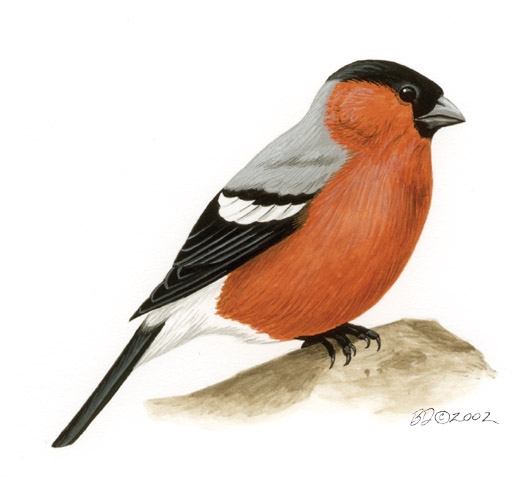
- Males have a bright rosy-red breast and belly, grey back, black cap, black wings with a prominent white wing-bar, and a black tail. Females are duller, with a pinkish-brown breast and belly, and a greyish-brown back. Both sexes have a distinctive white rump, visible in flight.
- Forma del becco
- Short, stout, conical, and black, perfectly adapted for crushing seeds and buds.
- Colore degli occhi
- Dark brown.
- Colore delle zampe
- Dark brown to blackish.
- Caratteristiche distintive
- The combination of a black cap, white wing-bar, and white rump is diagnostic for both sexes. The male's rosy-red underparts are unmistakable.
- Aspetto giovanile
- Juveniles lack the black cap, having a dull brown head. Their plumage is generally duller and browner than adult females, with a less distinct white wing-bar. They gradually acquire the black cap and adult coloration during their first autumn moult.
- Cambiamenti stagionali
- No significant seasonal plumage changes. The plumage remains consistent throughout the year, though wear and tear can make colors appear slightly duller before the annual moult.
- Dimorfismo sessuale
- Pronounced. Males are much brighter with rosy-red underparts, while females have pinkish-brown underparts.
Come identificare
- 1
Size and Shape
A small, stocky finch with a short neck and a relatively large head. Its stout, conical bill is a key feature.
- 2
Male Plumage
Look for the unmistakable bright rosy-red underparts, grey back, black cap, black wings with a prominent white wing-bar, and a white rump.
- 3
Female Plumage
Observe the pinkish-brown underparts, greyish-brown back, black cap, black wings with a white wing-bar, and a white rump. Duller than the male but shares key markings.
- 4
Juvenile Plumage
Note the dull brown head (lacking the black cap), overall browner plumage, and less distinct white wing-bar compared to adults.
- 5
White Rump
This is a crucial field mark, visible on both sexes, especially in flight. It contrasts sharply with the black tail.
- 6
Call
Listen for the soft, piping, melancholic 'peu' or 'dew' call. This distinctive whistle is often the first clue to its presence, as they are often hidden in foliage.
Habitat e areale
- Biomi
- Temperate forests, mixed woodlands, orchards, parks, large gardens, hedgerows, and scrubland.
- Areale geografico
- Widespread across temperate Europe and Asia, from the British Isles and Iberia eastwards to Japan. Absent from Iceland, parts of Scandinavia, and southern Mediterranean islands.
- Fascia altitudinale
- Typically found from sea level up to 1,800 meters, occasionally higher in mountainous regions during the breeding season.
- Ambienti preferiti
- Prefers areas with dense undergrowth, mature trees, and a good supply of seeds and buds. Often found near human habitation in winter, especially in gardens with berry-bearing shrubs.
Comportamento
- Periodo di attività
- Diurnal.
- Abitudini alimentari
- Primarily feeds on seeds, especially those of ash, birch, and nettle. Also consumes buds of fruit trees (which can make them a pest in orchards), berries (e.g., hawthorn, elder), and occasionally small invertebrates, particularly when feeding young. They use their strong, conical bill to efficiently de-husk seeds and snip off buds.
- Comportamento sociale
- Usually seen in pairs or small family groups. In winter, they may form larger, loose flocks, sometimes associating with other finches. Generally shy and inconspicuous.
- Tipo di volo
- Undulating flight, typical of finches, with rapid wing beats followed by a short glide.
- Migrazione
- Mostly resident or short-distance migrants. Northern populations may move south in winter, and some altitudinal migration occurs in mountainous areas. Irruptive movements can occur in years of poor food availability.
- Territorialità
- Males defend a breeding territory during the nesting season, primarily through song and display. Outside the breeding season, they are less territorial.
Canto e richiami
- Canto
- The song is a soft, melancholic, and often barely audible series of piping whistles and creaky notes, sometimes described as a 'flute-like' or 'whispered' song. It is not a loud or elaborate song.
- Richiamo
- The most characteristic call is a soft, piping 'peu' or 'dew' note, often repeated. It's a distinctive, slightly mournful whistle that is easily recognizable and often the first indication of a Bullfinch's presence. Alarm calls are a sharper 'chupp'.
- Quando vocalizza
- Vocalizes throughout the year, though the song is most frequently heard during the breeding season (spring and early summer). Calls are given regularly, especially when foraging or in contact with other individuals.
Riproduzione
- Stagione riproduttiva
- April to July, typically producing 1-2 broods per year.
- Abitudini di nidificazione
- The nest is a neat, cup-shaped structure built by the female, usually low down in dense bushes, hedges, or small trees, often well-concealed. It is constructed from twigs, moss, and lichens, lined with fine roots, hair, and feathers.
- Dimensione della covata
- 4-6 eggs.
- Descrizione dell'uovo
- 4-6 eggs, smooth and glossy, pale blue with purplish-brown spots and streaks, concentrated at the broad end.
- Periodo di incubazione
- 12-14 days, primarily by the female.
- Periodo di involo
- 12-18 days after hatching. Young are fed by both parents.
- Cure parentali
- Both parents feed the nestlings and fledglings. The male often feeds the female during incubation and brooding.
Dove trovarlo
Woodlands and Forests
Especially mixed or deciduous woodlands with dense undergrowth and mature trees.
Parks and Gardens
Large, well-vegetated parks and gardens, particularly those with berry-bearing shrubs and fruit trees, are good places to find them, especially in winter.
Orchards and Hedgerows
These provide both food sources (buds, seeds) and nesting sites.
Scrubland
Areas with dense bushes and thickets offer cover and food.
Consigli sul campo
- Listen for the call. Their soft, piping 'peu' call is often the easiest way to detect them before you see them, as they are quite shy and often remain hidden in foliage.
- Look for movement in dense vegetation. They prefer to forage within dense bushes and trees. Watch for subtle movements or flashes of color in thickets.
- Visit in winter. In winter, they are often more visible as they visit gardens and feed on berries and seeds, especially when other food sources are scarce.
- Be patient and quiet. Bullfinches are shy. Remain still and quiet in suitable habitats, and they may eventually reveal themselves.
- Check fruit trees and berry bushes. During late winter and early spring, they can be found feeding on buds of fruit trees. In autumn and winter, they frequent bushes with berries.
Specie simili
Pine Grosbeak
Pinicola enucleator
Larger size, longer tail, and a more robust bill. Males are rosy-red but lack the black cap and white wing-bar of the Bullfinch. Females are greyish with yellowish or orangish wash.
Crossbills (e.g., Red Crossbill)
Loxia curvirostra
Distinctive crossed mandibles, specialized for extracting seeds from conifer cones. Different head shape and overall plumage coloration (males brick-red, females yellowish-green), and lack the black cap and white wing-bar.
Chaffinch
Fringilla coelebs
While also a finch, the Chaffinch has a different plumage pattern (blue-grey cap, chestnut back, double white wing-bars, no black cap or white rump). Its song and calls are also distinctly different.
Fatti rapidi
- Distinctive Feature:
- Male's rosy-red breast and black cap; white rump on both sexes.
- Primary Diet:
- Seeds and buds.
- Vocalization:
- Soft, piping 'peu' call and whispered song.
- Habitat Preference:
- Dense woodlands, gardens, and hedgerows.
- Sociality:
- Pairs or small groups, shy.
Curiosità
- The Bullfinch's scientific name 'Pyrrhula' comes from the Greek word 'pyrrhos', meaning 'flame-colored', referring to the male's vibrant plumage.
- Despite their striking appearance, Bullfinches are often difficult to spot due to their shy nature and preference for dense cover.
- In some cultures, the Bullfinch is considered a symbol of good luck or a harbinger of spring.
- They are known to cause damage in orchards by eating fruit buds, leading to them being considered a pest in some agricultural areas.
- The Bullfinch's ability to mimic sounds has made it a popular cage bird in the past, though this practice is now largely illegal in many regions.
Classificazione scientifica
- Regno
- Animalia
- Phylum
- Chordata
- Classe
- Aves
- Ordine
- Passeriformes
- Famiglia
- Fringillidae
- Genere
- Pyrrhula
- Specie
- Pyrrhula pyrrhula
Esplora Eurasian Bullfinch
Identifica uccelli ovunque
Gratis su iOS, Android e Web. Identificazione per foto e suono, database completo e la tua lista personale.