
Visto un uccello? Identificalo all'istante con l'app Birdby
Apri l'appInformazioni
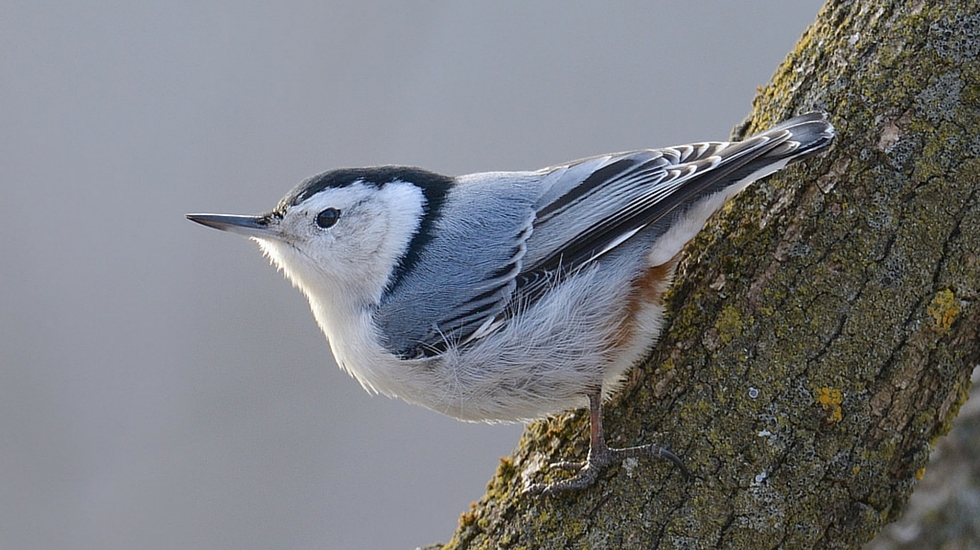
The White-breasted Nuthatch is a small, agile songbird known for its distinctive habit of foraging headfirst down tree trunks and branches. It is a common resident across much of North America, inhabiting mature deciduous and mixed forests. Its name 'nuthatch' refers to its habit of wedging nuts and seeds into bark crevices and then 'hatching' them open with its strong bill.
Dimensioni e longevità
- Lunghezza
- 13-14 cm (5.1-5.5 in)
- Apertura alare
- 20-27 cm (7.9-10.6 in)
- Peso
- 18-30 g (0.6-1.1 oz)
- Longevità
- 2-9 years (average 2 years in the wild, up to 9 years recorded)
- Dieta
- Omnivore (primarily insects and spiders in summer, seeds and nuts in winter)
Caratteristiche fisiche
- Piumaggio
- Adults have a blue-gray back, white face and underparts, and a prominent black cap extending from the bill to the nape. The undertail coverts are rufous. Wings are dark with lighter edgings. The tail is short and dark with white outer tail feathers, visible in flight.
- Forma del becco
- Long, straight, pointed, and slightly upturned bill; dark gray to black.
- Colore degli occhi
- Dark brown.
- Colore delle zampe
- Dark gray to black.
- Caratteristiche distintive
- The most distinctive feature is the black cap contrasting with the white face and underparts. Its habit of walking headfirst down trees is also a key identifier. The short tail and lack of a strong neck are characteristic of nuthatches.
- Aspetto giovanile
- Juveniles resemble adults but have duller plumage overall, with a less distinct black cap and a slightly grayer wash on the underparts. Their bills may also appear slightly shorter.
- Cambiamenti stagionali
- No significant seasonal plumage changes. Plumage remains consistent year-round.
- Dimorfismo sessuale
- Males typically have a solid black cap that extends to the back of the neck, while females often have a duller, sometimes grayish-black cap that may not extend as far back. The rufous wash on the undertail coverts can be slightly more intense in males.
Come identificare
- 1
Plumage
Look for the striking contrast of a blue-gray back, pure white underparts, and a solid black cap. The rufous undertail coverts are also a good field mark.
- 2
Behavior
Observe its unique foraging style: it often creeps headfirst down tree trunks and branches, a behavior rarely seen in other birds.
- 3
Vocalization
Listen for its distinctive, nasal 'yank-yank' call, which is often given while foraging or in flight.
- 4
Habitat
Check mature deciduous or mixed forests, especially those with large, old trees. They are also common in well-wooded suburban areas.
- 5
Size and Shape
Note its compact, short-tailed body shape and relatively long, straight bill. It's larger than other North American nuthatches.
Habitat e areale
- Biomi
- Temperate forests, woodlands, suburban parks, and large gardens.
- Areale geografico
- Widespread across North America, from southern Canada through the United States and into central Mexico. Absent from the extreme northern boreal forests and arid southwestern deserts.
- Fascia altitudinale
- Sea level up to 3,000 meters (10,000 feet), depending on the region and availability of suitable forest habitat.
- Ambienti preferiti
- Mature deciduous or mixed forests with large, old trees (especially oaks, hickories, and pines) that provide abundant bark crevices for foraging and nesting cavities. Also found in orchards and suburban areas with mature trees.
Comportamento
- Periodo di attività
- Diurnal.
- Abitudini alimentari
- Forages by creeping along tree trunks and branches, often headfirst, probing bark crevices for insects and spiders. Also gleans insects from leaves and twigs. In winter, it consumes a significant amount of seeds and nuts, which it often wedges into bark to hammer open. It caches food for later consumption.
- Comportamento sociale
- Typically solitary or found in pairs, especially during the breeding season. May join mixed-species foraging flocks in winter, particularly with chickadees and titmice.
- Tipo di volo
- Undulating flight pattern, typical of many small passerines, with rapid wing beats interspersed with brief glides. Flight is usually short, from tree to tree.
- Migrazione
- Mostly a permanent resident throughout its range. Northern populations may exhibit some short-distance, irruptive movements in years of poor seed crops, but generally non-migratory.
- Territorialità
- Pairs defend a breeding territory during the nesting season. They are generally less territorial outside of breeding, though they may defend food caches.
Canto e richiami
- Canto
- A series of nasal, whistled notes, often described as 'whi-whi-whi-whi' or 'yank-yank-yank-yank', delivered rapidly and often ascending or descending in pitch. The song is relatively simple and repetitive.
- Richiamo
- A distinctive, nasal 'yank-yank' call, often given while foraging. Also has a softer 'nit' or 'tup' contact call and various alarm calls, including a rapid 'sit-sit-sit'.
- Quando vocalizza
- Most vocal during the breeding season (spring and early summer) but can be heard year-round, especially the 'yank-yank' call while foraging.
Riproduzione
- Stagione riproduttiva
- Typically April to July, with peak activity in May and June.
- Abitudini di nidificazione
- Nests in natural tree cavities or old woodpecker holes, usually 2-15 meters (6-50 feet) high. They do not excavate their own cavities but may enlarge existing ones. The female lines the cavity with bark strips, plant fibers, grass, and sometimes feathers or fur. They may smear insects around the entrance hole, possibly to deter predators.
- Dimensione della covata
- 3-10 eggs (most commonly 5-9).
- Descrizione dell'uovo
- 3-10 (typically 5-9) eggs per clutch. Eggs are white or creamy white, speckled with reddish-brown or purplish dots, especially at the larger end. Approximately 19 x 14 mm (0.75 x 0.55 in).
- Periodo di incubazione
- 12-14 days, primarily by the female.
- Periodo di involo
- 14-26 days after hatching. Young are fed by both parents.
- Cure parentali
- Both parents feed the nestlings and fledglings. The male often feeds the female during incubation. Young remain with parents for a few weeks after fledging, learning foraging techniques.
Dove trovarlo
Mature Deciduous Forests
Look for them in oak, hickory, maple, and beech forests, where they find abundant food and nesting sites.
Mixed Forests
They also inhabit forests with a mix of deciduous and coniferous trees, utilizing both for foraging.
Suburban Parks and Gardens
If mature trees are present, especially large oaks or pines, White-breasted Nuthatches can be found in urban and suburban settings.
Bird Feeders
They are frequent visitors to feeders, especially in winter, where they enjoy sunflower seeds, peanuts, and suet.
Consigli sul campo
- Look Up. Spend time scanning tree trunks and large branches, particularly the upper parts, as they often forage high in the canopy.
- Listen for Calls. Their loud, nasal 'yank-yank' call is often the first indication of their presence, even before you see them.
- Observe Foraging Behavior. Watch for birds moving headfirst down tree trunks; this is a strong identifier for nuthatches.
- Check Feeders. In winter, place suet or black oil sunflower seeds in a feeder to attract them to your yard.
- Mixed-Species Flocks. In non-breeding seasons, they often join foraging flocks with chickadees, titmice, and downy woodpeckers. Look for them among these groups.
Specie simili
Red-breasted Nuthatch
Sitta canadensis
Smaller size, rusty underparts, black eye-line, and a smaller, less prominent black cap. Its call is also more nasal and higher-pitched, often described as 'ank-ank'.
Brown-headed Nuthatch
Sitta pusilla
Smaller, with a brown cap and a small white spot on the nape. Found primarily in pine forests of the southeastern U.S. Its call is a squeaky 'dee-dee-dee'.
Pygmy Nuthatch
Sitta pygmaea
Smallest nuthatch, with a brown cap and a white spot on the nape. Found in western North America, primarily in pine forests. Often forages in flocks. Its call is a rapid, high-pitched 'kit-kit-kit'.
Fatti rapidi
- Unique Foraging:
- Only bird in North America that regularly walks headfirst down tree trunks.
- Food Caching:
- Known to cache seeds and nuts in bark crevices for later consumption, especially in winter.
- Nest Defense:
- May smear insects around their nest cavity entrance, possibly to deter predators or competitors.
- Diet Shift:
- Primarily insectivorous in summer, shifting to a diet rich in seeds and nuts in winter.
- Non-Migratory:
- Generally a permanent resident throughout its range.
Curiosità
- The name 'nuthatch' comes from 'nut hack,' referring to its habit of wedging nuts into bark and hammering them open.
- Unlike woodpeckers, nuthatches do not use their tails for support when climbing trees; they rely solely on their strong legs and feet.
- They are one of the few bird species that can climb down a tree headfirst, thanks to their unique ankle joint structure.
- White-breasted Nuthatches have been observed using small tools, such as bark flakes, to pry open crevices for food.
- They often reuse the same nesting cavity year after year, sometimes enlarging it slightly.
Classificazione scientifica
- Regno
- Animalia
- Phylum
- Chordata
- Classe
- Aves
- Ordine
- Passeriformes
- Famiglia
- Sittidae
- Genere
- Sitta
- Specie
- Sitta carolinensis
Esplora White-breasted Nuthatch
Identifica uccelli ovunque
Gratis su iOS, Android e Web. Identificazione per foto e suono, database completo e la tua lista personale.