
Visto un uccello? Identificalo all'istante con l'app Birdby
Apri l'appInformazioni
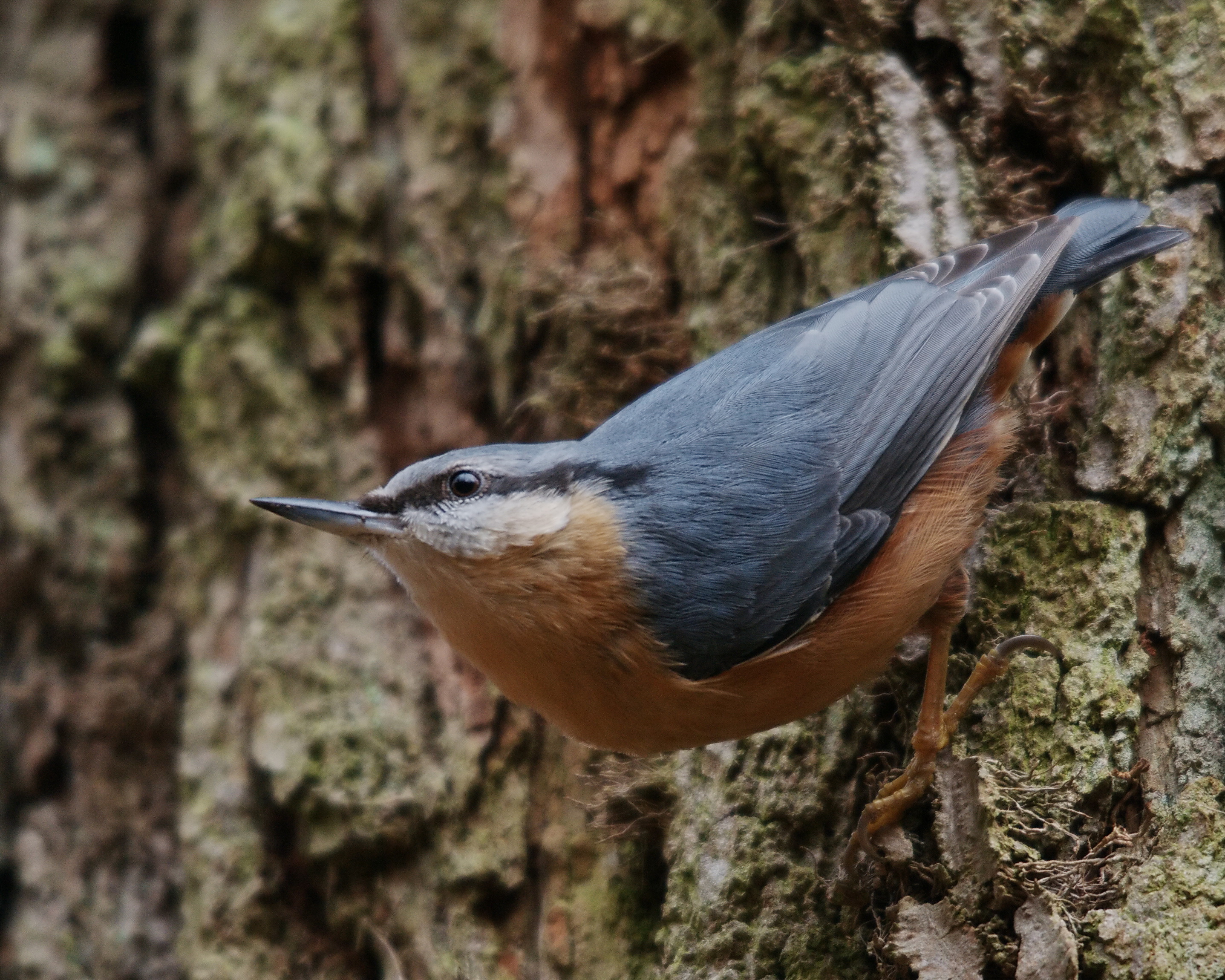
The Eurasian Nuthatch, known in Italian as 'Picchio muratore', is a small, agile passerine bird renowned for its unique ability to climb headfirst down tree trunks. It is a stocky bird with a large head, short tail, and a strong, pointed bill. Its distinctive blue-grey upperparts and warm buff underparts, combined with a prominent black eye-stripe, make it easily recognizable. It is a resident species across much of its range, typically found in mature woodlands and parks.
Dimensioni e longevità
- Lunghezza
- 12-14.5 cm
- Apertura alare
- 22.5-27 cm
- Peso
- 17-28 g
- Longevità
- 2-3 years (up to 10 years in captivity)
- Dieta
- Omnivore (primarily insects, seeds, nuts)
Caratteristiche fisiche
- Piumaggio
- Upperparts are slate-blue to blue-grey, with a contrasting black eye-stripe extending from the bill to the shoulder. Underparts are typically warm buff to orange-buff, with flanks often a richer chestnut. The throat and cheeks are white. The undertail coverts are rufous with white tips.
- Forma del becco
- Strong, straight, pointed, and chisel-like bill, dark grey to blackish.
- Colore degli occhi
- Dark brown to black.
- Colore delle zampe
- Greyish-brown to dark grey, with strong claws adapted for climbing.
- Caratteristiche distintive
- Its unique ability to climb headfirst down tree trunks, unlike woodpeckers which typically climb upwards. The prominent black eye-stripe and the blue-grey upperparts are key features. It has a short, square tail.
- Aspetto giovanile
- Juveniles resemble adults but have duller plumage overall, with less vibrant underparts and a less sharply defined eye-stripe. Their feathers may have a looser texture.
- Cambiamenti stagionali
- No significant seasonal plumage changes. The plumage remains consistent throughout the year.
- Dimorfismo sessuale
- Subtle. Males typically have a slightly richer chestnut color on the flanks and undertail coverts, and the black eye-stripe may be slightly broader and darker. Females have slightly duller underparts and a less intense eye-stripe, sometimes with a brownish tinge. However, these differences can be difficult to discern in the field.
Come identificare
- 1
Climbing Style
Look for a bird climbing headfirst down tree trunks. This is a unique and definitive characteristic that distinguishes it from woodpeckers and treecreepers, which typically climb upwards.
- 2
Plumage
Observe the slate-blue/blue-grey upperparts, the prominent black eye-stripe, and the warm buff/orange-buff underparts. The white throat and cheeks are also distinctive.
- 3
Shape and Size
Note its stocky build, large head, short tail, and strong, pointed bill. It's a relatively small passerine, similar in size to a Great Tit.
- 4
Vocalizations
Listen for its loud, clear, whistling 'dwip-dwip-dwip' song or its sharp 'sit' or 'tuit' calls. These are often heard before the bird is seen.
- 5
Behavior
Watch for its 'nut-cracking' behavior, where it wedges nuts into bark crevices and hammers them open. This is a strong indicator of a Nuthatch.
Habitat e areale
- Biomi
- Temperate forests, mixed woodlands, deciduous forests, coniferous forests (less common).
- Areale geografico
- Widespread across temperate Eurasia, from Western Europe to Japan. Its range extends from the British Isles and Scandinavia in the west, across central and eastern Europe, through Russia, and into East Asia.
- Fascia altitudinale
- Sea level up to 2,000 meters, occasionally higher in some mountainous regions.
- Ambienti preferiti
- Mature woodlands with old, broad-leaved trees (especially oaks, beeches, and hornbeams), parks, large gardens, and orchards. Requires trees with crevices for nesting and foraging, and often prefers areas with a good supply of nuts and seeds.
Comportamento
- Periodo di attività
- Diurnal, active from dawn to dusk.
- Abitudini alimentari
- Forages on tree trunks and branches, meticulously searching for insects, spiders, and larvae in bark crevices. It also consumes a significant amount of seeds and nuts, especially in autumn and winter. It is known for wedging nuts into bark crevices and hammering them open with its strong bill, a behavior known as 'nut-cracking'. It also visits bird feeders.
- Comportamento sociale
- Primarily solitary or found in pairs, especially during the breeding season. Outside of breeding, they may occasionally join mixed-species foraging flocks, particularly with tits and treecreepers, but generally maintain their independence.
- Tipo di volo
- Undulating flight pattern over short distances, often between trees. Direct and strong over longer distances.
- Migrazione
- Mostly resident throughout its range. Some northern populations may undertake short-distance altitudinal movements or irruptive movements in years of food scarcity, but it is not a true migratory species.
- Territorialità
- Highly territorial, especially during the breeding season. Pairs defend their nesting and foraging territories vigorously against other nuthatches.
Canto e richiami
- Canto
- A loud, clear, and far-carrying whistle, often described as a repeated 'dwip-dwip-dwip' or 'twee-twee-twee' series, varying in tempo and pitch. It can also include a trilling 'trrr-trrr-trrr' sound.
- Richiamo
- A variety of calls, including a sharp, explosive 'sit' or 'tuit', a rapid 'chit-chit-chit', and a scolding 'churr' or 'tchr-r-r-r' when alarmed or agitated.
- Quando vocalizza
- Most vocal during the breeding season (late winter to early summer) to establish and defend territories and attract mates. Calls can be heard year-round, especially when foraging or interacting with other birds.
Riproduzione
- Stagione riproduttiva
- Typically April to July, with a single brood per year, though a second brood is possible in some regions.
- Abitudini di nidificazione
- Nests in natural tree cavities or old woodpecker holes. If the entrance hole is too large, the nuthatch will 'plaster' it with mud, clay, or dung to reduce the opening, a unique behavior that gives it the 'muratore' (mason) name. The nest cup itself is lined with bark flakes, wood chips, and dry leaves.
- Dimensione della covata
- 5-9 eggs
- Descrizione dell'uovo
- 5-9 eggs, white with reddish-brown speckles, particularly concentrated at the broader end. Smooth and slightly glossy.
- Periodo di incubazione
- 13-18 days, primarily by the female.
- Periodo di involo
- 23-25 days after hatching. Both parents feed the young.
- Cure parentali
- Both parents participate in feeding the young. The female incubates, while the male brings food to her and later to the nestlings. After fledging, the young remain dependent on the parents for a short period before becoming independent.
Dove trovarlo
Mature Deciduous Woodlands
Especially those with old oak, beech, or hornbeam trees, which provide ample foraging opportunities and nesting cavities.
Parks and Large Gardens
Areas with mature trees, particularly if they offer supplementary food sources like bird feeders.
Orchards
Old orchards with fruit trees can also attract nuthatches due to the presence of insects and potential nesting sites.
Consigli sul campo
- Listen for Calls. Their loud and distinctive calls often give away their presence before they are seen. Learn their 'dwip' song and 'sit' call.
- Scan Tree Trunks. Focus your binoculars on the trunks and larger branches of mature trees, looking for movement, especially a bird moving downwards.
- Check Bird Feeders. In winter, they are frequent visitors to feeders offering peanuts, sunflower seeds, and suet. They often grab a seed and fly off to cache it or crack it open elsewhere.
- Look for Plastered Holes. During breeding season, look for tree cavities with reduced entrance holes, plastered with mud. This is a sure sign of a nesting Nuthatch.
Specie simili
Corsican Nuthatch
Sitta whiteheadi
Smaller, endemic to Corsica. Males have a black cap, and females have a grey cap, unlike the Eurasian Nuthatch's blue-grey upperparts and black eye-stripe. Underparts are paler.
Red-breasted Nuthatch
Sitta canadensis
Found in North America. Has a more prominent white supercilium above the black eye-stripe and rusty-red underparts, contrasting with the Eurasian Nuthatch's buff/orange-buff underparts.
Wallcreeper
Tichodroma muraria
While also a climber, the Wallcreeper is larger, has striking crimson patches on its wings (visible in flight), and a much longer, slender, downcurved bill. It typically inhabits rocky cliffs and mountains, not woodlands.
Fatti rapidi
- Unique Climbing:
- Only European bird that can climb headfirst down a tree trunk.
- Nest Modification:
- Plasters mud around nest hole entrances to reduce their size.
- Dietary Adaptability:
- Switches from insects in summer to nuts/seeds in winter.
- Food Caching:
- Known to cache seeds and nuts for later consumption.
- Territorial:
- Strongly territorial, especially during breeding.
Curiosità
- The name 'Nuthatch' comes from 'nut-hack', referring to its habit of wedging nuts into bark crevices and hacking them open with its bill.
- Its scientific name 'Sitta europaea' literally means 'European Nuthatch', with 'Sitta' being derived from the Ancient Greek word for 'nuthatch'.
- The Eurasian Nuthatch is one of the few bird species that can move both up and down tree trunks with equal ease, thanks to its strong legs and long hind toe.
- They are known to be quite bold and can become accustomed to human presence, especially in gardens with feeders.
- Different subspecies of Sitta europaea exist across its vast range, showing slight variations in plumage color, particularly in the intensity of the underpart coloration and the extent of the black eye-stripe.
Classificazione scientifica
- Regno
- Animalia
- Phylum
- Chordata
- Classe
- Aves
- Ordine
- Passeriformes
- Famiglia
- Sittidae
- Genere
- Sitta
- Specie
- Sitta europaea
Esplora Eurasian Nuthatch
Identifica uccelli ovunque
Gratis su iOS, Android e Web. Identificazione per foto e suono, database completo e la tua lista personale.