
Visto un uccello? Identificalo all'istante con l'app Birdby
Apri l'appInformazioni
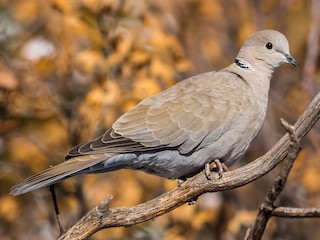
The Eurasian Collared Dove is a medium-sized dove, notably smaller and more slender than a domestic pigeon but larger than a Turtle Dove. It is characterized by its pale grey-buff plumage, black half-collar on the nape, and distinctive three-note cooing call. Originally native to Asia, it has undergone a remarkable and rapid expansion across Europe and North America in the last century, becoming a common sight in urban and suburban environments.
Dimensioni e longevità
- Lunghezza
- 30-33 cm
- Apertura alare
- 47-55 cm
- Peso
- 125-240 g
- Longevità
- Up to 17 years in the wild, typically 3-5 years.
- Dieta
- Granivore (primarily seeds, grains, and cereals), occasionally consumes fruits, berries, and invertebrates.
Caratteristiche fisiche
- Piumaggio
- Overall pale grey-buff to pinkish-grey plumage. The head is slightly paler, almost whitish on the forehead and chin. The back and upperwings are a uniform grey-brown, while the underparts are a lighter grey-pink. The primary flight feathers are darker, almost blackish. The most distinctive feature is the narrow black half-collar bordered with white on the nape (back of the neck). The undertail coverts are white, and the tail is long with a broad white tip on the outer tail feathers, contrasting with a dark grey base.
- Forma del becco
- Slender, short, and dark grey to blackish beak.
- Colore degli occhi
- Dark red iris, often appearing black, surrounded by a narrow white orbital ring.
- Colore delle zampe
- Reddish-purple to dark red.
- Caratteristiche distintive
- Black half-collar on the nape, pale overall plumage, long tail with white outer tips, and a characteristic three-note cooing call.
- Aspetto giovanile
- Juveniles resemble adults but lack the distinct black half-collar, which develops gradually. Their plumage may appear slightly duller and browner, and their legs and eyes may be less intensely colored.
- Cambiamenti stagionali
- No significant seasonal plumage changes. The plumage remains consistent throughout the year.
- Dimorfismo sessuale
- Males and females are virtually identical in plumage and size, making them difficult to distinguish visually in the field.
Come identificare
- 1
Size and Shape
Medium-sized dove, larger than a Turtle Dove but smaller than a Feral Pigeon. Slender body with a relatively long tail.
- 2
Plumage Color
Overall pale grey-buff to pinkish-grey. Look for the uniform, rather plain body color.
- 3
Black Half-Collar
The most distinctive field mark: a narrow black band bordered with white on the back of the neck (nape). This is absent in juveniles.
- 4
Tail Pattern
Long tail with a dark grey base and broad white tips on the outer tail feathers, visible in flight and when perched.
- 5
Call
Listen for the characteristic three-note 'hoo-hoo-hooo' or 'coo-COO-coo' call, with the middle note emphasized.
- 6
Behavior/Habitat
Often seen in urban/suburban areas, parks, gardens, and agricultural lands, frequently feeding on the ground or perching on wires and rooftops.
Habitat e areale
- Biomi
- Temperate forests, grasslands, urban and suburban areas, agricultural lands.
- Areale geografico
- Native to Asia (Indian subcontinent, China, Middle East), it has expanded across Europe, North Africa, and North America. It is now widespread across most of Europe, from Scandinavia to the Mediterranean, and has established populations in the Americas.
- Fascia altitudinale
- Primarily lowlands, but can be found up to 2,000 meters in some parts of its range, especially in agricultural areas.
- Ambienti preferiti
- Highly adaptable, it thrives in human-modified landscapes such as towns, villages, parks, gardens, farmlands, and suburban areas. It prefers open woodlands, scattered trees, and areas with readily available food sources like bird feeders or spilled grain.
Comportamento
- Periodo di attività
- Diurnal, most active during daylight hours, particularly in the morning and late afternoon.
- Abitudini alimentari
- Primarily ground feeders, foraging for seeds, grains, and cereals in open areas. They often feed in flocks, especially outside the breeding season. They are frequent visitors to bird feeders and agricultural fields. They also consume some berries, fruits, and occasionally small invertebrates.
- Comportamento sociale
- Often seen in pairs or small groups, especially during the breeding season. Outside of breeding, they can form larger flocks, particularly around abundant food sources. They are generally not aggressive towards other species but can be territorial during nesting.
- Tipo di volo
- Direct and strong flight with rapid wingbeats. When landing, they often glide with wings held in a shallow 'V' shape. They can be quite agile in flight, especially when evading predators.
- Migrazione
- Mostly resident throughout its range, though some northern populations may undertake short-distance dispersive movements or partial migrations in harsh winters. The species is known for its rapid and extensive range expansion, which is a form of dispersal rather than true migration.
- Territorialità
- Males establish and defend a small territory around the nest site during the breeding season, primarily through cooing displays and occasional chases.
Canto e richiami
- Canto
- The primary 'song' is a distinctive three-note cooing call, often transcribed as 'hoo-hoo-hooo' or 'coo-COO-coo'. The middle note is emphasized and slightly higher pitched. This call is repeated frequently, especially by males during courtship and territorial defense.
- Richiamo
- In addition to the cooing, they emit a harsh, nasal 'krrraah' alarm call when startled or taking flight. They also have a soft 'gurr' or 'purr' sound during courtship or when interacting with mates.
- Quando vocalizza
- Vocalizes year-round, but most frequently and intensely during the breeding season (spring and summer). Calls can be heard throughout the day, often from prominent perches.
Riproduzione
- Stagione riproduttiva
- Highly protracted, often from March to October in temperate regions, and can breed almost year-round in warmer climates or where food is abundant. They can raise multiple broods (2-6) per year.
- Abitudini di nidificazione
- Nests are typically flimsy platforms of twigs, often built in trees, shrubs, or on man-made structures like eaves, window ledges, or utility poles. Both parents participate in nest construction.
- Dimensione della covata
- 2 eggs.
- Descrizione dell'uovo
- Typically 2 white, elliptical eggs, smooth and non-glossy.
- Periodo di incubazione
- 14-18 days, incubated by both parents.
- Periodo di involo
- 15-19 days after hatching. Young leave the nest but are still fed by parents for a short period.
- Cure parentali
- Both male and female share incubation duties and feed the nestlings with 'crop milk' (pigeon milk) initially, transitioning to regurgitated seeds as they grow.
Dove trovarlo
Urban and Suburban Areas
Parks, gardens, residential areas, city centers, and any place with scattered trees and human activity.
Agricultural Lands
Fields with spilled grain, farmyards, and areas around silos.
Bird Feeders
They are frequent visitors to garden bird feeders, especially those offering seeds and grains.
Consigli sul campo
- Listen for the Call. Their distinctive three-note cooing call is often heard before the bird is seen. It's a reliable way to locate them.
- Check Elevated Perches. They often perch on rooftops, utility wires, television aerials, and prominent tree branches.
- Observe Feeding Areas. Look for them foraging on the ground in open areas, especially under bird feeders or near agricultural fields.
- Look for Pairs. During the breeding season, they are often seen in pairs. Outside of breeding, they may form small flocks.
Specie simili
Turtle Dove
Streptopelia turtur
The Turtle Dove is smaller, has a more rufous-brown plumage, and distinctive black and white striped patches on the sides of its neck (not a full collar). Its call is a softer, purring 'turrr-turrr'. It is also a migratory species, unlike the largely resident Collared Dove.
African Collared Dove
Streptopelia roseogrisea
Very similar in appearance and often confused, especially in areas of overlap or where escaped cage birds occur. The African Collared Dove is generally paler, more sandy-colored, and slightly smaller. Its call is a two-note 'coo-coo' rather than the three-note call of the Eurasian Collared Dove. Hybridization can occur where ranges overlap.
Mourning Dove
Zenaida macroura
Found in North America, the Mourning Dove is smaller, more slender, and has a longer, pointed tail. It lacks the black half-collar and has small black spots on its wings. Its call is a mournful 'coo-OO-oo-oo'.
Fatti rapidi
- Global Population Trend:
- Increasing
- Introduced Species:
- Yes (in Europe and North America)
- Dietary Preference:
- Seeds and Grains
- Nesting Material:
- Twigs (often flimsy nests)
- Number of Broods:
- Multiple (2-6) per year
Curiosità
- The Eurasian Collared Dove is one of the most successful avian colonizers in recent history, having spread across Europe from its original Asian range in less than a century, and then colonizing North America from a small introduction in the Bahamas.
- Its rapid expansion is attributed to its adaptability to human environments, its ability to breed multiple times a year, and its generalist diet.
- The species' scientific name 'decaocto' means 'eighteen' in Latin, referring to a Greek myth where a servant girl transformed into a dove that cooed 'decaocto' (18) to lament her low wages of 18 coins.
- Despite its commonality, it was virtually unknown in Western Europe before the 20th century.
Classificazione scientifica
- Regno
- Animalia
- Phylum
- Chordata
- Classe
- Aves
- Ordine
- Columbiformes
- Famiglia
- Columbidae
- Genere
- Streptopelia
- Specie
- Streptopelia decaocto
Esplora Eurasian Collared Dove
Identifica uccelli ovunque
Gratis su iOS, Android e Web. Identificazione per foto e suono, database completo e la tua lista personale.