
Visto un uccello? Identificalo all'istante con l'app Birdby
Apri l'appInformazioni
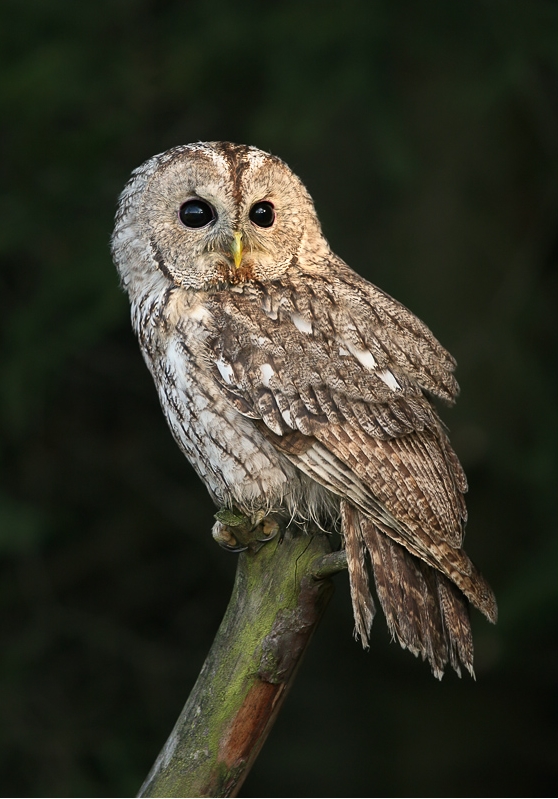
The Tawny Owl, also known as the "Allocco" in Italian, is a medium-sized, robust owl with a large, rounded head and no ear tufts. It is one of the most common and widespread owls in Europe, known for its distinctive hooting call and nocturnal habits. Its cryptic plumage provides excellent camouflage against tree bark, making it difficult to spot during the day.
Dimensioni e longevità
- Lunghezza
- 37-43 cm
- Apertura alare
- 81-96 cm
- Peso
- 380-800 g (females typically larger and heavier than males)
- Longevità
- Up to 18 years in the wild, though average is 4-5 years
- Dieta
- Carnivore, primarily preying on small mammals (voles, mice, shrews, young rabbits), small birds, amphibians, reptiles, and large insects. Occasionally takes fish or earthworms.
Caratteristiche fisiche
- Piumaggio
- Highly variable, typically rufous-brown (red morph) or grey-brown (grey morph) with dark streaking and mottling, providing excellent camouflage. The underparts are paler with dark streaks. The facial disc is prominent, often paler than the rest of the head, with dark concentric rings around the eyes.
- Forma del becco
- Short, strong, and sharply hooked, pale yellowish to horn-colored.
- Colore degli occhi
- Dark brown to black, giving a 'soft' or 'gentle' appearance, unlike the yellow eyes of many other owl species.
- Colore delle zampe
- Feathered down to the toes, which are dark grey with black talons.
- Caratteristiche distintive
- Large, rounded head without ear tufts; dark eyes; cryptic plumage in either grey or rufous morph; prominent facial disc. The lack of ear tufts immediately distinguishes it from species like the Long-eared Owl.
- Aspetto giovanile
- Young birds are covered in fluffy, downy plumage, typically paler and more uniformly greyish or brownish than adults, with less distinct streaking. They gradually acquire adult plumage over their first year.
- Cambiamenti stagionali
- No significant seasonal plumage changes. Plumage remains consistent year-round, though wear and tear can make it appear slightly duller before molting.
- Dimorfismo sessuale
- Females are generally larger and heavier than males, but plumage is identical.
Come identificare
- 1
Size and Shape
Medium-sized, stocky owl with a large, rounded head and no ear tufts. Appears robust.
- 2
Eyes
Distinctive dark brown to black eyes, giving a 'friendly' or 'gentle' expression, unlike the yellow eyes of many other owls.
- 3
Plumage Color
Look for either a rufous-brown (red morph) or grey-brown (grey morph) overall coloration, heavily streaked and mottled, providing excellent camouflage against tree bark.
- 4
Facial Disc
Prominent facial disc, often paler than the rest of the head, with dark concentric rings around the eyes.
- 5
Vocalization
Listen for the male's classic 'hoo-hoo-hoo-hooo' hoot and the female's sharp 'kewick' call, especially at dusk or during the night.
- 6
Habitat
Typically found in woodlands, parks, and mature gardens, often in close proximity to human habitation.
Habitat e areale
- Biomi
- Temperate forests, woodlands, parks, large gardens, urban areas with mature trees.
- Areale geografico
- Widespread across Europe, from the Iberian Peninsula and British Isles eastwards through central Asia to Korea. Also found in parts of North Africa and the Middle East.
- Fascia altitudinale
- Sea level up to 2,500 meters, though most common in lowlands and foothills.
- Ambienti preferiti
- Deciduous and mixed woodlands with old, mature trees for nesting cavities, often near open areas for hunting. Adapts well to suburban and urban environments where suitable trees and prey are available.
Comportamento
- Periodo di attività
- Strictly nocturnal, becoming active at dusk and hunting throughout the night. Roosts during the day, often well-hidden against a tree trunk or in a dense canopy.
- Abitudini alimentari
- Primarily nocturnal hunter, using its acute hearing and excellent night vision to locate prey. Hunts from a perch, swooping down silently to capture prey with its powerful talons. Also capable of hunting on the wing. Pellets (undigested remains) are regularly regurgitated.
- Comportamento sociale
- Monogamous and highly territorial, typically found in pairs. Juveniles disperse from parental territories in late summer/autumn.
- Tipo di volo
- Silent, undulating flight with deep, powerful wingbeats, often close to the ground or through dense woodland. Can be surprisingly agile in confined spaces.
- Migrazione
- Sedentary and non-migratory throughout its range. Individuals typically remain within their breeding territory year-round.
- Territorialità
- Highly territorial, especially during the breeding season. Pairs defend their territory year-round through vocalizations and occasional aggressive encounters with intruders.
Canto e richiami
- Canto
- The classic 'hoo-hoo-hoo-hooo' hoot of the male, often described as a quavering, drawn-out 'kewick-hoo-hoo'. This is a territorial call.
- Richiamo
- The female's call is a sharp, high-pitched 'kewick' or 'ke-wick'. Both sexes also produce a variety of other calls, including 'chup' calls, hisses, and screeches, especially around the nest or when agitated.
- Quando vocalizza
- Most vocal during the breeding season (late winter to early spring) and in autumn when young are dispersing and new territories are being established. Primarily vocal at night, especially at dusk and dawn.
Riproduzione
- Stagione riproduttiva
- February to June, with peak egg-laying in March-April. Can have a second brood if the first fails or if prey is abundant.
- Abitudini di nidificazione
- Nests almost exclusively in tree cavities (e.g., old woodpecker holes, natural hollows), but will also use old raptor nests, squirrel dreys, or artificial nest boxes. No nest material is added, eggs are laid directly on the wood debris.
- Dimensione della covata
- 2-5 eggs, typically 3-4.
- Descrizione dell'uovo
- Typically 2-5 (range 1-7) pure white, spherical eggs, measuring approximately 46 x 39 mm.
- Periodo di incubazione
- 28-30 days, primarily by the female.
- Periodo di involo
- Young leave the nest (branch) at 30-35 days old, but are still dependent on parents for several weeks, often up to 2-3 months, before becoming fully independent.
- Cure parentali
- Female incubates and broods the young, while the male provides food for both the female and the owlets. Both parents defend the nest aggressively.
Dove trovarlo
Deciduous and Mixed Woodlands
Look in areas with mature trees, especially those with old growth and potential nesting cavities.
Urban Parks and Gardens
Many Tawny Owls thrive in urban environments with large, old trees, often going unnoticed during the day.
Cemeteries and Churchyards
These often contain mature trees and quiet spaces, providing ideal habitat.
Consigli sul campo
- Listen at Dusk and Dawn. The best time to hear Tawny Owls is at dusk or dawn, particularly during the breeding season (late winter/early spring) and autumn.
- Look for Pellets. Check the base of large trees for owl pellets (regurgitated indigestible prey remains), which indicate an owl roosting site above.
- Scan Tree Trunks. During the day, they roost motionless, often pressed against a tree trunk. Their cryptic plumage makes them incredibly difficult to spot, so look very carefully for an unusual shape or outline.
- Use a Flashlight at Night (Ethically). If you hear an owl calling at night, a low-powered flashlight can sometimes help locate it, but avoid disturbing the bird with bright or prolonged light.
- Check for Mobbing Birds. Small birds like jays, blackbirds, and tits will often mob a roosting owl during the day, drawing attention to its location.
Specie simili
Long-eared Owl
Asio otus
The Tawny Owl lacks ear tufts, has dark eyes, and a more rounded head. The Long-eared Owl has prominent ear tufts, orange eyes, and a more slender build. Their calls are also distinctly different.
Short-eared Owl
Asio flammeus
The Tawny Owl is a woodland species with dark eyes and no ear tufts. The Short-eared Owl is a diurnal/crepuscular open-country species with yellow eyes and very small, often inconspicuous, ear tufts. Plumage patterns are also different.
Little Owl
Athene noctua
The Tawny Owl is significantly larger. The Little Owl is much smaller, has bright yellow eyes, a flattened head, and a more upright posture. It is also more active during the day.
Fatti rapidi
- Primary Activity:
- Nocturnal
- Key Identification Mark:
- Dark eyes, no ear tufts, rounded head
- Diet Focus:
- Small mammals
- Nesting Site:
- Tree cavities
- Conservation Status:
- Least Concern
Curiosità
- The Tawny Owl's hoot is one of the most iconic sounds of the European night, often associated with mystery and wisdom.
- Despite being a woodland bird, Tawny Owls are highly adaptable and can thrive in urban environments, often nesting in parks and large gardens.
- They are fiercely territorial, and pairs will often remain in the same territory for their entire lives.
- The two main plumage morphs (grey and rufous) are genetically determined and can occur within the same brood.
- Tawny Owls have asymmetrical ear openings, which helps them pinpoint the exact location of prey in complete darkness.
Classificazione scientifica
- Regno
- Animalia
- Phylum
- Chordata
- Classe
- Aves
- Ordine
- Strigiformes
- Famiglia
- Strigidae
- Genere
- Strix
- Specie
- Strix aluco
Esplora Tawny Owl
Identifica uccelli ovunque
Gratis su iOS, Android e Web. Identificazione per foto e suono, database completo e la tua lista personale.