
Visto un uccello? Identificalo all'istante con l'app Birdby
Apri l'appInformazioni
The Zebra Finch (Taeniopygia guttata), known in Italian as Diamante Mandarino, is a small passerine bird native to Australia and Indonesia. It is one of the most popular pet birds worldwide due to its vibrant plumage, active nature, and relatively easy care. In the wild, it is a highly social and adaptable species, thriving in arid and semi-arid grasslands and savannas.
Dimensioni e longevità
- Lunghezza
- 10-12 cm
- Apertura alare
- 15-17 cm
- Peso
- 10-16 g
- Longevità
- 3-5 years (wild), 5-7 years (captivity, up to 10-12 years)
- Dieta
- Granivore (primarily seeds), occasionally insects
Caratteristiche fisiche
- Piumaggio
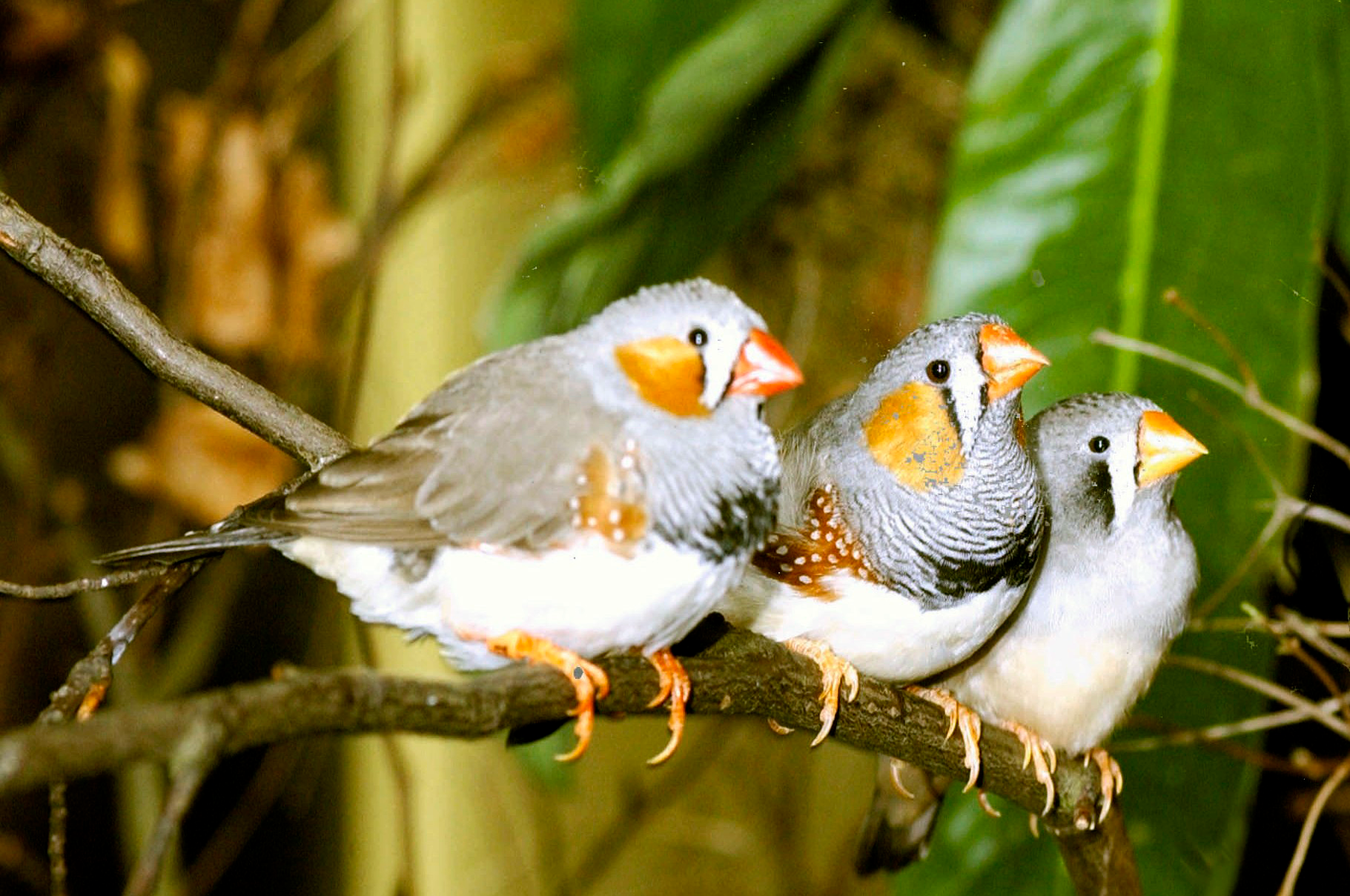
- Males have a distinctive orange cheek patch, zebra-like barring on the throat and upper breast, and chestnut flanks with white spots. The back and wings are grey, and the belly is white. Females are duller, lacking the orange cheek patches and flank markings, with a grey head and breast, and a black tear-drop stripe below the eye. Both sexes have a black tail with white barring.
- Forma del becco
- Conical and stout, bright orange-red in males, duller orange in females and juveniles.
- Colore degli occhi
- Reddish-brown
- Colore delle zampe
- Orange
- Caratteristiche distintive
- The most distinctive features are the male's orange cheek patches and flank spots, and the zebra-like barring on the throat. The tear-drop stripe below the eye is present in both sexes but more prominent in females.
- Aspetto giovanile
- Juveniles resemble females but have a black beak that gradually turns orange over several weeks. Their plumage is generally duller, and the characteristic markings are less defined.
- Cambiamenti stagionali
- No significant seasonal plumage changes. Plumage remains consistent year-round.
- Dimorfismo sessuale
- Pronounced. Males are more brightly colored with orange cheek patches, chestnut flanks with white spots, and zebra barring on the throat. Females lack these features, being predominantly grey and white with a duller beak.
Come identificare
- 1
Size and Shape
Small, plump finch with a short, conical beak and a relatively short tail.
- 2
Male Plumage
Look for the bright orange cheek patches, the black and white 'zebra' barring on the throat and upper breast, and the chestnut flanks with white spots. The beak is bright orange-red.
- 3
Female Plumage
Females are duller, lacking the orange cheek patches and flank markings. They have a grey head and breast, a prominent black tear-drop stripe below the eye, and a duller orange beak.
- 4
Juvenile Plumage
Young birds resemble females but have a black beak that gradually changes to orange. Their markings are less distinct.
- 5
Vocalizations
Listen for the male's complex, chattering song and the characteristic 'teet' or 'tew' contact calls.
- 6
Behavior
Observe their highly social nature, often seen foraging in active flocks on the ground, especially near water.
Habitat e areale
- Biomi
- Grasslands, savannas, shrublands, open woodlands, arid and semi-arid regions.
- Areale geografico
- Native to Australia (widespread across most of the continent, excluding coastal areas of the east and south) and the Lesser Sunda Islands (Indonesia). Introduced populations exist in Puerto Rico, Portugal, and the United States.
- Fascia altitudinale
- Typically found from sea level up to approximately 1,000 meters.
- Ambienti preferiti
- Prefers open country with scattered trees and shrubs, often near water sources. They are highly adaptable and can be found in agricultural areas, suburban gardens, and even urban parks where suitable vegetation and water are available.
Comportamento
- Periodo di attività
- Diurnal, most active during the cooler parts of the day, morning and late afternoon.
- Abitudini alimentari
- Primarily ground feeders, foraging for seeds of grasses and herbaceous plants. They will also consume small insects, especially during breeding season to supplement protein for chicks. They often feed in large flocks.
- Comportamento sociale
- Highly social birds, typically found in flocks ranging from a few individuals to hundreds, especially around water sources. They are monogamous, forming strong pair bonds.
- Tipo di volo
- Fast, direct, and undulating flight, often in tight flocks. They are agile fliers, especially when navigating through dense vegetation.
- Migrazione
- Resident throughout their range, but may undertake local nomadic movements in response to rainfall and food availability, particularly in arid regions.
- Territorialità
- Generally not territorial outside of the immediate vicinity of their nest during breeding. Flocks share foraging grounds peacefully.
Canto e richiami
- Canto
- The male's song is a complex, variable series of short, high-pitched 'beep' notes, trills, and whistles, often described as a 'meep-meep-meep' followed by a series of rapid, chattering notes. Each male develops a unique song, often learning from its father or other males in the flock.
- Richiamo
- Common calls include a distinctive, loud, nasal 'teet' or 'tew' call, used for contact within the flock. Alarm calls are sharper and more urgent. Females typically produce a simpler 'quip' or 'whitt' call.
- Quando vocalizza
- Vocalize frequently throughout the day, especially when foraging, interacting with flock members, or during courtship displays.
Riproduzione
- Stagione riproduttiva
- Highly opportunistic, breeding primarily after rainfall in arid regions, which can occur at any time of year. In more temperate areas, breeding typically occurs during spring and autumn.
- Abitudini di nidificazione
- Nests are typically flask-shaped or dome-shaped structures with a side entrance, built from grass stems, twigs, and other plant material, lined with soft feathers or wool. They are often placed in dense shrubs, small trees, or even artificial structures like eaves of buildings.
- Dimensione della covata
- 3-7 eggs, commonly 4-6.
- Descrizione dell'uovo
- Small, oval, and pure white. They are typically smooth with no markings.
- Periodo di incubazione
- 11-16 days, typically 12-14 days, shared by both parents.
- Periodo di involo
- 18-21 days after hatching. Young birds are fed by both parents for an additional 1-2 weeks after fledging.
- Cure parentali
- Both parents participate in nest building, incubation, and feeding of the young. They are dedicated parents, often raising multiple broods in a single breeding season.
Dove trovarlo
Arid and Semi-arid Grasslands
Widespread across inland Australia, particularly in areas with spinifex and other native grasses.
Shrublands and Open Woodlands
Found in areas with scattered trees and shrubs, providing nesting and roosting sites.
Water Sources
Almost always found near water, as they need to drink frequently. Look around waterholes, dams, and rivers.
Human-modified Landscapes
Can be found in agricultural areas, suburban gardens, and parks, especially where seed-bearing plants are abundant.
Consigli sul campo
- Look for flocks. Zebra Finches are rarely solitary. Scan for groups of small birds foraging on the ground or perched in low vegetation.
- Listen for calls. Their distinctive 'teet' calls and the male's song are often the first indication of their presence.
- Visit waterholes. In arid regions, waterholes are magnets for Zebra Finches, especially in the early morning and late afternoon.
- Observe feeding behavior. Watch for small birds actively pecking at seeds on the ground. Their quick, jerky movements are characteristic.
Specie simili
Double-barred Finch
Taeniopygia bichenovii
The Double-barred Finch has two distinct black bars across its white breast and lacks the orange cheek patches and chestnut flanks of the male Zebra Finch. Its beak is grey, not orange-red.
Plum-headed Finch
Aidemosyne modesta
The Plum-headed Finch has a distinctive plum-colored head in males and a less prominent plum wash in females. It lacks the zebra barring and orange cheek patches of the Zebra Finch. Its overall plumage is more olive-brown.
Fatti rapidi
- Social Structure:
- Highly social, forms large flocks
- Dietary Preference:
- Seeds (granivorous)
- Breeding Strategy:
- Opportunistic, often multiple broods per year
- Vocalization:
- Complex male song, distinct contact calls
- Habitat Adaptability:
- Thrives in arid to semi-arid environments, near water
Curiosità
- Zebra Finches are one of the most studied bird species in the world, particularly for their vocal learning abilities, making them a model organism in neuroscience.
- Male Zebra Finches learn their songs from their fathers or other adult males, and each male develops a unique song, similar to human speech acquisition.
- They are incredibly resilient to arid conditions, capable of surviving long periods without surface water by extracting moisture from seeds and metabolic water.
- Despite their small size, they are prolific breeders, often raising several clutches in quick succession when conditions are favorable.
- In captivity, numerous color mutations have been developed, leading to a wide variety of appearances beyond their wild type.
Classificazione scientifica
- Regno
- Animalia
- Phylum
- Chordata
- Classe
- Aves
- Ordine
- Passeriformes
- Famiglia
- Estrildidae
- Genere
- Taeniopygia
- Specie
- Taeniopygia guttata
Esplora Zebra Finch
Identifica uccelli ovunque
Gratis su iOS, Android e Web. Identificazione per foto e suono, database completo e la tua lista personale.