
Visto un uccello? Identificalo all'istante con l'app Birdby
Apri l'appInformazioni
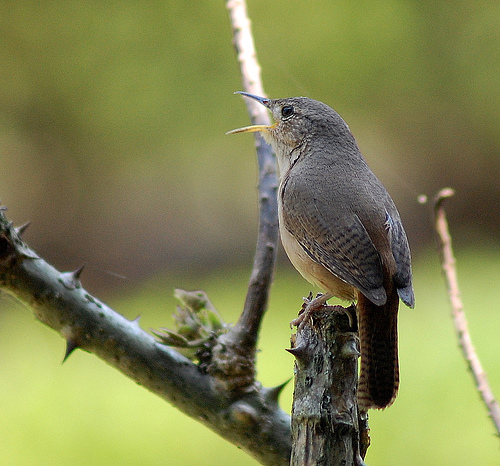
The Wren, or Scricciolo in Italian, is a very small, plump, and short-tailed passerine bird, renowned for its disproportionately loud and complex song. It is one of the most widespread bird species in the Northern Hemisphere, often found in dense undergrowth.
Dimensioni e longevità
- Lunghezza
- 9-10.5 cm
- Apertura alare
- 13-17 cm
- Peso
- 6-12 g
- Longevità
- 2-3 years (up to 7 years in captivity)
- Dieta
- Insectivore
Caratteristiche fisiche
- Piumaggio
- Upperparts are rufous-brown, finely barred with darker brown and black, especially on the wings and tail. Underparts are paler, greyish-brown, also finely barred on the flanks. A distinctive pale supercilium (eyebrow stripe) is present above the eye. The short tail is often held cocked upwards.
- Forma del becco
- Slender, pointed, and slightly decurved; dark brown to blackish.
- Colore degli occhi
- Dark brown.
- Colore delle zampe
- Pale brown to pinkish-brown.
- Caratteristiche distintive
- Its small size, plump body, short cocked tail, and fine barring are highly characteristic. The pale supercilium is also a key feature.
- Aspetto giovanile
- Juveniles resemble adults but may have slightly less distinct barring and a duller overall appearance. The pale supercilium is present but can be less pronounced.
- Cambiamenti stagionali
- No significant seasonal plumage changes. Plumage remains consistent throughout the year.
- Dimorfismo sessuale
- None; males and females are identical in plumage and size.
Come identificare
- 1
Size and Shape
Look for a very small, plump bird with a short, often cocked-up tail. Its overall appearance is compact and rounded.
- 2
Plumage
Note the rufous-brown upperparts with fine dark barring, especially on the wings and tail. The pale supercilium (eyebrow stripe) is a key field mark.
- 3
Behavior
Observe its active, restless movements, constantly flitting through dense undergrowth, often close to the ground. It frequently bobs its head and body.
- 4
Song
Listen for its remarkably loud, complex, and rapid song, which is disproportionate to its size. It's a series of trills and warbles, often ending with a distinctive rattle.
- 5
Habitat
Check dense, tangled vegetation, hedgerows, and woodland undergrowth, particularly near water. They prefer areas with good cover.
Habitat e areale
- Biomi
- Forests, woodlands, scrublands, hedgerows, gardens, parks, riparian zones.
- Areale geografico
- Widespread across Europe, North Africa, Asia (from Siberia to Japan), and North America. It is the only member of the Troglodytidae family found outside the Americas.
- Fascia altitudinale
- Sea level up to 3,000 meters in some mountainous regions, though typically found at lower to mid-elevations.
- Ambienti preferiti
- Prefers dense vegetation, tangled undergrowth, thickets, brambles, and areas with fallen logs and leaf litter, providing cover and abundant insect prey. Often found near water.
Comportamento
- Periodo di attività
- Diurnal, active from dawn to dusk.
- Abitudini alimentari
- Primarily insectivorous, foraging actively among dense vegetation, on the ground, and in crevices. It gleans insects, spiders, and other small invertebrates from leaves, bark, and the ground. Occasionally consumes small berries in winter.
- Comportamento sociale
- Generally solitary or found in pairs during the breeding season. Outside of breeding, they may roost communally in cold weather to conserve heat, sometimes in large numbers.
- Tipo di volo
- Short, rapid, and direct flights, often low to the ground, darting between cover. It rarely flies long distances in the open.
- Migrazione
- Mostly resident throughout much of its range, particularly in milder climates. Northern populations are partially migratory, moving south or to lower elevations in winter. Some individuals undertake short-distance movements.
- Territorialità
- Males are highly territorial during the breeding season, defending their territory with vigorous song. They are often polygynous, with a male sometimes mating with multiple females within his territory.
Canto e richiami
- Canto
- A remarkably loud, complex, and rapid series of trills, warbles, and high-pitched notes, often ending with a distinctive rattling trill. It is delivered with surprising power for such a small bird and can be heard from a considerable distance. The song is often described as 'explosive'.
- Richiamo
- Common calls include a sharp 'tic-tic-tic' or 'churr', often given when alarmed or agitated. A softer 'tseep' contact call is also used.
- Quando vocalizza
- Sings throughout the year, but most frequently and intensely during the breeding season (spring and early summer). Males sing to attract mates and defend territory. Calls are given year-round.
Riproduzione
- Stagione riproduttiva
- Typically April to July, with two or sometimes three broods per year.
- Abitudini di nidificazione
- Males build several 'cock's nests' within their territory, often spherical or domed structures with a side entrance, made of moss, leaves, grass, and spider silk, lined with feathers. The female selects one of these for egg-laying. Nests are usually well-hidden in dense vegetation, tree cavities, or rock crevices.
- Dimensione della covata
- 5-8 eggs
- Descrizione dell'uovo
- 5-8 (occasionally up to 16) small, smooth, glossy white eggs, often sparsely speckled with reddish-brown, particularly at the broader end.
- Periodo di incubazione
- 14-16 days, primarily by the female.
- Periodo di involo
- 15-19 days after hatching. Young are fed by both parents.
- Cure parentali
- Both parents feed the nestlings, though the female does most of the incubation. Males may continue to feed fledglings from the first brood while the female starts a second clutch.
Dove trovarlo
Woodlands and Forests
Look in the understory, especially where there is dense scrub, fallen logs, and thickets.
Gardens and Parks
Often found in well-vegetated gardens, parks, and urban green spaces with good cover.
Hedgerows and Brambles
Excellent places to find Wrens, as they provide both cover and foraging opportunities.
Riparian Zones
Along riverbanks, streams, and ponds with dense vegetation.
Consigli sul campo
- Listen for the song. The Wren's song is its most distinctive feature and often the first indication of its presence. It's surprisingly loud for its size.
- Look low. Wrens spend most of their time foraging in the lower strata of vegetation, often on or very close to the ground.
- Be patient and still. They are shy and quick-moving. Find a good spot near dense cover and wait quietly; they will often emerge briefly.
- Check dense cover. Focus your search on thickets, bramble patches, ivy-covered walls, and piles of brushwood.
Specie simili
Eurasian Nuthatch
Sitta europaea
While also small and active, the Nuthatch has a longer, straighter bill, a blue-grey back, and a distinctive black eye-stripe. It climbs head-first down tree trunks, a behavior not seen in the Wren. The Wren is much smaller and has a cocked tail.
Goldcrest
Regulus regulus
The Goldcrest is even smaller than the Wren and has a distinctive yellow/orange crown stripe bordered by black. It lacks the Wren's prominent supercilium and fine barring, and its tail is not typically cocked.
Firecrest
Regulus ignicapilla
Similar to the Goldcrest in size and shape, the Firecrest has a more vibrant orange crown stripe, a black eye-stripe, and a white supercilium, but it lacks the Wren's overall brown coloration and characteristic shape.
Fatti rapidi
- Smallest European Bird (by weight):
- Often considered the smallest bird in Europe by weight, though the Goldcrest is slightly lighter on average.
- Loudest Song for Size:
- Possesses one of the loudest songs relative to its body size among all birds.
- Cocked Tail:
- Its habit of holding its short tail cocked vertically is a very distinctive posture.
- Polygynous:
- Males often mate with multiple females within their territory.
- Communal Roosting:
- Known to roost communally in large numbers during cold winter nights to share body heat.
Curiosità
- The Wren is the national bird of the United Kingdom, though this is often mistakenly attributed to the Robin.
- Despite its small size, a male Wren can build multiple nests (up to 12) in his territory to attract females.
- In some folklore, the Wren is known as the 'King of Birds' due to a fable where it outsmarted an eagle by hiding on its back and flying higher.
- Its scientific name, Troglodytes, means 'cave-dweller', referring to its habit of nesting and foraging in dark, hidden places.
Classificazione scientifica
- Regno
- Animalia
- Phylum
- Chordata
- Classe
- Aves
- Ordine
- Passeriformes
- Famiglia
- Troglodytidae
- Genere
- Troglodytes
- Specie
- Troglodytes troglodytes
Esplora Wren
Identifica uccelli ovunque
Gratis su iOS, Android e Web. Identificazione per foto e suono, database completo e la tua lista personale.