
Visto un uccello? Identificalo all'istante con l'app Birdby
Apri l'appInformazioni
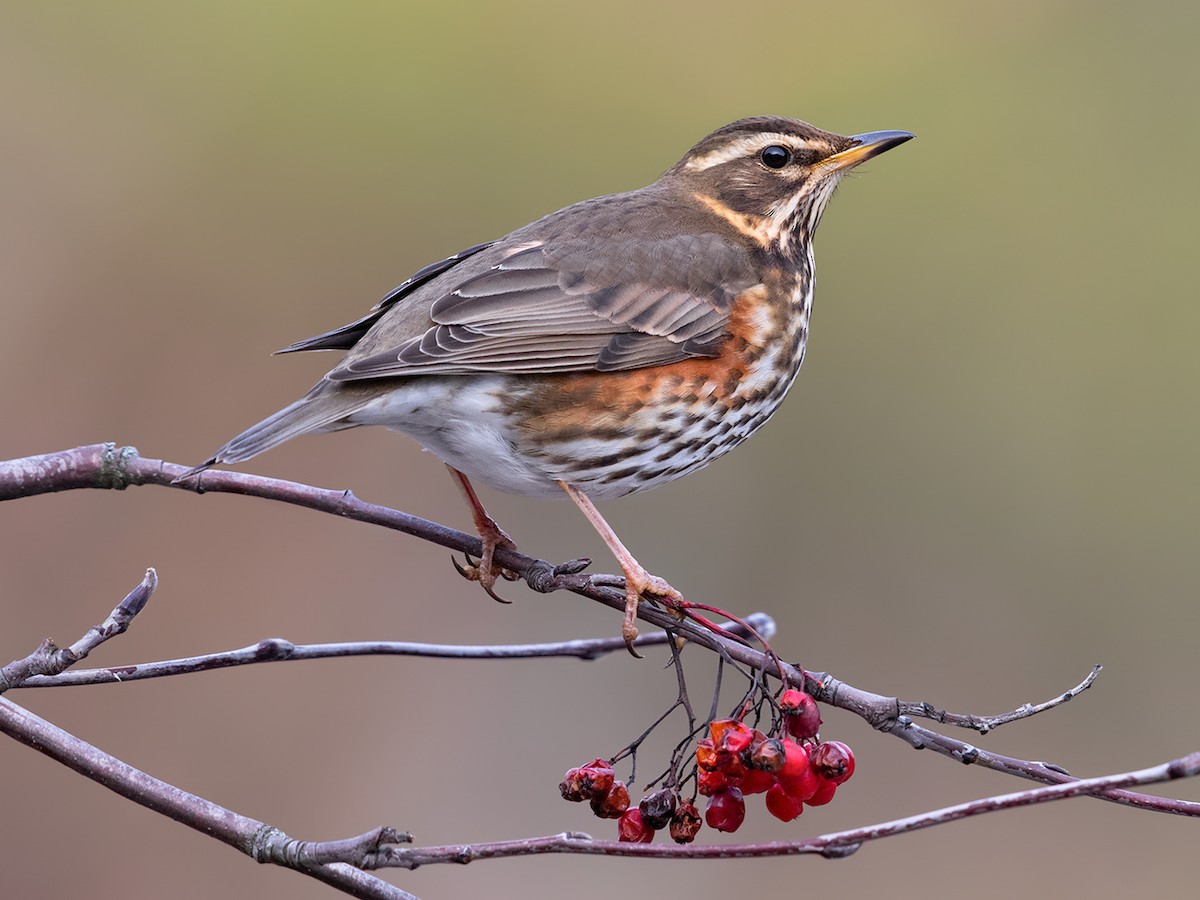
The Redwing is a small thrush, easily recognized by its prominent creamy supercilium and reddish-orange flanks and underwing coverts. It is a migratory species, breeding in northern Europe and Asia and wintering in central and southern Europe, North Africa, and parts of the Middle East. Known for its melodious song and distinctive 'tseep' call, it often forms large flocks outside the breeding season.
Dimensioni e longevità
- Lunghezza
- 20-24 cm
- Apertura alare
- 33-35 cm
- Peso
- 50-75 g
- Longevità
- 2-5 years (up to 10 years recorded)
- Dieta
- Omnivore (primarily invertebrates and berries)
Caratteristiche fisiche
- Piumaggio
- Upperparts are uniformly brown. Underparts are whitish with heavy dark streaking on the breast and flanks. The most distinctive features are the prominent creamy-white supercilium (eyebrow stripe) and the reddish-orange patches on the flanks and underwing coverts, visible in flight or when perched with wings slightly raised.
- Forma del becco
- Slender, pointed, dark brown to black with a yellowish base to the lower mandible.
- Colore degli occhi
- Dark brown.
- Colore delle zampe
- Pale pinkish-brown to yellowish-brown.
- Caratteristiche distintive
- Creamy supercilium, reddish-orange flanks and underwing coverts, streaked breast and flanks.
- Aspetto giovanile
- Juveniles are similar to adults but have a more mottled or spotted appearance on the upperparts and breast, with less distinct streaking. The supercilium may be less pronounced, and the reddish flanks can be duller.
- Cambiamenti stagionali
- No significant seasonal plumage changes. Plumage may appear slightly duller or more worn towards the end of the breeding season before the annual molt.
- Dimorfismo sessuale
- Males and females are virtually identical in plumage.
Come identificare
- 1
Supercilium
Look for the prominent creamy-white stripe above the eye, extending from the bill to behind the eye. This is a key field mark.
- 2
Flanks and Underwing
Observe the sides of the body and the underside of the wings. The reddish-orange coloration on the flanks and underwing coverts is diagnostic, especially when the bird is in flight or stretches its wings.
- 3
Breast Streaking
Note the heavy, dark streaking on the whitish breast and flanks, which contrasts with the plainer brown upperparts.
- 4
Size and Shape
It's a relatively small, slender thrush, smaller than a Blackbird but larger than a Robin. Its posture is often more upright than a Song Thrush.
- 5
Call
Listen for its distinctive, high-pitched 'tseep' call, especially when birds are flying overhead during migration or in winter flocks.
Habitat e areale
- Biomi
- Boreal forests, taiga, subarctic scrub, open woodlands, parks, gardens, agricultural land, heathland.
- Areale geografico
- Breeds across northern Europe and northern Asia, from Iceland and Scandinavia eastward through Siberia. Winters in western, central, and southern Europe, North Africa, and parts of the Middle East (e.g., Turkey, Iran).
- Fascia altitudinale
- Typically breeds at lower to mid-elevations, but can be found up to 1,000 meters in some areas. In wintering grounds, it is generally found in lowlands.
- Ambienti preferiti
- During breeding, prefers coniferous and mixed woodlands, birch and willow scrub, and open forest edges. In winter, it favors open fields, pastures, orchards, parks, and gardens, often near berry-bearing shrubs and trees.
Comportamento
- Periodo di attività
- Diurnal, active during daylight hours.
- Abitudini alimentari
- Forages on the ground, often in open areas, searching for invertebrates such as earthworms, snails, slugs, and insects. Also consumes a wide variety of berries and fruits, especially in autumn and winter (e.g., hawthorn, rowan, ivy, juniper). May 'thrash' leaf litter to uncover food.
- Comportamento sociale
- During the breeding season, they are territorial and typically solitary or in pairs. Outside the breeding season, they are highly gregarious, forming large, often mixed-species flocks with Fieldfares (Turdus pilaris), especially when foraging or roosting.
- Tipo di volo
- Strong, direct, and undulating flight. Often flies in loose flocks, especially during migration. When flushed, it typically flies a short distance before landing again.
- Migrazione
- A long-distance migratory species. Northern populations are obligate migrants, moving south for the winter. They migrate primarily at night, often in large, vocal flocks. Autumn migration occurs from September to November, and spring migration from March to April.
- Territorialità
- Territorial during the breeding season, with males defending nesting areas through song and displays. Less territorial in wintering grounds, where they forage communally.
Canto e richiami
- Canto
- A beautiful, fluty, and melancholic song, consisting of a series of clear, whistled phrases, often starting with a repeated 'chook-chook-chook' followed by a varied, warbling trill. It can be quite varied and complex, often sung from a prominent perch.
- Richiamo
- The most characteristic call is a thin, high-pitched 'tseep' or 'seep', often given in flight, especially during migration. Also has a chattering 'chook-chook-chook' alarm call, similar to the start of its song, and a soft 'churr' call.
- Quando vocalizza
- Sings primarily during the breeding season (April-July), often at dawn and dusk. Calls are heard year-round, particularly the 'tseep' call during migration and in wintering flocks.
Riproduzione
- Stagione riproduttiva
- April to July, typically one or two broods per season.
- Abitudini di nidificazione
- Nests are usually built in trees or shrubs, often close to the trunk or in a fork, typically 1-5 meters above the ground. The nest is a cup-shaped structure made of grass, moss, twigs, and leaves, lined with mud and fine grass.
- Dimensione della covata
- 3-6 eggs (most commonly 4-5).
- Descrizione dell'uovo
- 3-6 eggs, typically 4-5. Eggs are pale blue or greenish-blue, sparsely spotted or speckled with reddish-brown, particularly at the broader end. Size: approximately 26 x 19 mm.
- Periodo di incubazione
- 11-14 days, primarily by the female.
- Periodo di involo
- 12-15 days after hatching. Young leave the nest before they can fly strongly, often remaining in dense cover nearby.
- Cure parentali
- Both parents feed the nestlings. The female primarily incubates, but both participate in raising the young.
Dove trovarlo
Open Woodlands and Forest Edges
During the breeding season, look in coniferous and mixed forests, especially at the edges or clearings with dense undergrowth.
Parks and Gardens
In winter, they frequently visit urban and suburban parks and gardens, particularly those with berry-bearing trees and shrubs.
Agricultural Fields and Pastures
Wintering Redwings often forage in open agricultural land, especially after ploughing, searching for invertebrates.
Heathland and Scrub
Breeding birds can be found in subarctic scrub and heathland areas in their northern range.
Consigli sul campo
- Listen for calls. The high-pitched 'tseep' call is often the first indication of Redwings, especially during migration or when they are flying overhead in winter.
- Look for flocks. Outside the breeding season, Redwings are highly social. Look for them foraging in large flocks, often mixed with Fieldfares, in open fields or on berry bushes.
- Check berry bushes. In autumn and winter, focus on trees and shrubs laden with berries (e.g., hawthorn, rowan, ivy) as these are prime feeding spots.
- Observe ground foraging. Watch for them hopping on lawns, fields, or under trees, pausing to listen and then probing the ground for worms and insects.
- Dawn and Dusk. During migration, large numbers can be seen and heard flying overhead at dawn and dusk.
Specie simili
Song Thrush
Turdus philomelos
The Song Thrush lacks the prominent creamy supercilium and the reddish-orange flanks of the Redwing. Its underparts are more uniformly spotted with dark V-shaped markings, and its overall coloration is warmer brown. Its call is a sharp 'tsip' rather than the Redwing's 'tseep'.
Mistle Thrush
Turdus viscivorus
The Mistle Thrush is significantly larger and paler overall, with a more upright posture. It has larger, rounder spots on its breast and flanks, and lacks the supercilium and reddish flanks. Its flight is more powerful, and its call is a harsh, rattling 'churr'.
Fieldfare
Turdus pilaris
The Fieldfare is larger than the Redwing, with a distinctive grey head and rump, chestnut back, and heavily spotted breast. It lacks the supercilium and reddish flanks. Often found in mixed flocks with Redwings in winter, but easily distinguished by its grey head and larger size.
Fatti rapidi
- Migration:
- Long-distance migrant
- Sociality:
- Solitary in breeding, highly gregarious in winter
- Distinctive Mark:
- Creamy supercilium and reddish flanks
- Winter Diet:
- Heavy reliance on berries
- Vocalization:
- Melodious song, distinctive 'tseep' call
Curiosità
- Redwings are one of the smallest thrushes in Europe.
- They are known to migrate at night, often covering vast distances.
- In some parts of their wintering range, Redwings can be seen in flocks numbering in the thousands.
- The scientific name 'iliacus' refers to the flanks, highlighting their distinctive reddish patches.
- Their song is often described as one of the most beautiful and melancholic of European thrushes.
Classificazione scientifica
- Regno
- Animalia
- Phylum
- Chordata
- Classe
- Aves
- Ordine
- Passeriformes
- Famiglia
- Turdidae
- Genere
- Turdus
- Specie
- Turdus iliacus
Esplora Redwing
Identifica uccelli ovunque
Gratis su iOS, Android e Web. Identificazione per foto e suono, database completo e la tua lista personale.