
Visto un uccello? Identificalo all'istante con l'app Birdby
Apri l'appInformazioni
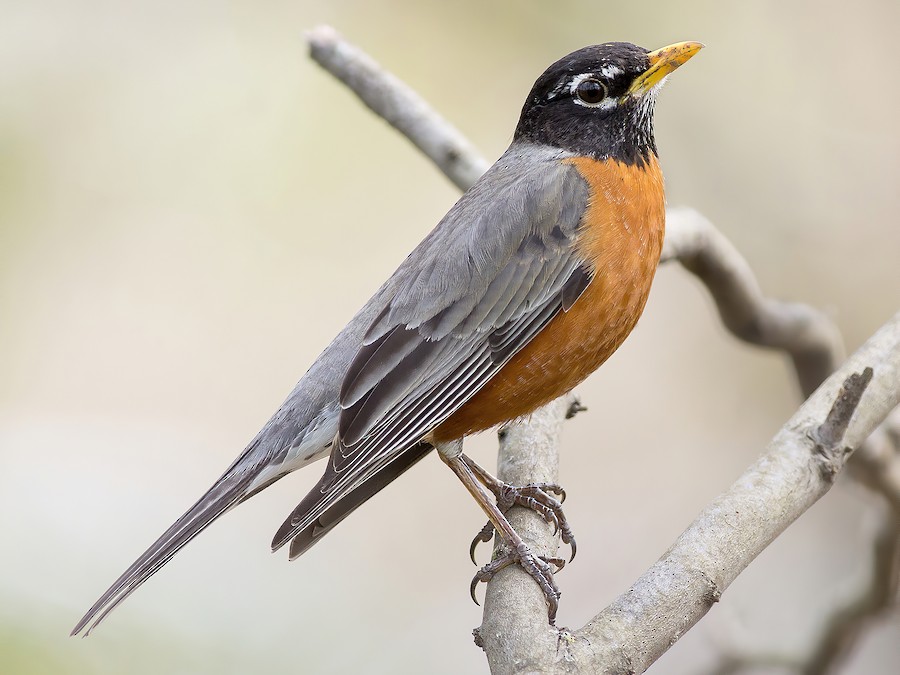
The American Robin is a migratory passerine bird of the thrush family, Turdidae. It is named after the European Robin because of its reddish-orange breast, though the two species are not closely related. It is one of the most widespread and familiar birds in North America, known for its distinctive song and common presence in suburban gardens and parks.
Dimensioni e longevità
- Lunghezza
- 20-28 cm (8-11 in)
- Apertura alare
- 31-41 cm (12-16 in)
- Peso
- 72-94 g (2.5-3.3 oz)
- Longevità
- Average 2 years in the wild, up to 14 years recorded
- Dieta
- Omnivore, primarily insects, earthworms, and fruits
Caratteristiche fisiche
- Piumaggio
- Adults have a dark gray to black head, back, and wings, with a prominent reddish-orange breast and flanks. The lower belly and undertail coverts are white. There is a broken white eye-ring and white streaking on the throat.
- Forma del becco
- Medium-sized, straight, and pointed. Yellow with a dark tip, especially in males during breeding season; can be darker in winter.
- Colore degli occhi
- Dark brown
- Colore delle zampe
- Dark brown to black
- Caratteristiche distintive
- The combination of dark gray upperparts, reddish-orange breast, and white lower belly is highly distinctive. The broken white eye-ring is also a key field mark.
- Aspetto giovanile
- Juveniles have a spotted breast and flanks, with a paler orange wash, and often have pale streaking on the back and head. The spots gradually fade as they mature.
- Cambiamenti stagionali
- Plumage generally remains consistent year-round, though colors may appear slightly duller outside of the breeding season due to feather wear and less intense pigmentation. Males' beaks become brighter yellow with a darker tip during breeding.
- Dimorfismo sessuale
- Males are typically slightly larger and have more vibrant, darker plumage, especially the head and breast, compared to females. Females tend to have duller, paler orange breasts and lighter gray heads and backs.
Come identificare
- 1
Plumage Coloration
Look for the dark gray to black upperparts (head, back, wings) contrasting sharply with the bright reddish-orange breast and flanks. The lower belly is white.
- 2
Eye-ring
Observe the distinct, broken white eye-ring around the dark eye. This is a reliable field mark.
- 3
Size and Shape
It's a medium-sized, plump thrush with a relatively long tail and an upright posture when on the ground.
- 4
Behavior
Watch for its characteristic foraging behavior: running a few steps, stopping abruptly, tilting its head, and then probing the ground with its beak.
- 5
Song
Listen for its cheerful, caroling song, often described as 'cheerily, cheer up, cheerily, cheer up,' especially at dawn.
Habitat e areale
- Biomi
- Forests, woodlands, grasslands, urban and suburban areas, agricultural lands
- Areale geografico
- Breeds across most of North America, from Alaska and Canada south through the United States and into central Mexico. Winters from southern Canada and the northern United States south to Florida, the Gulf Coast, and Mexico.
- Fascia altitudinale
- Sea level up to 3,600 meters (12,000 feet) in mountainous regions.
- Ambienti preferiti
- Highly adaptable, preferring open woodlands, forest edges, parks, gardens, lawns, and agricultural fields with scattered trees. They thrive in areas with a mix of open ground for foraging and trees/shrubs for nesting and cover.
Comportamento
- Periodo di attività
- Diurnal, most active during early morning and late afternoon. Known for singing at dawn.
- Abitudini alimentari
- Forages primarily on the ground, often running a few steps and then stopping abruptly to listen and look for prey. Uses its beak to probe the soil for earthworms and insects. Also consumes a wide variety of fruits and berries, especially in fall and winter. May also catch insects in flight.
- Comportamento sociale
- During the breeding season, they are territorial and typically seen in pairs. Outside of breeding, they can form large flocks, especially during migration and in winter roosts, sometimes numbering in the thousands.
- Tipo di volo
- Strong, direct, and undulating flight over longer distances. Often flies low between trees or across open spaces. When startled, it may fly rapidly to cover.
- Migrazione
- Primarily migratory, though populations in the southern parts of its range and in urban areas may be resident year-round. Northern populations migrate south for the winter, often forming large flocks. Spring migration occurs from February to May, and fall migration from August to November.
- Territorialità
- Males establish and defend breeding territories through song and aggressive displays. Females also participate in nest defense.
Canto e richiami
- Canto
- A rich, musical, and varied song, often described as a 'cheerily, cheer up, cheerily, cheer up' pattern. It consists of clear, whistled phrases, often rising and falling in pitch, delivered in a continuous, caroling manner. Males sing frequently from prominent perches, especially at dawn and dusk.
- Richiamo
- Common calls include a sharp 'peek' or 'tut' alarm call, a rapid 'cuck-cuck-cuck' when agitated, and a soft 'tseep' contact call. During flight, a thin 'seep' call may be heard.
- Quando vocalizza
- Most vocal during the breeding season (spring and early summer), particularly at dawn and dusk. Can be heard singing throughout the day, especially after rain. Alarm calls are given year-round when a threat is perceived.
Riproduzione
- Stagione riproduttiva
- Typically from April to July, with two to three broods common in a season.
- Abitudini di nidificazione
- Nests are typically built in trees, shrubs, or on ledges of buildings, usually 1.5-4.5 meters (5-15 feet) above the ground. The nest is a sturdy cup-shaped structure made of grass, twigs, mud, and lined with fine grasses. The female primarily builds the nest.
- Dimensione della covata
- 3-5 eggs, most commonly 4.
- Descrizione dell'uovo
- Eggs are typically a distinctive 'robin's egg blue' (pale blue to greenish-blue) with no markings. They are oval-shaped.
- Periodo di incubazione
- 12-14 days, primarily by the female.
- Periodo di involo
- 13-14 days after hatching. Young leave the nest before they can fly well and are cared for by both parents for several days to weeks.
- Cure parentali
- Both parents feed the nestlings and fledglings. The male may take over feeding the first brood while the female starts a second nest.
Dove trovarlo
Suburban and Urban Areas
Commonly found in parks, gardens, lawns, and residential areas where there are open grassy spaces for foraging and trees/shrubs for cover and nesting.
Forest Edges and Open Woodlands
Look along the edges of forests, in clearings, and in open deciduous or mixed woodlands.
Agricultural Lands
Can be found in fields and orchards, especially where there are scattered trees or hedgerows.
Consigli sul campo
- Listen for their song. Their distinctive, cheerful song is often the first indication of their presence, especially in the early morning or late afternoon.
- Observe foraging behavior. Watch open grassy areas for their characteristic stop-and-go foraging, often followed by head-tilting and probing for earthworms.
- Check fruit trees and berry bushes. In fall and winter, they often congregate in trees and bushes laden with fruits and berries.
- Look for winter roosts. During winter, they can form very large communal roosts in dense evergreen trees or thickets. These can be spectacular to observe at dusk.
Specie simili
Varied Thrush
Ixoreus naevius
The Varied Thrush has a similar thrush shape and some orange on the breast, but it has a distinct black breast band, an orange supercilium (eyebrow stripe), and a darker, more mottled back. Its song is also very different, consisting of a single, long, ethereal note.
Rufous-backed Robin
Turdus rufopalliatus
Found primarily in Mexico and occasionally in the southwestern US. It has a rufous (reddish-brown) back, contrasting with the American Robin's gray back. Its head is also typically darker than its back, and the breast color is similar.
Eastern Bluebird
Sialia sialis
While also having a reddish breast, the Eastern Bluebird is smaller, has bright blue upperparts (not gray), and a white belly. Its posture and foraging behavior are also distinct.
Fatti rapidi
- Iconic Status:
- State bird of Connecticut, Michigan, and Wisconsin.
- Dietary Shift:
- Primarily insectivorous in spring/summer, shifting to frugivorous in fall/winter.
- Early Bird:
- Often one of the first birds to sing at dawn, earning it the nickname 'early bird'.
- Mud Nests:
- Uses mud as a key structural component in its nest, making it very sturdy.
- Migration:
- Despite its name 'migratorius', some populations are resident, especially in urban areas where food is available year-round.
Curiosità
- The American Robin is not closely related to the European Robin (Erithacus rubecula), despite sharing a similar common name and reddish breast. They belong to different genera and even different subfamilies within the thrush family.
- Robins have excellent hearing and vision, which they use to detect earthworms moving underground. They often tilt their heads to better pinpoint the location of prey.
- During severe winter weather, American Robins can enter a state of torpor, a temporary reduction in metabolic rate and body temperature, to conserve energy.
- They are known to eat a wide variety of berries, including those that are toxic to humans, such as those from poison ivy and sumac.
- American Robins are often seen pulling earthworms from lawns, a behavior that has made them a familiar sight in many backyards across North America.
Classificazione scientifica
- Regno
- Animalia
- Phylum
- Chordata
- Classe
- Aves
- Ordine
- Passeriformes
- Famiglia
- Turdidae
- Genere
- Turdus
- Specie
- Turdus migratorius
Esplora American Robin
Identifica uccelli ovunque
Gratis su iOS, Android e Web. Identificazione per foto e suono, database completo e la tua lista personale.