
Visto un uccello? Identificalo all'istante con l'app Birdby
Apri l'appInformazioni
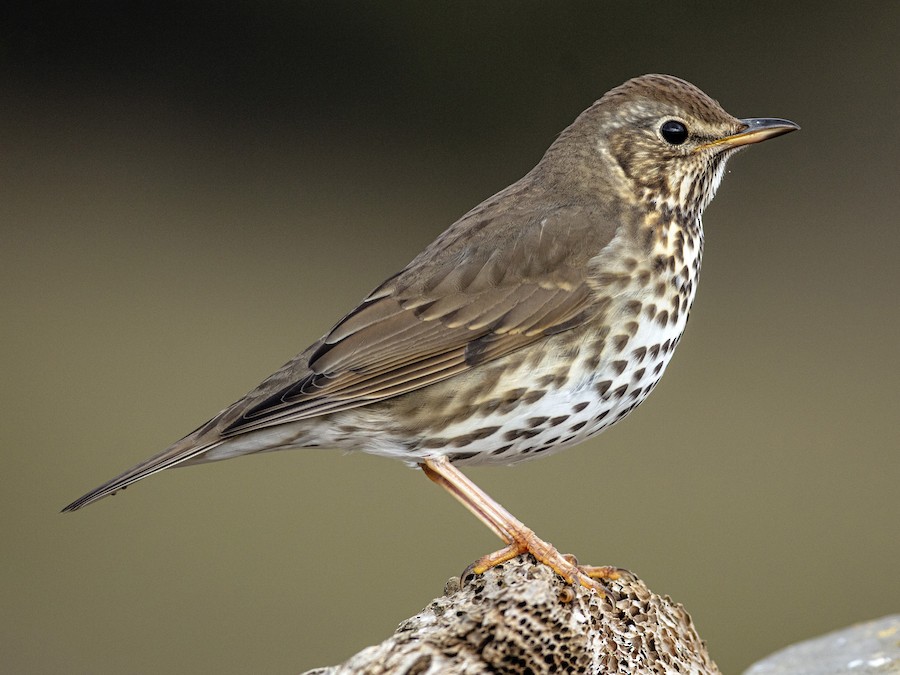
The Song Thrush, known in Italian as 'Tordo bottaccio', is a medium-sized passerine bird renowned for its beautiful and varied song. It is a common and widespread species across much of Eurasia, inhabiting woodlands, gardens, and parks. Its distinctive spotted breast and habit of smashing snails on stones are key identification features.
Dimensioni e longevità
- Lunghezza
- 20-23 cm
- Apertura alare
- 33-36 cm
- Peso
- 50-107 g
- Longevità
- Typically 2-3 years in the wild, up to 10 years recorded.
- Dieta
- Omnivore, primarily insectivorous and molluscivorous, especially during breeding season. Also consumes berries and fruits.
Caratteristiche fisiche
- Piumaggio
- Upperparts are uniformly warm brown, often with a rufous tinge. Underparts are pale cream to buff, heavily marked with distinct, dark brown, arrow-shaped or triangular spots that extend from the throat down to the flanks. The flanks often show a warmer, buffy wash. The undertail coverts are typically unspotted white.
- Forma del becco
- Medium-length, slender, and pointed. Dark brown to blackish on the upper mandible, paler yellowish-horn at the base of the lower mandible.
- Colore degli occhi
- Dark brown.
- Colore delle zampe
- Pinkish-brown to yellowish-brown.
- Caratteristiche distintive
- The combination of warm brown upperparts, heavily spotted pale underparts with distinct arrow-shaped spots, and the lack of a prominent supercilium (eyebrow stripe) are key. The underwing coverts are rufous-orange, visible in flight.
- Aspetto giovanile
- Juveniles resemble adults but have paler, more streaky upperparts with buff spots and streaks, giving them a slightly scaly appearance. The spotting on the underparts is generally less defined and more diffuse than in adults.
- Cambiamenti stagionali
- No significant seasonal plumage changes. Plumage may appear slightly duller or more worn towards the end of the breeding season before the annual molt.
- Dimorfismo sessuale
- None. Males and females are outwardly identical in plumage and size.
Come identificare
- 1
Plumage Pattern
Look for warm brown upperparts and a pale, heavily spotted breast and flanks. The spots are typically dark brown and arrow-shaped or triangular.
- 2
Underwing Color
In flight, observe the rufous-orange underwing coverts, a key distinguishing feature from other thrushes.
- 3
Song
Listen for its characteristic, rich, and varied song, with phrases often repeated 2-4 times. This is one of the most reliable identification methods.
- 4
Behavior
Watch for its foraging behavior on the ground, particularly the 'snail-smashing' habit against a stone anvil.
- 5
Size and Shape
Note its medium size, relatively compact body, and upright stance when alert.
Habitat e areale
- Biomi
- Temperate forests, woodlands, parks, gardens, hedgerows, orchards, and suburban areas.
- Areale geografico
- Widespread across Europe, North Africa, and Asia, from Ireland and Portugal east to Siberia. Introduced to Australia and New Zealand.
- Fascia altitudinale
- From sea level up to 2,000 meters, occasionally higher in some mountainous regions.
- Ambienti preferiti
- Prefers areas with dense undergrowth for nesting and foraging, often near open ground for feeding. Requires access to damp soil for invertebrates and hard surfaces (stones) for snail-smashing.
Comportamento
- Periodo di attività
- Diurnal, most active during early morning and late afternoon.
- Abitudini alimentari
- Forages primarily on the ground, hopping and pausing to listen for prey. Known for its distinctive method of breaking snail shells by repeatedly smashing them against a 'thrashing stone' or anvil. Diet includes earthworms, slugs, snails, insects (beetles, caterpillars), spiders, and various berries and fruits, especially in autumn and winter.
- Comportamento sociale
- Generally solitary or in pairs during the breeding season. Outside of breeding, they can form loose flocks, especially during migration or when foraging at abundant food sources (e.g., berry bushes).
- Tipo di volo
- Strong, undulating flight over longer distances. Often flies low between cover. When disturbed, it typically flies rapidly into dense vegetation.
- Migrazione
- Northern and eastern populations are migratory, moving south and west to winter in southern Europe, North Africa, and the Middle East. Western and southern European populations are largely resident or undertake short-distance movements. Migrates at night.
- Territorialità
- Males establish and defend breeding territories through song and aggressive displays. Both sexes defend the nest site.
Canto e richiami
- Canto
- One of the most celebrated bird songs in Europe. A rich, loud, and varied song consisting of short, repeated phrases, often with each phrase repeated 2-4 times before moving to a new one. Phrases are clear, fluty, and melodious, incorporating mimicry of other birds. Often sings from a prominent perch.
- Richiamo
- Common calls include a sharp, explosive 'tsip' or 'chup' contact call, especially in flight or when alarmed. Also a thin, high-pitched 'seep' call during migration. An alarm call is a harsh 'chook-chook-chook'.
- Quando vocalizza
- Sings most actively from late winter through early summer, primarily at dawn and dusk, but also throughout the day. Migratory calls are heard during migration periods.
Riproduzione
- Stagione riproduttiva
- Typically March to July, with two to three broods per season.
- Abitudini di nidificazione
- The nest is a neat, cup-shaped structure built by the female, usually in a bush, hedge, or tree fork, often well-hidden. It is constructed from grass, moss, twigs, and leaves, lined internally with a distinctive smooth, hard layer of mud, rotten wood, and saliva, giving it a 'plastered' appearance.
- Dimensione della covata
- 3-6 eggs.
- Descrizione dell'uovo
- 3-6 (typically 4-5) eggs per clutch. Eggs are smooth, glossy, and bright blue, often with sparse, fine black or dark brown spots, particularly at the broader end.
- Periodo di incubazione
- 11-15 days, primarily by the female.
- Periodo di involo
- 12-15 days after hatching. Young leave the nest before they can fly strongly.
- Cure parentali
- Both parents feed the nestlings and fledglings. The female primarily incubates, while the male often brings food to her on the nest.
Dove trovarlo
Gardens and Parks
Common in suburban and urban green spaces, especially those with mature trees, shrubs, and open lawns.
Woodlands and Forests
Found in deciduous and mixed woodlands, particularly at the edges or in areas with good undergrowth.
Hedgerows and Orchards
These provide excellent cover for nesting and foraging opportunities for insects and fruits.
Consigli sul campo
- Listen for the Song. The Song Thrush's distinctive, repetitive song is often the first indication of its presence. Listen for it from prominent perches in trees or on rooftops, especially at dawn and dusk.
- Look for Snail Anvils. Search for 'thrashing stones' – larger stones or rocks with broken snail shells scattered around them. This is a clear sign of Song Thrush activity.
- Observe Foraging Behavior. Watch open ground, lawns, and leaf litter for thrushes hopping and pausing, listening for invertebrates. They are often quite bold in gardens.
- Check Berry Bushes. In autumn and winter, check berry-laden bushes and trees, as Song Thrushes will feed on fruits.
Specie simili
Mistle Thrush
Turdus viscivorus
The Mistle Thrush is larger, paler, and greyer overall, with rounder, bolder spots on the breast and flanks that are less arrow-shaped. It has a more upright posture, a longer tail, and prominent white undertail coverts. Its flight is more powerful and direct. The song is less varied and more melancholic, often described as fluty but repetitive phrases, typically sung from a high perch in windy weather.
Redwing
Turdus iliacus
The Redwing is smaller than the Song Thrush and has a prominent creamy-white supercilium (eyebrow stripe) and a distinctive rufous-red flank patch, which is absent in the Song Thrush. Its underparts are also spotted, but the pattern is generally finer and less extensive. The song is a fluty, melancholic warble, less varied than the Song Thrush's, and its call is a distinctive 'tseep'.
Fieldfare
Turdus pilaris
The Fieldfare is larger and more upright than the Song Thrush. It has a distinctive grey head and rump, a chestnut back, and a black tail. Its breast is rufous-orange with heavy streaking, and its flanks are heavily spotted. It lacks the uniform brown upperparts of the Song Thrush. Its call is a harsh 'chack-chack-chack'.
Fatti rapidi
- Distinguishing Song:
- Known for repeating musical phrases 2-4 times.
- Snail Specialist:
- Uses 'anvil stones' to break snail shells.
- Underwing Color:
- Rufous-orange underwings visible in flight.
- Nest Lining:
- Nests have a distinctive smooth, plastered mud lining.
- Egg Color:
- Bright blue eggs with sparse black spots.
Curiosità
- The Song Thrush is one of the few birds known to use tools, specifically stones, to break open the shells of snails.
- Its song is so complex and varied that it can incorporate mimicry of other bird species, though it's less known for this than the Mistle Thrush.
- In some cultures, the Song Thrush's arrival in spring is seen as a harbinger of good weather and new beginnings.
- Despite its widespread distribution, populations have declined in some areas, particularly in Western Europe, due to habitat loss and changes in agricultural practices.
Classificazione scientifica
- Regno
- Animalia
- Phylum
- Chordata
- Classe
- Aves
- Ordine
- Passeriformes
- Famiglia
- Turdidae
- Genere
- Turdus
- Specie
- Turdus philomelos
Esplora Song Thrush
Identifica uccelli ovunque
Gratis su iOS, Android e Web. Identificazione per foto e suono, database completo e la tua lista personale.