
Nampak burung? Kenal pasti serta-merta dengan aplikasi Birdby
Buka aplikasiTentang
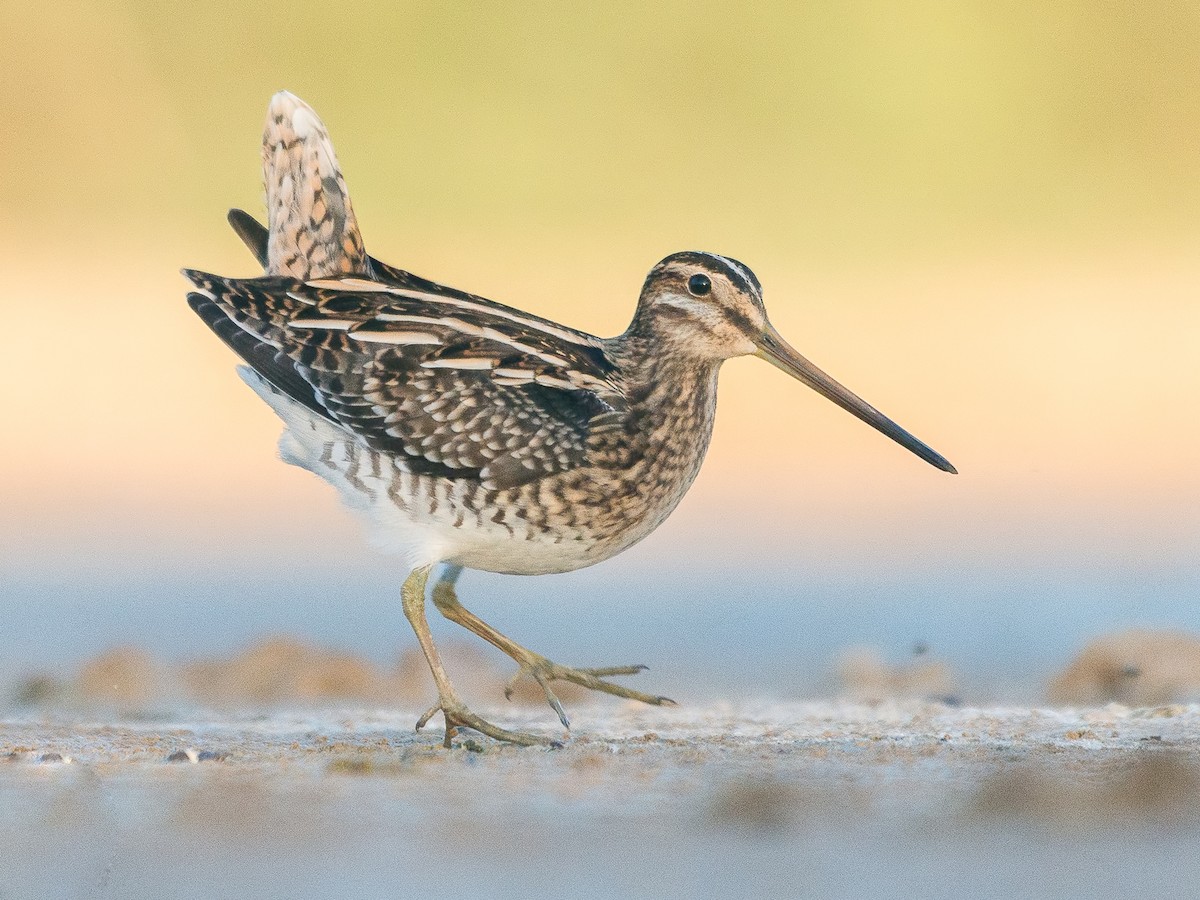
The Common Snipe, often referred to as 'Bekas' in some regions, is a medium-sized, cryptically plumaged wading bird with a remarkably long, straight bill. It is known for its elusive nature, preferring well-vegetated wetlands, and its distinctive 'drumming' display flight.
Saiz dan jangka hayat
- Panjang
- 23-28 cm (9.1-11.0 in)
- Bentang sayap
- 39-45 cm (15.4-17.7 in)
- Berat
- 80-140 g (2.8-4.9 oz), with some individuals up to 180 g
- Jangka hayat
- Typically 2-5 years in the wild, with a maximum recorded age of over 10 years.
- Pemakanan
- Insectivore, primarily feeding on invertebrates found in soft mud.
Ciri-ciri fizikal
- Bulu
- Upperparts are mottled and streaked with dark brown, black, and rufous, providing excellent camouflage. The underparts are whitish with streaking on the flanks and breast. It has prominent buffy-white stripes on its head: a median crown stripe, superciliary stripes, and malar stripes. The back shows four distinct buffy-yellow longitudinal stripes (tramlines) formed by the edges of the scapulars. The tail is short, wedge-shaped, and typically shows rufous-orange outer tail feathers, especially visible in flight.
- Bentuk paruh
- Extremely long (6-7 cm), straight, and slender, dark brown to blackish, with a slightly paler base to the lower mandible. The tip is flexible and sensitive, used for probing.
- Warna mata
- Dark brown.
- Warna kaki
- Greenish-grey to yellowish-green.
- Ciri-ciri pembeza
- Long bill, cryptic plumage with prominent head stripes and 'tramlines' on the back, short legs, and a distinctive zig-zag flight pattern when flushed.
- Rupa muda
- Juveniles resemble adults but often have slightly duller plumage, with less distinct buffy-yellow 'tramlines' on the back and sometimes finer streaking on the breast.
- Perubahan bermusim
- No significant seasonal plumage changes. Breeding and non-breeding plumages are essentially identical.
- Dimorfisme seksual
- Males and females are generally monomorphic in plumage and size, making them difficult to distinguish visually in the field.
Cara mengenal pasti
- 1
Overall Appearance
Look for a medium-sized, plump wader with a very long, straight bill and short legs. Its cryptic brown, black, and buff streaked plumage provides excellent camouflage.
- 2
Head Pattern
Note the distinctive head stripes: a pale median crown stripe, pale superciliary stripes (above the eye), and dark eye-stripe. This 'striped head' pattern is a key field mark.
- 3
Back Pattern ('Tramlines')
Observe the four prominent buffy-yellow longitudinal stripes running down the back, formed by the pale edges of the scapular feathers. These 'tramlines' are diagnostic.
- 4
Flight Pattern
When flushed, its explosive, erratic, zig-zag flight, often accompanied by a sharp 'scape!' call, is highly characteristic. In display, listen for the unique 'drumming' sound.
- 5
Tail
In flight, the short, wedge-shaped tail often shows rufous-orange outer tail feathers, which can be a useful distinguishing feature from Great Snipe.
- 6
Behavior
Its secretive nature, preference for dense wetland vegetation, and habit of probing in mud are strong indicators.
Habitat dan taburan
- Biom
- Wetlands, marshes, bogs, fens, wet meadows, tundra, and damp grasslands.
- Taburan geografi
- Holarctic breeding range, encompassing much of northern Europe, Asia, and North America. Winters in southern Europe, Africa, South Asia, and Central and South America.
- Julat ketinggian
- Typically found from sea level up to 2,000 meters (6,500 feet), occasionally higher in some mountainous regions.
- Persekitaran pilihan
- Areas with shallow water, soft mud, and dense emergent vegetation (e.g., sedges, rushes, grasses) for cover and foraging. Requires open areas for display flights.
Tingkah laku
- Masa aktif
- Primarily crepuscular and nocturnal, especially during migration and foraging. Can be active during the day, particularly in overcast conditions or during the breeding season.
- Tabiat makan
- Probes soft mud and shallow water with its long bill, using its sensitive tip to detect and extract invertebrates such as insect larvae (especially craneflies), worms, crustaceans, and mollusks. Also consumes some plant material, seeds, and small fish.
- Tingkah laku sosial
- Generally solitary or found in loose aggregations outside the breeding season. During migration, they may form small flocks. On breeding grounds, males are territorial.
- Corak terbang
- When flushed, it takes off with a characteristic explosive, zig-zag flight, often accompanied by a sharp 'scape' call, before leveling out into a swift, direct flight. During display, males perform a 'drumming' flight, diving from high altitudes, causing specialized outer tail feathers to vibrate and produce a unique sound.
- Migrasi
- Migratory across most of its range. Northern populations migrate south for the winter, while some southern populations may be resident or undertake shorter movements. Migration occurs primarily at night.
- Wilayah
- Males establish and defend breeding territories, primarily through aerial displays and vocalizations. They are highly territorial during the breeding season.
Nyanyian dan panggilan
- Nyanyian
- The 'song' is a mechanical sound known as 'drumming' or 'bleating,' produced by air rushing through the stiffened outer tail feathers during a rapid dive in the display flight. It sounds like a vibrating, pulsating 'hoo-hoo-hoo-hoo-hoo'.
- Panggilan
- The most common call is a sharp, explosive 'scape!' or 'chick-chick' given when flushed. Also produces a 'chip-per' call during display flights and a 'tchik-a, tchik-a' call on the ground.
- Bila ia bersuara
- Calls are given year-round, especially when flushed. Drumming display is primarily heard during the breeding season (spring and early summer), often at dawn, dusk, and sometimes at night.
Pembiakan
- Musim membiak
- April to July in most of its range, varying with latitude.
- Tabiat bersarang
- Nests are typically well-concealed depressions on the ground, often at the base of a tussock or in dense vegetation, lined with grass and leaves. Usually built by the female.
- Saiz kelompok telur
- Usually 4 eggs.
- Penerangan telur
- Typically 4 eggs, olive-buff to greenish-brown, heavily blotched and spotted with dark brown or black, particularly at the broader end. Pyriform (pear-shaped).
- Tempoh pengeraman
- 18-21 days, primarily by the female.
- Tempoh meninggalkan sarang
- Chicks are precocial and leave the nest shortly after hatching. They are able to fly at about 19-20 days old, but remain with parents for several weeks.
- Penjagaan ibu bapa
- Mainly by the female. Males may sometimes attend to a second brood if the female starts another. Both parents may lead chicks to foraging areas.
Di mana ia ditemui
Wetlands and Marshes
Look in freshwater and brackish marshes, fens, bogs, and wet meadows with dense vegetation and shallow water.
Damp Grasslands
Areas of damp, tussocky grassland, especially near water bodies, are favored habitats.
Tundra
In northern breeding grounds, they can be found in wet tundra habitats.
Petua lapangan
- Listen for the 'scape!' call. Common Snipes are often heard before they are seen. Their explosive 'scape!' call when flushed is a primary identification cue.
- Look for movement in dense cover. They are very well camouflaged. Scan dense wetland vegetation carefully for subtle movements or the long bill probing in the mud.
- Observe display flights. During the breeding season, watch for males performing their 'drumming' display flights, especially at dawn and dusk. The sound is unmistakable.
- Be patient and quiet. Their secretive nature requires patience. Approach wetland edges quietly and use binoculars to scan potential foraging areas.
Spesies serupa
Great Snipe
Gallinago media
Larger and heavier than Common Snipe. Has a shorter bill, a more upright posture, and a more heavily barred belly. The outer tail feathers are white, lacking the rufous of the Common Snipe. Its flight is heavier and less erratic, and it lacks the 'drumming' display flight, instead performing a communal lek display on the ground.
Jack Snipe
Lymnocryptes minimus
Significantly smaller than Common Snipe. Has a shorter bill, a more rounded head, and lacks the prominent median crown stripe and 'tramlines' on the back. Its flight is slower and lower, often dropping quickly into cover. It is typically silent when flushed and has a distinctive 'bobbing' motion when walking.
Wilson's Snipe
Gallinago delicata
Formerly considered a subspecies of Common Snipe (G. g. delicata), now recognized as a distinct species in North America. Very similar in appearance and behavior to Common Snipe, but generally has 16 tail feathers (vs. 14 in Common Snipe) and slightly different vocalizations and drumming sounds. Field identification is extremely challenging without close examination or specific vocal cues.
Fakta pantas
- Bill Length:
- Approximately 6-7 cm, about 1/3 of its body length.
- Drumming Sound:
- Produced by vibrating outer tail feathers during a dive.
- Camouflage:
- Exceptional cryptic plumage makes them very difficult to spot on the ground.
- Flight Speed:
- Can reach speeds of up to 97 km/h (60 mph) during escape flights.
- Taxonomic Note:
- Wilson's Snipe (Gallinago delicata) was formerly considered a subspecies of Common Snipe.
Fakta menarik
- The Common Snipe's eyes are set far back on its head, giving it a wide field of vision (almost 360 degrees) to detect predators while its bill is buried in the mud.
- The term 'sniper' originated from hunters who found it extremely difficult to hunt snipes due to their erratic flight and camouflage, requiring exceptional shooting skills.
- The flexible tip of its bill allows the snipe to open its bill slightly underground to grasp prey without having to extract its entire bill from the mud.
- Some Common Snipe populations undertake incredibly long migrations, traveling thousands of kilometers between breeding and wintering grounds.
Klasifikasi saintifik
- Alam
- Animalia
- Filum
- Chordata
- Kelas
- Aves
- Ordo
- Charadriiformes
- Keluarga
- Scolopacidae
- Genus
- Gallinago
- Spesies
- Gallinago gallinago
Terokai Common Snipe
Kenal pasti burung di mana sahaja
Percuma di iOS, Android dan Web. Pengenalan gambar dan suara, pangkalan data spesies lengkap dan senarai peribadi anda.