
Så du en fugl? Identifiser den umiddelbart med Birdby-appen
Åpne appenOm arten
The Common Cuckoo, known as Gjøk in Norwegian, is a medium-sized migratory bird renowned for its brood parasitic breeding strategy. It is widely distributed across Eurasia and Africa, recognized by its distinctive two-note call and hawk-like appearance in flight.
Størrelse og levetid
- Lengde
- 32-34 cm
- Vingespenn
- 55-60 cm
- Vekt
- 105-130 g (male), 115-155 g (female)
- Levetid
- 6-7 years (up to 12 years recorded)
- Kosthold
- Insectivore, primarily feeding on large, hairy caterpillars that many other birds avoid, as well as other insects and their larvae.
Fysiske kjennetegn
- Fjærdrakt
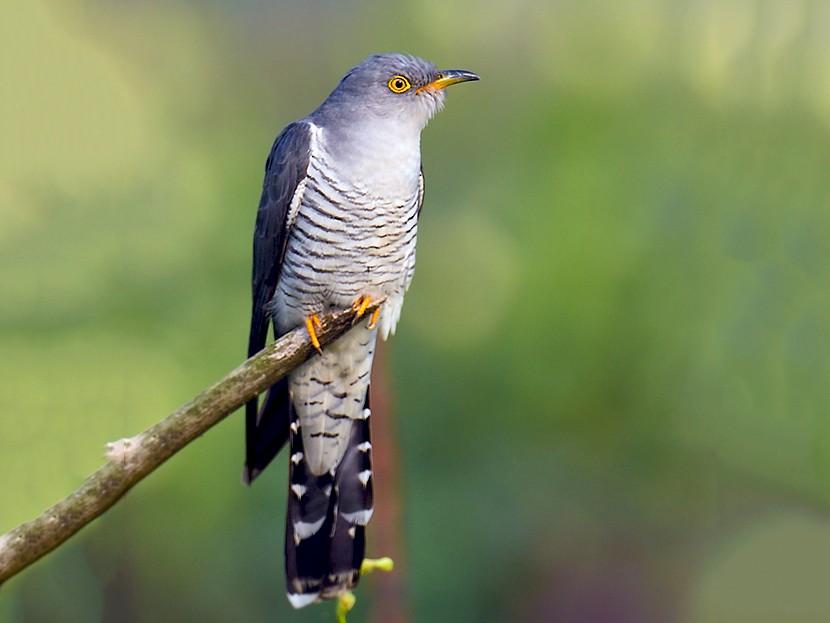
- Adult males typically have a grey head, neck, and upperparts, with a white belly barred with dark grey. The undertail coverts are white. Adult females can be similar to males (grey morph) or have a rufous-brown plumage with dark barring on the upperparts and underparts (hepatic morph). Both sexes have dark grey flight feathers and a long, dark grey tail with white spots on the outer feathers.
- Nebbform
- Relatively slender, slightly downcurved, dark grey to blackish, with a yellowish base to the lower mandible.
- Øyenfarge
- Bright yellow in adults, brownish in juveniles.
- Beinfarge
- Yellowish-orange
- Særtrekk
- Long, pointed wings, long tail, and a distinctive hawk-like silhouette in flight. The barred underparts and grey upperparts are key. The hepatic morph female is unmistakable.
- Ungfuglutseende
- Juveniles are heavily barred brown and rufous on the upperparts, with a white nape patch and white-tipped feathers, giving a scaly appearance. The underparts are whitish with fine dark barring. The eyes are brownish, and the gape is yellow.
- Sesongendringer
- No significant seasonal plumage changes in adults, as they undergo a complete post-breeding moult before migration.
- Kjønnsdimorfisme
- Males and grey morph females are very similar in plumage, though females may have a slight rufous wash on the breast. Hepatic morph females are distinctly different, being rufous-brown with heavy barring. Females are generally slightly larger and heavier than males.
Slik identifiseres
- 1
Call
The most reliable identification feature is the male's distinctive 'cuck-oo' call. The female's bubbling call is also unique.
- 2
Flight and Silhouette
Observe its flight pattern: direct, strong, and hawk-like with rapid wing beats and occasional glides. Note the long, pointed wings and long tail. In flight, it often holds its wings slightly below the horizontal.
- 3
Plumage (Adult Male/Grey Morph Female)
Look for grey upperparts, head, and breast, contrasting with white underparts barred with dark grey. The tail is dark with white spots on the outer feathers.
- 4
Plumage (Hepatic Morph Female)
If present, this morph is unmistakable: rufous-brown upperparts and underparts, heavily barred with dark brown/black.
- 5
Juvenile Plumage
Young birds are heavily barred brown and rufous, with a distinctive white nape patch and scaly appearance on the back.
- 6
Behavior
Its secretive nature and tendency to perch upright on exposed branches are characteristic. Listen for the calls of potential host species, as cuckoos are often found in their vicinity.
Habitat og utbredelse
- Biomer
- Forests, woodlands, scrublands, heathlands, open country with scattered trees, reedbeds, and agricultural areas.
- Utbredelsesområde
- Breeds across most of Europe and Asia, from the Atlantic coast to Japan. Winters in sub-Saharan Africa and parts of Southeast Asia.
- Høydeområde
- From sea level up to 3,000 meters in some mountainous regions.
- Foretrukne miljøer
- Favors areas with a good supply of host nests and abundant insect prey. Often found in mosaics of open and wooded habitats.
Atferd
- Aktivitetstid
- Diurnal.
- Matvaner
- Primarily insectivorous, specializing in large, hairy caterpillars (e.g., Lasiocampidae, Arctiidae) that are toxic or unpalatable to many other birds. It removes the irritating hairs by rubbing the caterpillar on a branch or by swallowing them and later regurgitating the indigestible hairs as pellets. Also consumes other insects like beetles, grasshoppers, and larvae.
- Sosial atferd
- Generally solitary, especially during the breeding season. Males are highly territorial and defend large territories. Females are also solitary and seek out host nests independently.
- Flygemønster
- Strong, direct, and hawk-like flight with rapid wing beats, often gliding. Can be mistaken for a small raptor, especially a Eurasian Sparrowhawk, due to its shape and flight style.
- Trekkmønster
- Long-distance migratory. European populations migrate south to sub-Saharan Africa, typically departing from July to September and returning from April to May. Asian populations winter in Southeast Asia.
- Territoriell atferd
- Males are highly territorial, defending their breeding grounds with their characteristic call. Females are not territorial in the same way but defend access to host nests during egg-laying.
Sang og kall
- Sang
- The iconic 'cuck-oo' call, typically given by the male. The first note is higher pitched and louder than the second. It can be repeated many times. The call is often associated with spring and summer.
- Kall
- Females have a distinctive bubbling or gurgling call, often described as 'kwik-kwik-kwik' or 'water-bubbling'. Both sexes may give a 'hoo-hoo-hoo' call in alarm or excitement.
- Når den lyder
- Males call most frequently during the breeding season (April to July), primarily in the morning and evening, but also throughout the day. Females call when seeking mates or host nests.
Hekking
- Hekkesesong
- May to July in Europe, varying geographically.
- Reirbygging
- Obligate brood parasite. Does not build its own nest. Females lay their eggs individually in the nests of various host species. Each female specializes in parasitizing a particular host species, and her eggs mimic the size and color of the host's eggs. Over 100 host species have been recorded, but common hosts include Dunnock, Meadow Pipit, Reed Warbler, and Pied Wagtail.
- Kullstørrelse
- One egg per host nest. A female cuckoo can lay 12-25 eggs in a breeding season.
- Beskrivelse av egg
- Eggs are typically small for the size of the cuckoo, varying greatly in color and pattern to mimic the host's eggs. They can be white, blue, green, or spotted, depending on the host species. A female cuckoo can lay up to 25 eggs in a season, each in a different host nest.
- Rugetid
- 11-13 days (shorter than most host species, allowing the cuckoo chick to hatch first).
- Tid til flyging
- 17-21 days. The cuckoo chick typically ejects the host's eggs or young from the nest shortly after hatching, ensuring it receives all parental care.
- Foreldreomsorg
- None from the biological parents. The cuckoo chick is entirely raised by the host parents.
Hvor finnes den
Woodlands and Forests
Especially open woodlands, forest edges, and clearings where host species are abundant.
Heathlands and Moorlands
Often found in these open habitats, particularly where Meadow Pipits are common hosts.
Reedbeds and Wetlands
Areas with Reed Warblers are prime locations for cuckoos.
Agricultural Landscapes
Can be found in areas with scattered trees, hedgerows, and fields, especially if host species like Dunnocks are present.
Felttips
- Listen for the call. The male's 'cuck-oo' call is the easiest way to detect its presence, especially from April to July. Once heard, try to locate the bird perched on an exposed branch.
- Look for host species. Cuckoos are often found in areas where their preferred host species (e.g., Dunnocks, Meadow Pipits, Reed Warblers) are common. Observing agitated host birds can sometimes lead to a cuckoo sighting.
- Scan open perches. Cuckoos often perch conspicuously on dead trees, fence posts, or prominent branches, especially when calling or surveying for host nests.
- Observe flight. Keep an eye out for its distinctive hawk-like flight, particularly when it moves between perches or across open areas.
Lignende arter
Eurasian Sparrowhawk
Accipiter nisus
The Common Cuckoo can be mistaken for a Eurasian Sparrowhawk due to its similar size, grey upperparts, and barred underparts. However, the cuckoo has a longer, more pointed tail, more pointed wings, and a less prominent head in flight. Sparrowhawks have broader, more rounded wings and a shorter, squarer tail. The cuckoo's flight is more direct and less agile than a sparrowhawk's. The cuckoo also lacks the raptor's hooked beak and strong talons.
Great Spotted Cuckoo
Clamator glandarius
The Great Spotted Cuckoo is larger, has a prominent crest, and is heavily spotted on the upperparts. Its range is primarily southern Europe, Africa, and parts of Asia, with limited overlap with the Common Cuckoo in some areas. Its call is also very different.
Raske fakta
- Brood Parasite:
- Lays eggs in other birds' nests.
- Diet Specialization:
- Eats hairy caterpillars.
- Iconic Call:
- Male's 'cuck-oo' call.
- Migration:
- Long-distance migrant to Africa/Asia.
- Host Mimicry:
- Eggs mimic host species' eggs.
Morsomme fakta
- The Common Cuckoo's name in many languages, including English ('cuckoo') and Norwegian ('gjøk'), is onomatopoeic, derived directly from the male's characteristic call.
- A female cuckoo can lay up to 25 eggs in a single breeding season, each in a different host nest, demonstrating remarkable reproductive output for a brood parasite.
- The cuckoo chick, often within hours of hatching, instinctively pushes the host's eggs or young out of the nest, ensuring it receives all the food and attention from the unwitting foster parents.
- Different female cuckoos specialize in parasitizing specific host species, and this specialization is thought to be passed down maternally, with females inheriting the egg-laying preferences of their mothers.
- Despite being raised by small passerines, young cuckoos grow to full size and then undertake their first migration to Africa or Asia completely independently, without guidance from either their biological or foster parents.
Vitenskapelig klassifisering
- Rike
- Animalia
- Rekke
- Chordata
- Klasse
- Aves
- Orden
- Cuculiformes
- Familie
- Cuculidae
- Slekt
- Cuculus
- Art
- Cuculus canorus
Utforsk Common Cuckoo
Identifiser fugler hvor som helst
Gratis på iOS, Android og web. Bilde- og lydidentifisering, full artsdatabase og din personlige liste.