
Så du en fugl? Identifiser den umiddelbart med Birdby-appen
Åpne appenOm arten
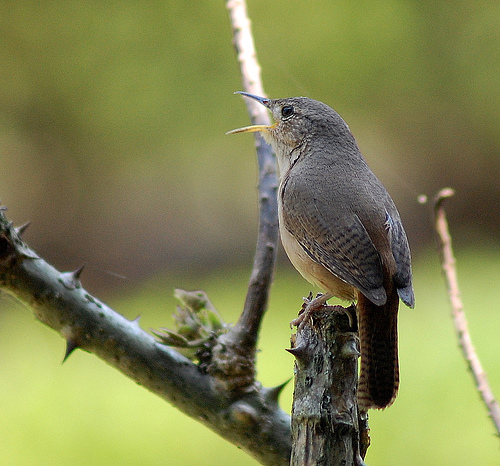
Gjerdesmetten, also known as the Eurasian Wren or Winter Wren, is a very small, plump, and short-tailed passerine bird. It is characterized by its rich brown plumage, finely barred wings and tail, and a distinctive cocked tail. Despite its diminutive size, it possesses a remarkably loud and complex song.
Størrelse og levetid
- Lengde
- 9-10.5 cm
- Vingespenn
- 13-17 cm
- Vekt
- 6-12 g
- Levetid
- 2-3 years (up to 6 years recorded)
- Kosthold
- Insectivore
Fysiske kjennetegn
- Fjærdrakt
- Upperparts are reddish-brown, finely barred with darker brown. Underparts are paler, buffish-brown, also finely barred, especially on the flanks. It has a pale supercilium (eyebrow stripe) and a short, often cocked tail, which is also barred. The wings are short and rounded.
- Nebbform
- Slender, pointed, and slightly decurved dark brown to blackish beak, adapted for probing for insects.
- Øyenfarge
- Dark brown.
- Beinfarge
- Pale brown to pinkish-brown.
- Særtrekk
- Its very small size, plump body, short and often cocked tail, and rich brown, barred plumage are highly distinctive. The pale supercilium is also a good field mark.
- Ungfuglutseende
- Juveniles resemble adults but may have slightly less distinct barring and a softer, fluffier appearance. They quickly attain adult plumage after their first molt.
- Sesongendringer
- No significant seasonal plumage changes. The plumage remains consistent throughout the year.
- Kjønnsdimorfisme
- None; males and females are identical in plumage and size.
Slik identifiseres
- 1
Size and Shape
Look for a very small, plump bird with a short, often upright (cocked) tail. It appears almost spherical.
- 2
Plumage
Note the rich reddish-brown overall coloration with fine dark barring on the wings, tail, and flanks. A pale supercilium is usually visible.
- 3
Behavior
Observe its active, restless movements, hopping and flitting through dense undergrowth, often close to the ground. Its tail is frequently cocked.
- 4
Song
Listen for its surprisingly loud, rapid, and complex song, a series of trills and warbles that can be heard from a considerable distance.
Habitat og utbredelse
- Biomer
- Forests, woodlands, scrublands, gardens, parks, hedgerows, riparian zones.
- Utbredelsesområde
- Widespread across the Holarctic region, including Europe, Asia, and North America (where it is often referred to as Winter Wren or Pacific Wren, depending on subspecies). In Norway, it is common throughout the country, including coastal areas and up into the subalpine zone.
- Høydeområde
- Sea level up to 2,000 meters, sometimes higher in mountainous regions.
- Foretrukne miljøer
- Dense undergrowth, tangled vegetation, fallen logs, root systems, and areas with abundant insect life. Often found near water sources.
Atferd
- Aktivitetstid
- Diurnal, most active during the early morning and late afternoon.
- Matvaner
- Primarily insectivorous, foraging actively among dense vegetation, under leaves, in crevices, and on the ground. It gleans insects, spiders, and other small invertebrates. It moves with quick, jerky movements, often hopping and flitting.
- Sosial atferd
- Generally solitary or found in pairs during the breeding season. Outside of breeding, they may roost communally in cold weather to conserve heat.
- Flygemønster
- Short, rapid, and direct flights, often low to the ground, with quick wingbeats. It rarely flies long distances in the open.
- Trekkmønster
- Many populations are resident year-round. Northern populations, particularly in Scandinavia and Russia, may undertake short-distance migrations to milder coastal areas or further south during harsh winters. In Norway, many are resident, but some move to coastal areas or south.
- Territoriell atferd
- Males are highly territorial during the breeding season, defending their territory with vigorous singing. They may be polygynous, with a male mating with multiple females within his territory.
Sang og kall
- Sang
- A remarkably loud, complex, and rapid series of trills, warbles, and high-pitched notes, often delivered with great energy. It can be heard from a surprising distance for such a small bird. The song often includes a distinctive, rattling trill.
- Kall
- Common calls include a sharp, metallic 'tic-tic-tic' or 'churr', often given when alarmed or agitated. Also a soft 'tseep' contact call.
- Når den lyder
- Sings throughout the year, but most frequently and intensely during the breeding season (spring and early summer). Calls are given year-round.
Hekking
- Hekkesesong
- April to July in most of its range, with two broods common.
- Reirbygging
- Males build several 'cock's nests' within their territory, often in dense vegetation, tree roots, rock crevices, or old buildings. The female selects one for lining and egg-laying. Nests are typically dome-shaped with a side entrance, constructed from moss, leaves, and grass, lined with feathers and hair.
- Kullstørrelse
- 4-8 eggs
- Beskrivelse av egg
- 4-8 (typically 5-7) small, smooth, glossy white eggs, often sparsely speckled with reddish-brown, particularly at the broader end.
- Rugetid
- 12-16 days, primarily by the female.
- Tid til flyging
- 15-19 days after hatching. Young are fed by both parents.
- Foreldreomsorg
- Both parents feed the nestlings and fledglings. The male may continue to feed the first brood while the female starts a second clutch.
Hvor finnes den
Dense Undergrowth
Check thickets, brambles, and dense shrubbery in woodlands, forests, and gardens.
Riparian Zones
Look along stream banks, river edges, and damp areas with tangled vegetation.
Gardens and Parks
Often found in well-vegetated gardens, especially those with hedges, ivy, or dense ground cover.
Fallen Logs and Root Systems
They frequently forage in and around fallen timber and exposed tree roots.
Felttips
- Listen for its song. The Gjerdesmett's loud song is often the first indication of its presence, especially in dense cover where it can be hard to spot visually.
- Look low. They spend most of their time foraging close to the ground or within the lower layers of vegetation.
- Be patient and still. Due to their small size and quick movements, they can be elusive. Standing still and waiting for them to emerge from cover is often effective.
- Check sheltered areas in winter. In cold weather, they may seek shelter in dense evergreen foliage, woodpiles, or even outbuildings.
Lignende arter
Goldcrest
Regulus regulus
Goldcrests are even smaller, have a distinctive yellow/orange crown stripe (black-bordered in males), and lack the Gjerdesmett's barred plumage and cocked tail. Their song is much higher-pitched and less powerful.
Firecrest
Regulus ignicapilla
Similar to Goldcrest but with a more prominent white supercilium and a black eye-stripe. Also lacks the Gjerdesmett's barring and cocked tail.
Dunnock
Prunella modularis
Dunnocks are larger, greyer on the head and breast, and lack the Gjerdesmett's rich brown barring and upright tail. Their song is a simpler, less powerful warble.
Raske fakta
- Smallest European Bird (by weight):
- Often considered the smallest European bird by weight, though the Goldcrest is slightly smaller by length.
- Loudest Song for its Size:
- Produces one of the loudest songs relative to its body size among all birds.
- Polygynous:
- Males often mate with multiple females within their territory.
- Cocked Tail:
- Characteristic upright tail posture.
Morsomme fakta
- In some cultures, the Wren is associated with royalty and is known as the 'King of Birds' due to an old fable where it outsmarted an eagle by hiding on its back and flying higher.
- During cold winter nights, Wrens are known to huddle together in communal roosts, sometimes with dozens of individuals, to share body heat and survive freezing temperatures.
- The male Gjerdesmett builds multiple 'cock's nests' within his territory, showcasing them to potential mates. The female then chooses one to line and lay her eggs in.
- Despite its small size, the Gjerdesmett is incredibly hardy and can survive harsh winters, often by foraging actively and utilizing sheltered microhabitats.
Vitenskapelig klassifisering
- Rike
- Animalia
- Rekke
- Chordata
- Klasse
- Aves
- Orden
- Passeriformes
- Familie
- Troglodytidae
- Slekt
- Troglodytes
- Art
- Troglodytes troglodytes
Utforsk Gjerdesmett
Identifiser fugler hvor som helst
Gratis på iOS, Android og web. Bilde- og lydidentifisering, full artsdatabase og din personlige liste.