
Viu um pássaro? Identifique na hora com o app Birdby
Abrir o appSobre
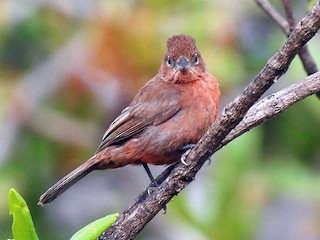
A small, striking passerine bird known for the male's vibrant red plumage and distinctive crest. It is found in various open and semi-open habitats across South America.
Tamanho e longevidade
- Comprimento
- 13-14 cm
- Envergadura
- 18-20 cm
- Peso
- 12-16 g
- Longevidade
- 3-5 years in the wild (estimated)
- Dieta
- Omnivore (primarily insects and seeds)
Características físicas
- Plumagem
- Adult male: Entire head, crest, and upperparts are a brilliant crimson-red, often appearing slightly darker on the crest. The underparts are a contrasting white, sometimes with a faint pinkish wash on the flanks. Adult female: Head and upperparts are dull reddish-brown to olive-brown, with a slightly paler throat and whitish underparts. The crest is present but less prominent and duller in color than the male's. Juveniles: Resemble females but are generally duller and more brownish, with a less defined crest.
- Formato do bico
- Conical, relatively short and stout, adapted for seed eating. Color is typically dark horn to blackish.
- Cor dos olhos
- Dark brown.
- Cor das pernas
- Dark gray to blackish.
- Características distintivas
- The male's bright red plumage and prominent erectile crest are unmistakable. The female's duller reddish-brown plumage with a smaller crest and whitish underparts are key. Both sexes have a relatively short tail.
- Aparência juvenil
- Similar to adult females but generally duller, more brownish, and with a less developed crest. The reddish tones are muted.
- Mudanças sazonais
- No significant seasonal plumage changes are noted for this species. Plumage remains consistent throughout the year, though wear and tear can make colors appear slightly duller over time.
- Dimorfismo sexual
- Pronounced. Males are bright crimson-red with a prominent crest, while females are dull reddish-brown with a smaller, less conspicuous crest and whitish underparts.
Como identificar
- 1
Male Plumage
Look for the unmistakable brilliant crimson-red head, crest, and upperparts, contrasting with white underparts. The crest is often held erect.
- 2
Female Plumage
Identify females by their dull reddish-brown to olive-brown upperparts, a smaller, less prominent crest, and whitish underparts. They lack the male's vibrant red.
- 3
Crest
Both sexes possess an erectile crest, though it is much more prominent and brightly colored in males. Observe if the bird raises and lowers this crest.
- 4
Habitat
Search in dense, thorny scrub, secondary growth, and forest edges, often near open areas or clearings. They are typically found low in vegetation or on the ground.
- 5
Vocalization
Listen for the male's high-pitched, clear, and somewhat thin whistling song, often repetitive. The 'chip' or 'tsip' contact call is also distinctive.
Habitat e distribuição
- Biomas
- Tropical and subtropical grasslands, savannas, shrublands, and open woodlands.
- Distribuição geográfica
- South America, primarily in central and eastern Brazil, eastern Bolivia, Paraguay, and northern Argentina. Disjunct populations may occur.
- Faixa altitudinal
- Typically found from sea level up to approximately 1,500 meters (5,000 feet).
- Ambientes preferidos
- Prefers areas with dense undergrowth, thorny scrub, secondary growth, forest edges, and clearings, often near water sources. It avoids dense, unbroken forest.
Comportamento
- Horário de atividade
- Diurnal, most active during the early morning and late afternoon.
- Hábitos alimentares
- Forages primarily on the ground or in low vegetation, gleaning insects (beetles, ants, caterpillars) and small seeds. It can be observed hopping actively through leaf litter or perching low in bushes to pick food items. Occasionally takes small fruits.
- Comportamento social
- Usually observed singly or in pairs, especially during the breeding season. Outside of breeding, they may join small, mixed-species foraging flocks, particularly with other small finch-like birds.
- Padrão de voo
- Flight is typically short, undulating, and low to the ground, often between patches of dense vegetation. Not known for long-distance flights.
- Padrão migratório
- Generally considered resident throughout its range, though some local or altitudinal movements may occur in response to food availability or seasonal changes.
- Territorialidade
- Males are territorial during the breeding season, defending their nesting area with songs and displays.
Canto e chamados
- Canto
- The song is a series of high-pitched, clear, and somewhat thin whistles, often described as 'tsee-tsee-tsee-tew' or 'swee-swee-swee-swee'. It can be quite repetitive and delivered from a prominent perch.
- Chamado
- Common calls include a sharp 'chip' or 'tsip' note, often given when alarmed or in contact with a mate. A softer 'seep' may also be heard.
- Quando vocaliza
- Most vocal during the breeding season, typically from dawn until mid-morning, and again in the late afternoon. Calls can be heard year-round.
Reprodução
- Estação reprodutiva
- Varies geographically, but generally coincides with the rainy season, typically from October to March in much of its range.
- Hábitos de nidificação
- Nests are cup-shaped, constructed from fine plant fibers, rootlets, and grasses, often lined with softer materials. They are typically placed low in dense bushes or thorny shrubs, well-concealed.
- Tamanho da ninhada
- 2-3 eggs.
- Descrição do ovo
- Eggs are usually 2-3, whitish or pale bluish-white, often speckled or spotted with reddish-brown or purplish markings, particularly at the larger end.
- Período de incubação
- Approximately 12-14 days, primarily by the female.
- Período de emplumação
- Chicks fledge around 10-12 days after hatching.
- Cuidado parental
- Both parents participate in feeding the young, though the female does most of the incubation. Males actively defend the nest territory.
Onde encontrar
Shrublands and Savannas
Look in areas with dense, thorny bushes and scattered trees, typical of Cerrado and Chaco biomes.
Forest Edges and Secondary Growth
Check the transition zones between forests and open areas, as well as regenerating clearings with abundant undergrowth.
Gardens and Parks (rural)
In some rural areas, they may venture into gardens or parks with suitable dense vegetation.
Dicas de campo
- Patience and Stealth. Maria-fidalga can be shy and often stays hidden in dense vegetation. Move slowly and quietly.
- Listen for Song. The male's song is a key indicator of its presence, especially during the breeding season. Once heard, try to locate the singing bird.
- Scan Low Vegetation. They forage primarily on the ground or in the lower strata of bushes. Focus your binoculars on these areas.
- Early Morning/Late Afternoon. These are the most active times for foraging and vocalization.
Espécies semelhantes
Maria-fidalga-de-crista-preta
Coryphospingus pileatus
The male Maria-fidalga-de-crista-preta has a black crest and a gray back, contrasting sharply with the all-red upperparts and crest of the Maria-fidalga (Coryphospingus cucullatus). Females are also distinguishable by subtle plumage differences, with C. pileatus females having a grayer tone to their upperparts.
Tico-tico-rei
Coryphospingus paraguayensis
This is a proposed split from Coryphospingus cucullatus, sometimes considered a subspecies. If recognized as a full species, it would be distinguished by subtle vocal and morphological differences, primarily in the extent and shade of red plumage and specific song patterns. Field identification can be extremely challenging without detailed knowledge of local populations.
Fatos rápidos
- Common Name:
- Maria-fidalga
- Scientific Name:
- Coryphospingus cucullatus
- Family:
- Thraupidae (Tanagers)
- Conservation Status:
- Least Concern
- Diet:
- Insects and Seeds
- Habitat:
- Shrublands, Savannas, Forest Edges
- Key Feature (Male):
- Brilliant crimson-red plumage and prominent crest
Curiosidades
- The name 'Maria-fidalga' in Portuguese translates roughly to 'Noble Mary' or 'Lady Mary', likely referring to the bird's elegant appearance, especially the male's crest.
- Despite its striking coloration, the Maria-fidalga can be surprisingly difficult to spot due to its preference for dense undergrowth and its often secretive behavior.
- The erectile crest is used in courtship displays and territorial interactions, making the male even more conspicuous when excited.
Classificação científica
- Reino
- Animalia
- Filo
- Chordata
- Classe
- Aves
- Ordem
- Passeriformes
- Família
- Thraupidae
- Gênero
- Coryphospingus
- Espécie
- cucullatus
Explorar o Maria-fidalga
Identifique aves em qualquer lugar
Grátis no iOS, Android e Web. Identificação por foto e som, base completa de espécies e sua lista pessoal.