
Videli ste ptico? Prepoznajte jo takoj z aplikacijo Birdby
Odpri aplikacijoO vrsti
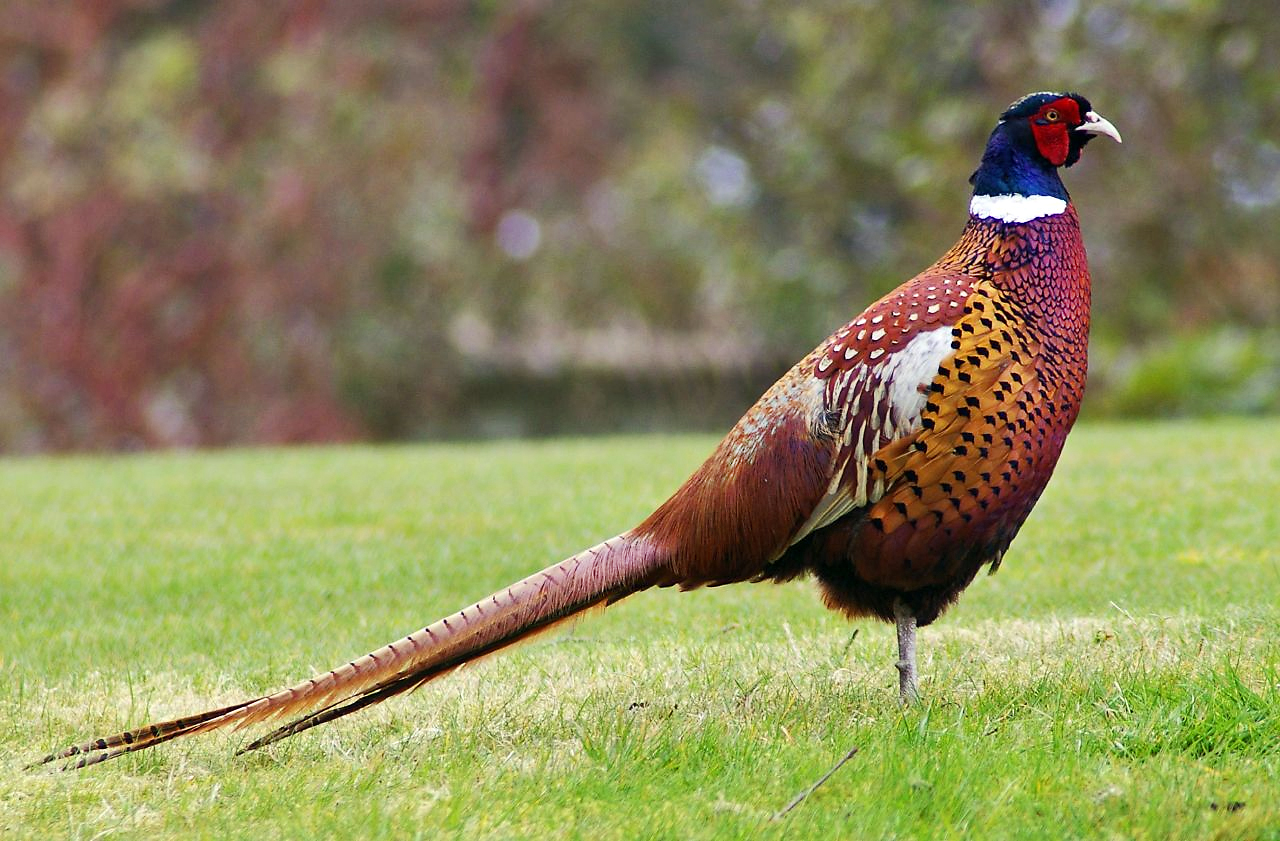
Fazan, also known as the Common Pheasant, is a large, long-tailed game bird native to Asia and parts of Europe, but widely introduced across the globe. Males are strikingly colorful with iridescent plumage, while females are camouflaged in duller brown tones. They are ground-dwelling birds, often seen foraging in open fields near woodland edges.
Velikost in življenjska doba
- Dolžina
- Male: 60-89 cm (including tail of 35-50 cm); Female: 50-63 cm (including tail of 20-25 cm)
- Razpon kril
- 70-90 cm
- Teža
- Male: 0.9-1.5 kg; Female: 0.7-1.1 kg
- Življenjska doba
- 1-3 years in the wild, up to 10 years in captivity
- Prehrana
- Omnivore
Telesne značilnosti
- Perje
- Male: Iridescent green head and neck, often with a white neck ring (depending on subspecies). Red wattles around the eyes. Body plumage is coppery-brown with black barring and purple-green iridescence, often with golden-yellow flanks. Long, barred tail. Female: Cryptic dull brown and black mottling, providing excellent camouflage. Shorter tail than males.
- Oblika kljuna
- Short, stout, conical, and horn-colored to yellowish-brown.
- Barva oči
- Yellowish-brown to dark brown.
- Barva nog
- Greyish-brown, with males possessing a spur on the tarsus.
- Razlikovalne značilnosti
- Males are unmistakable with their vibrant plumage, long tail, and red facial wattles. Females are distinguished from other game birds by their relatively long, pointed tail and overall mottled brown appearance.
- Videz mladiča
- Juveniles resemble adult females but are generally smaller and have less distinct markings. Young males gradually acquire their adult male plumage over their first year.
- Sezonske spremembe
- No significant seasonal plumage changes. Plumage remains consistent year-round, though males' colors may appear more vibrant during breeding season due to increased activity and display.
- Spolni dimorfizem
- Pronounced. Males are significantly larger, much more colorful, and have a much longer tail than females. Males also possess spurs.
Kako prepoznati
- 1
Male Plumage
Look for the iridescent green head, red facial wattles, and coppery-brown body with black barring. The long, pointed, barred tail is a key feature.
- 2
Female Plumage
Observe the mottled brown and black camouflage, which helps them blend into vegetation. Note the relatively long, pointed tail, though shorter than the male's.
- 3
Size and Shape
Pheasants are large, robust game birds with a distinctive long tail, especially prominent in males. Their body is more elongated than partridges or grouse.
- 4
Flight
When flushed, they take off with an explosive, whirring flight, often flying in a straight line for a short distance before gliding down.
- 5
Call
Listen for the male's loud, abrupt 'kok-kok!' or 'ko-orrrk!' call, often accompanied by wing-whirring.
- 6
Habitat
Look for them in open fields, agricultural land, hedgerows, and woodland edges, often near dense cover.
Habitat in razširjenost
- Biomi
- Grasslands, agricultural fields, open woodlands, scrubland, marshes, and hedgerows.
- Geografska razširjenost
- Native to Asia (from the Caucasus to Japan) and parts of Europe. Widely introduced and naturalized across Europe, North America, Australia, and New Zealand.
- Višinski razpon
- Typically found from sea level up to 2,500 meters, though generally prefers lower elevations.
- Priljubljena okolja
- Prefers mosaic landscapes with a mix of open fields for foraging, dense cover for roosting and nesting (e.g., hedgerows, woodland edges, thickets), and access to water sources.
Vedenje
- Čas aktivnosti
- Diurnal, most active during early morning and late afternoon.
- Prehranjevalne navade
- Forages primarily on the ground, scratching with its feet and pecking. Diet includes seeds, grains, berries, roots, leaves, insects, worms, and small reptiles. They are opportunistic feeders.
- Družbeno vedenje
- Generally solitary or in small groups outside the breeding season. During breeding, males are polygynous, establishing territories and attracting multiple females. Females are solitary during nesting and chick-rearing.
- Način letenja
- Flies with rapid, whirring wingbeats, often in a straight line, typically for short distances. Can achieve considerable speed but is not sustained. Often takes off explosively when startled, accompanied by a loud 'whirr' of wings.
- Selitev
- Resident throughout its range; does not migrate.
- Teritorialnost
- Males are highly territorial during the breeding season, defending their territories against rival males with aggressive displays and occasional fights.
Petje in glasovi
- Petje
- Males produce a distinctive, loud, two-syllable 'kok-kok!' or 'ko-orrrk!' call, often followed by a rapid wing-whirring display. This call serves as a territorial advertisement and attracts females.
- Klic
- Females have a softer 'geck-geck' or 'cluck' call, particularly when with chicks. Both sexes emit alarm calls, a sharp 'kek-kek-kek' when startled.
- Kdaj se oglaša
- Males call most frequently during the breeding season (spring and early summer), especially at dawn and dusk. Alarm calls can be heard year-round when birds are disturbed.
Razmnoževanje
- Razmnoževalna sezona
- April to June, with peak activity in May.
- Gnezditvene navade
- Nests are shallow depressions scraped in the ground, typically well-hidden in dense vegetation (e.g., tall grass, hedgerows, under bushes). Lined with grass, leaves, and feathers.
- Velikost zalege
- Typically 8-15 eggs, but can range from 5 to 20.
- Opis jajca
- 8-15 eggs, olive-brown to pale blue-green, unspotted, and glossy. Approximately 45 x 36 mm.
- Obdobje valjenja
- 23-26 days, incubated solely by the female.
- Obdobje izleta
- Chicks are precocial and leave the nest shortly after hatching. They can fly short distances at 10-12 days old and are independent at 10-12 weeks.
- Skrb staršev
- Only the female cares for the eggs and chicks. She leads them to foraging areas and protects them from predators.
Kje najti
Agricultural Fields
Often seen foraging for seeds and grains in cultivated fields, especially corn, wheat, and stubble fields.
Hedgerows and Woodland Edges
Provides essential cover for roosting, nesting, and escape from predators. Look along the boundaries of fields and forests.
Scrubland and Thickets
Dense vegetation offers protection and nesting sites. They will often burst out of such cover when disturbed.
Roadsides
Can frequently be seen along rural roadsides, especially in the early morning or late afternoon, foraging for food.
Terenski nasveti
- Look at dawn and dusk. Pheasants are most active during these times, foraging in open areas before retreating to cover.
- Scan field edges and hedgerows. They often walk along the edges of fields, using the cover of hedgerows for safety.
- Listen for calls. The male's distinctive 'kok-kok!' call is a good indicator of their presence, especially during spring.
- Be patient and quiet. Pheasants are wary birds. Approach quietly and observe from a distance, using binoculars.
- Look for tracks and droppings. Their three-toed tracks can be found in soft ground, and droppings may indicate their presence.
Podobne vrste
Grey Partridge
Perdix perdix
Smaller, rounder body, shorter tail, and lacks the iridescent head and long tail of the male Pheasant. Females are also much smaller and lack the Pheasant's elongated body shape.
Red-legged Partridge
Alectoris rufa
Smaller, more compact body, distinctive black and white striped flanks, and red legs and beak. Lacks the long tail and iridescent plumage of the male Pheasant.
Domestic Chicken
Gallus gallus domesticus
While some domestic chickens might have similar body shapes, they lack the specific iridescent plumage and long, pointed tail of the male Pheasant. Wild pheasants are also much more wary and agile.
Hitra dejstva
- Native Range:
- Asia and parts of Europe
- Introduced Range:
- Globally, including North America, Europe, Australia, New Zealand
- Diet:
- Omnivorous (seeds, grains, insects, berries)
- Social Structure:
- Polygynous during breeding, otherwise solitary or small groups
- Flight:
- Short, explosive bursts with rapid wingbeats
- Nesting:
- Ground nest, well-hidden in dense vegetation
Zanimivosti
- The Common Pheasant is one of the most widely introduced game birds in the world, primarily for hunting purposes.
- There are numerous subspecies of Phasianus colchicus, leading to a wide variety of plumage patterns and colors, especially in males. Many introduced populations are hybrids of these subspecies.
- The name 'colchicus' refers to Colchis, an ancient region in modern-day Georgia, from where the birds were historically introduced to Europe.
- Despite their striking appearance, male pheasants are surprisingly good at camouflage when still in dense cover.
- Pheasants are known for their 'crowing' call, which is often followed by a characteristic wing-whirring display.
Znanstvena klasifikacija
- Kraljestvo
- Animalia
- Deblo
- Chordata
- Razred
- Aves
- Red
- Galliformes
- Družina
- Phasianidae
- Rod
- Phasianus
- Vrsta
- Phasianus colchicus
Raziskujte Fazan
Prepoznajte ptice povsod
Brezplačno za iOS, Android in splet. Prepoznavanje po fotografiji in zvoku, popolna baza vrst in vaš osebni seznam.