
Bir kuş gördünüz mü? Birdby uygulamasıyla anında tanımlayın
Uygulamayı açHakkında
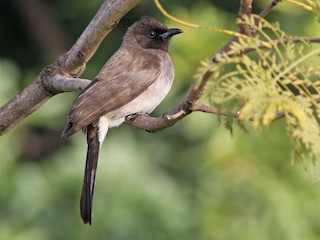
The Common Bulbul, often referred to as Bülbül in Turkish, is a medium-sized passerine bird belonging to the bulbul family. It is characterized by its drab, mostly grey-brown plumage, a distinctive dark cap, and a lively, often conspicuous behavior. It is a highly adaptable species, thriving in a variety of habitats across its extensive African range.
Boyut ve yaşam süresi
- Uzunluk
- 18-22 cm
- Kanat açıklığı
- 25-30 cm
- Ağırlık
- 30-50 g
- Yaşam süresi
- 5-10 years in the wild
- Beslenme
- Omnivore (primarily frugivorous and insectivorous)
Fiziksel özellikler
- Tüyler
- Overall dull grey-brown plumage, darker on the upperparts and paler, often whitish, on the underparts. The head is distinctly darker, appearing almost black, forming a cap that extends to the nape and ear-coverts. The vent area (undertail coverts) is typically yellowish, though this can vary geographically from bright yellow to duller buff or even whitish. Some subspecies may show a faint streaking on the breast.
- Gaga şekli
- Relatively short, slender, and slightly decurved black beak, well-suited for plucking fruits and catching insects.
- Göz rengi
- Dark brown, often appearing black.
- Bacak rengi
- Dark grey to blackish.
- Ayırt edici özellikler
- The combination of a dark cap, plain grey-brown body, and often yellowish vent is key. The lack of prominent crests or bright patches (except for the vent) distinguishes it from many other bulbul species. Its active, often restless demeanor is also characteristic.
- Genç birey görünümü
- Juveniles resemble adults but generally have a duller, less defined dark cap and often a paler, more washed-out overall plumage. The yellowish vent may be less intense or absent in very young birds.
- Mevsimsel değişimler
- No significant seasonal plumage changes. The plumage remains consistent throughout the year.
- Cinsiyet farkı
- Males and females are monomorphic, meaning they are visually identical in plumage and size.
Nasıl tanımlanır
- 1
Dark Cap
Look for the distinct dark, almost black, cap on the head, contrasting with the paler grey-brown body.
- 2
Vent Color
Check the undertail coverts (vent area). In most subspecies of Common Bulbul, this will be yellowish, ranging from bright to dull. This is a key differentiator from the Dark-capped Bulbul (P. tricolor) which has a whitish vent.
- 3
Overall Plumage
Note the generally plain, unstreaked grey-brown plumage. There are no prominent wing bars, eye-stripes (other than the dark cap extending to ear-coverts), or crests (unlike Cape Bulbul).
- 4
Vocalizations
Listen for its characteristic lively, chattering, and whistling song, and its sharp 'chick-chick' calls. These are often the first indication of its presence.
- 5
Behavior
Observe its active, restless foraging behavior in trees and shrubs, often flicking its tail. It is generally quite bold and accustomed to human presence in urban areas.
Habitat ve yayılış
- Biyomlar
- Forest edges, woodlands, savannas, shrublands, riparian zones, agricultural areas, gardens, and urban parks.
- Coğrafi yayılış
- Widespread across much of sub-Saharan Africa, extending from Mauritania and Senegal in the west, eastwards to Ethiopia and Somalia, and southwards to South Africa. It is absent from dense rainforests and arid deserts.
- Yükseklik aralığı
- Sea level up to approximately 2,500 meters, occasionally higher in some regions.
- Tercih ettiği ortamlar
- Prefers open woodlands, scrub, and areas with scattered trees and bushes. It is highly adaptable and frequently found in human-modified landscapes, including suburban gardens and cultivated areas, where food and nesting sites are readily available.
Davranış
- Aktivite zamanı
- Diurnal, most active during the early morning and late afternoon.
- Beslenme alışkanlıkları
- Highly opportunistic feeder. Primarily frugivorous, consuming a wide variety of berries and fruits. Also insectivorous, catching insects in flight or gleaning them from foliage. Nectar and small invertebrates are also part of its diet. Forages actively in trees and shrubs, often in pairs or small family groups.
- Sosyal davranış
- Usually seen in pairs or small family groups. Outside the breeding season, they may form larger, loose flocks, especially around abundant food sources. They are generally quite vocal and conspicuous.
- Uçuş şekli
- Flight is typically undulating and direct, often with rapid wing beats. It can be quite agile when maneuvering through dense vegetation.
- Göç şekli
- Mostly resident throughout its range, with some local or altitudinal movements in response to food availability or seasonal changes. It is not considered a long-distance migratory species.
- Bölgesellik
- Pairs defend a breeding territory during the nesting season, often vocally. Outside of breeding, they are less territorial and may forage in communal areas.
Ötüş ve sesler
- Şarkı
- The song is a lively, varied, and often cheerful series of chattering, whistling, and warbling notes. It is highly variable between individuals and regions but typically consists of short, melodic phrases repeated several times. It can be quite loud and far-carrying.
- Çağrı
- Common calls include a sharp, scolding 'chick-chick' or 'chick-a-peep', a harsh 'churr', and various soft chirps and whistles used for contact or alarm. The alarm call is a rapid, agitated series of notes.
- Ne zaman ses çıkarır
- Vocalizes throughout the day, especially prominent during the breeding season and in the early morning and late afternoon.
Üreme
- Üreme mevsimi
- Varies geographically, typically coinciding with the rainy season or periods of abundant food. Can breed almost year-round in some tropical regions, but generally peaks between September and March in southern Africa, and March to July in West Africa.
- Yuvalama alışkanlıkları
- Nests are typically cup-shaped, loosely constructed from twigs, grass, leaves, and rootlets, often lined with finer materials like hair or feathers. They are usually placed in a fork of a tree or shrub, often well-concealed within dense foliage, at a height of 1-5 meters above the ground.
- Kuluçka büyüklüğü
- 2-4 eggs, most commonly 3.
- Yumurta tanımı
- Eggs are typically pale pinkish-white to creamy, heavily speckled and blotched with reddish-brown, purple, or grey, often concentrated at the broader end. They are oval-shaped.
- Kuluçka süresi
- Approximately 12-15 days, primarily by the female.
- Yuvadan ayrılma süresi
- Chicks fledge about 12-14 days after hatching. They remain dependent on parents for some time after leaving the nest.
- Ebeveyn bakımı
- Both parents participate in feeding the nestlings and fledglings. The female primarily incubates, but both sexes contribute to nest building and defense.
Nerede bulunur
Gardens and Parks
Common in suburban and urban gardens, parks, and cultivated areas, especially where fruit-bearing trees and shrubs are present.
Woodlands and Savannas
Found in open woodlands, savanna habitats, and areas with scattered trees and bushes.
Agricultural Areas
Frequently seen in orchards, farmlands, and plantations, where they can find abundant food.
Riparian Zones
Often found along rivers and streams, where vegetation is denser.
Saha ipuçları
- Listen for its song. The Common Bulbul is a very vocal bird. Learning its distinctive chattering and whistling song will often lead you to its location before you see it.
- Look in fruit trees and bushes. They are primarily frugivorous, so checking fruit-bearing plants, especially figs, berries, and other soft fruits, is a good strategy.
- Observe active foraging. They are active foragers, constantly moving through foliage. Look for movement in the mid-story of trees and shrubs.
- Check urban green spaces. Don't overlook city parks and gardens; they are highly adapted to human environments and can be quite common there.
- Be patient and still. While often bold, remaining still and quiet will allow them to approach closer as they forage.
Benzer türler
Dark-capped Bulbul
Pycnonotus tricolor
Historically considered a subspecies of Common Bulbul, now often treated as a separate species. The main difference is the lack of a yellow vent in P. tricolor, which has a whitish or buffy vent. Field identification can be challenging where ranges overlap or are adjacent, relying heavily on vent coloration and subtle vocal differences.
Cape Bulbul
Pycnonotus capensis
Restricted to the fynbos biome of the Western Cape, South Africa. It has a more prominent, shaggy crest, a distinct white eye-ring, and a duller, less contrasting vent than the Common Bulbul. Its calls are also distinct.
Garden Bulbul
Pycnonotus xanthopygos
Found in the Middle East. While similar in overall shape and drab plumage, the Garden Bulbul has a bright yellow vent and a more prominent, slightly shaggier crest. Its range does not overlap with the Common Bulbul.
Hızlı bilgiler
- Family:
- Pycnonotidae (Bulbuls)
- Diet:
- Omnivorous (fruits, insects, nectar)
- Habitat:
- Varied, from woodlands to urban gardens
- Conservation Status:
- Least Concern
- Vocalization:
- Lively, chattering song and sharp calls
- Sexual Dimorphism:
- None (monomorphic)
- Migration:
- Mostly resident
İlginç bilgiler
- The name 'Bülbül' is derived from Persian and is often associated with nightingales in poetry, despite the Common Bulbul being a different species with a distinct song.
- Common Bulbuls are important seed dispersers due to their fruit-eating habits, playing a role in plant regeneration in their ecosystems.
- They are known to be quite bold and can become accustomed to human presence, often visiting bird feeders in gardens.
- The species complex of 'Common Bulbul' has undergone significant taxonomic revision, with several former subspecies now recognized as distinct species, such as the Dark-capped Bulbul (P. tricolor).
Bilimsel sınıflandırma
- Alem
- Animalia
- Şube
- Chordata
- Sınıf
- Aves
- Takım
- Passeriformes
- Aile
- Pycnonotidae
- Cins
- Pycnonotus
- Tür
- Pycnonotus barbatus
Common Bulbul hakkında daha fazlası
Her yerde kuşları tanımlayın
iOS, Android ve Web'de ücretsiz. Fotoğraf ve ses tanımlama, tam tür veritabanı ve kişisel yaşam listeniz.