
Spotted a bird? Identify it instantly with the Birdby app
Open the appAbout
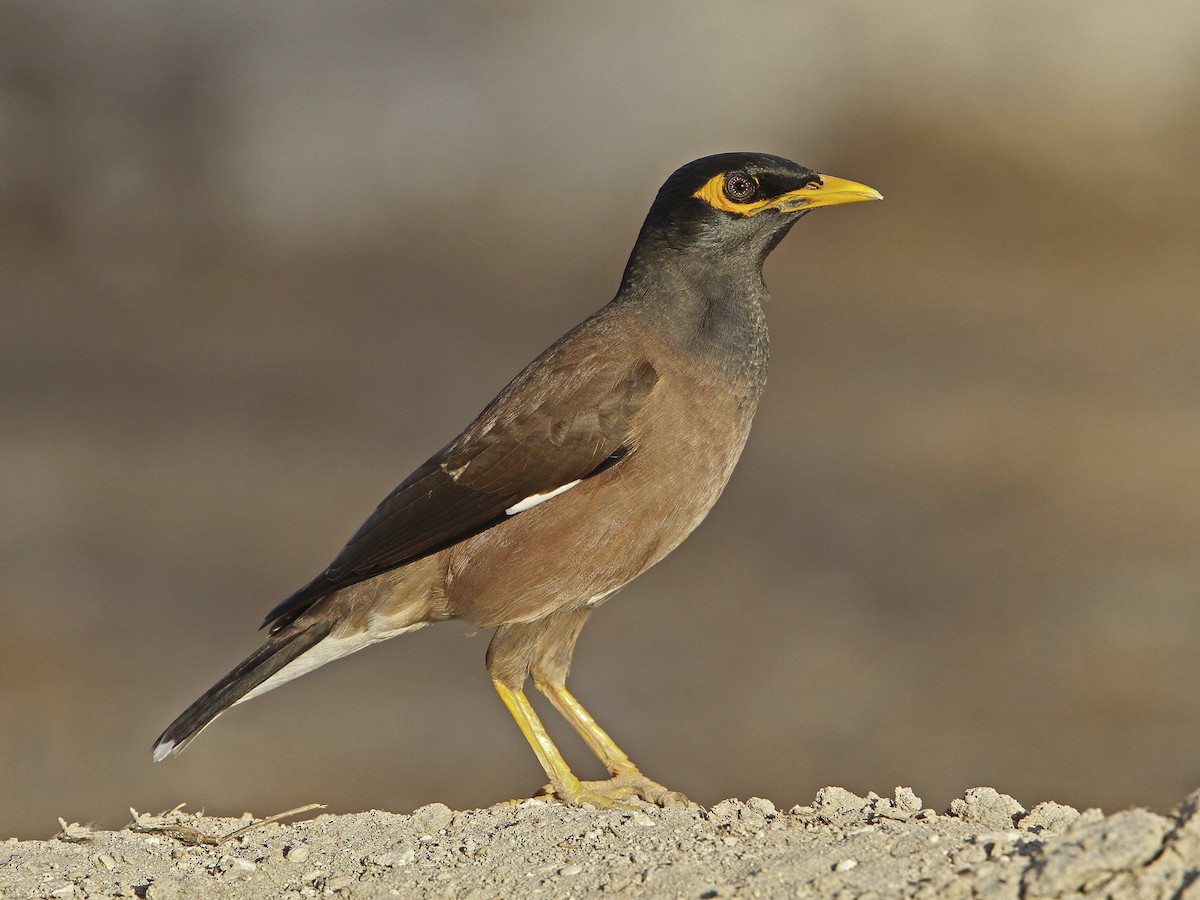
The Indian Myna is a medium-sized passerine bird in the starling family, Sturnidae. It is native to Asia but has been introduced to many other parts of the world, where it is often considered an invasive species due to its aggressive nature and impact on native ecosystems. It is highly adaptable and thrives in urban and agricultural environments.
Size & lifespan
- Length
- 23-26 cm
- Wingspan
- 37-42 cm
- Weight
- 82-143 g
- Lifespan
- 4-12 years in the wild, up to 25 years in captivity
- Diet
- Omnivore
Physical characteristics
- Plumage
- Adults have a glossy black head and neck, with a dark brown body. The lower belly and vent are white. The wings are dark brown with prominent white patches on the primaries, visible in flight. The tail is dark brown with white tips on the outer tail feathers.
- Beak shape
- Strong, pointed, and bright yellow. The base of the lower mandible is often slightly darker.
- Eye color
- Dark brown, surrounded by a distinctive patch of bare yellow skin.
- Leg color
- Bright yellow
- Distinguishing features
- The combination of the glossy black head, dark brown body, bright yellow bill and legs, and the prominent yellow bare skin around the eye are key identification features. The large white wing patches are very conspicuous in flight.
- Juvenile appearance
- Juveniles resemble adults but have duller plumage, with a less glossy black head and a paler brown body. The yellow skin around the eye is less vibrant, and the bill and legs are a duller yellow or yellowish-brown.
- Seasonal changes
- No significant seasonal plumage changes. Plumage may appear slightly duller when worn before molting.
- Sexual dimorphism
- Males and females are monomorphic, meaning they look identical in plumage and size.
How to identify
- 1
Head and Eye
Look for the glossy black head and the distinctive patch of bare yellow skin around the dark eye.
- 2
Body Plumage
Note the dark brown body contrasting with the black head and white lower belly/vent.
- 3
Bill and Legs
Observe the bright yellow bill and legs, which are very conspicuous.
- 4
Wing Patches
In flight, the large, prominent white patches on the primary feathers are a key identifier.
- 5
Tail
Look for the dark tail with white tips on the outer feathers, often fanned slightly during landing or display.
- 6
Behavior
Their confident, often bold demeanor, ground foraging, and noisy vocalizations are characteristic.
Habitat & range
- Biomes
- Tropical and subtropical grasslands, savannas, shrublands, forests, and urban/suburban areas.
- Geographic range
- Native to Asia, from Iran, Afghanistan, Pakistan, India, Nepal, Bhutan, Bangladesh, Sri Lanka, and Myanmar, extending into Southeast Asia. Introduced populations are widespread globally, including Australia, New Zealand, South Africa, Hawaii, Fiji, and many other Pacific and Indian Ocean islands, as well as parts of Europe and North America.
- Elevation range
- Sea level up to approximately 3,000 meters in some parts of its native range, but typically found at lower elevations.
- Preferred environments
- Highly adaptable, preferring open woodlands, cultivated lands, parks, gardens, and urban environments. They are particularly common in areas with human habitation, where food and nesting sites are abundant.
Behavior
- Activity time
- Diurnal, most active during the day, especially in the morning and late afternoon.
- Feeding habits
- Highly opportunistic omnivores. Their diet includes a wide variety of insects (grasshoppers, crickets, beetles, caterpillars), other invertebrates (earthworms, spiders), fruits, berries, seeds, nectar, discarded human food, and occasionally small vertebrates like lizards, eggs, and nestlings of other birds. They forage on the ground, in trees, and around human settlements.
- Social behavior
- Highly social birds, often seen in pairs or small family groups during the breeding season. Outside of breeding, they form large communal roosts, sometimes numbering in the thousands, especially in urban areas. They are known for their aggressive and territorial behavior, particularly towards other bird species.
- Flight pattern
- Strong, direct, and somewhat undulating flight with rapid wing beats. They often glide for short distances.
- Migration pattern
- Primarily resident throughout its range, though some local movements may occur in response to food availability or harsh weather conditions. They are not migratory in the traditional sense.
- Territoriality
- Highly territorial, especially during the breeding season. They aggressively defend nesting sites and foraging areas from other mynas and native bird species, often evicting them from nests or competing for resources.
Song & calls
- Song
- A varied and complex song, consisting of a mixture of chattering, whistles, clicks, squawks, and gurgles. They are known mimics and can incorporate sounds from their environment into their vocalizations. The song is often delivered from a prominent perch.
- Call
- A wide repertoire of calls, including harsh 'churrr' or 'kraak' alarm calls, sharp 'cheer' contact calls, and various scolding or chattering notes. They are generally very vocal birds.
- When they vocalize
- Vocalize throughout the day, particularly active in the morning and evening. Communal roosts can be very noisy.
Breeding & reproduction
- Breeding season
- Varies geographically, but generally from spring to summer (e.g., March-September in India, September-March in Australia). They can have multiple broods per year.
- Nesting habits
- Nests are bulky, untidy structures made of twigs, grass, leaves, rubbish, and often human-made materials like plastic and paper. They typically nest in tree hollows, building cavities, roof spaces, or abandoned nests of other birds. Both sexes participate in nest building.
- Clutch size
- 3-6 eggs, commonly 4-5.
- Egg description
- Eggs are glossy, pale blue or greenish-blue, sometimes with faint reddish-brown spots. They are typically oval-shaped.
- Incubation period
- 17-18 days, primarily by the female, though the male may assist.
- Fledging period
- 22-24 days after hatching. Young are fed by both parents.
- Parental care
- Both parents share duties of incubation (to a lesser extent for males) and feeding the nestlings. Young are dependent on parents for several weeks after fledging.
Where to find
Urban and Suburban Areas
Common in cities, towns, parks, gardens, and residential areas, especially where food scraps are available.
Agricultural Lands
Frequently found in cultivated fields, orchards, and farmlands, foraging for insects and fruits.
Open Woodlands and Grasslands
In their native range, they inhabit open country with scattered trees and grasslands.
Communal Roosts
Look for large gatherings of mynas in trees or on buildings at dusk, particularly in urban centers.
Field tips
- Listen for their calls. Their noisy and varied vocalizations often give away their presence before they are seen.
- Observe foraging behavior. They are often seen walking confidently on lawns, pavements, or cultivated ground, pecking for food.
- Look for communal roosts. At dawn and dusk, large numbers can be observed flying to and from communal roosting sites.
- Check around human activity. They are highly habituated to humans and frequently found near markets, cafes, and picnic areas.
Similar species
Common Starling
Sturnus vulgaris
Common Starlings are entirely dark with iridescent plumage and speckled with white spots, especially in winter. They lack the brown body, yellow eye-patch, and prominent white wing patches of the Indian Myna. Their bill is dark in winter and yellow in summer, but without the bare yellow skin around the eye.
Jungle Myna
Acridotheres fuscus
Jungle Mynas are similar in size and shape but have a crest of feathers on the forehead and lack the bare yellow skin around the eye. Their plumage is generally a more uniform dark grey-brown, and the white wing patch is less extensive.
Bank Myna
Acridotheres ginginianus
Bank Mynas are slightly smaller and paler grey-brown than Indian Mynas. They have an orange-red bill and legs, and a patch of bare orange-red skin around the eye, distinguishing them from the yellow features of the Indian Myna.
Quick facts
- Common Name:
- Indian Myna
- Scientific Name:
- Acridotheres tristis
- Family:
- Sturnidae (Starlings)
- Diet:
- Omnivore
- Conservation Status:
- Least Concern (IUCN Red List)
- Key Identification Mark:
- Glossy black head, brown body, yellow bill/legs, yellow eye-patch, white wing patches in flight.
- Social Behavior:
- Highly social, forms large communal roosts.
- Invasive Status:
- Considered one of the world's most invasive species outside its native range.
Fun facts
- The Indian Myna was listed among the world's 100 worst invasive species by the IUCN.
- They are excellent mimics and can incorporate sounds from their environment, including human speech, into their vocalizations.
- Their scientific name 'Acridotheres tristis' translates to 'sad grasshopper hunter', referring to their diet and somewhat melancholic-sounding calls.
- Indian Mynas are known for their aggressive nest site competition, often evicting native birds from their nests.
- They are highly intelligent birds and can solve simple problems to access food.
Scientific classification
- Kingdom
- Animalia
- Phylum
- Chordata
- Class
- Aves
- Order
- Passeriformes
- Family
- Sturnidae
- Genus
- Acridotheres
- Species
- Acridotheres tristis
Explore the Indian Myna
Identify birds anywhere
Free on iOS, Android, and Web. Photo & sound identification, full species database, and your personal life list.