
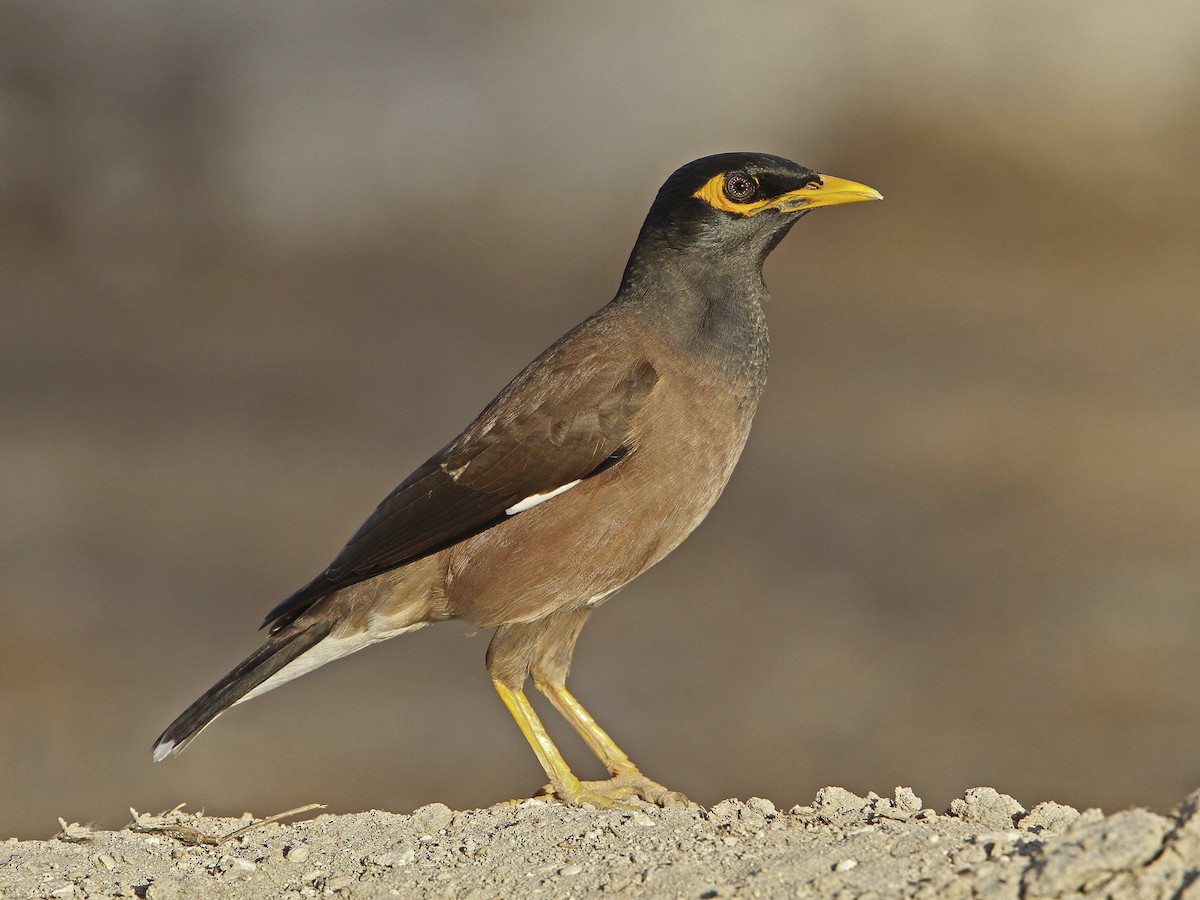
Where does the Indian Myna live?
Acridotheres tristis
Spotted a bird? Identify it instantly with the Birdby app
Open the appThe Indian Myna lives in specific habitats and regions. Knowing where, and when, to look improves your chances of a successful sighting.
Biomes
Tropical and subtropical grasslands, savannas, shrublands, forests, and urban/suburban areas.
Geographic range
Native to Asia, from Iran, Afghanistan, Pakistan, India, Nepal, Bhutan, Bangladesh, Sri Lanka, and Myanmar, extending into Southeast Asia. Introduced populations are widespread globally, including Australia, New Zealand, South Africa, Hawaii, Fiji, and many other Pacific and Indian Ocean islands, as well as parts of Europe and North America.
Preferred environments
Highly adaptable, preferring open woodlands, cultivated lands, parks, gardens, and urban environments. They are particularly common in areas with human habitation, where food and nesting sites are abundant.
Elevation range
Sea level up to approximately 3,000 meters in some parts of its native range, but typically found at lower elevations.
Where to look
Urban and Suburban Areas
Common in cities, towns, parks, gardens, and residential areas, especially where food scraps are available.
Agricultural Lands
Frequently found in cultivated fields, orchards, and farmlands, foraging for insects and fruits.
Open Woodlands and Grasslands
In their native range, they inhabit open country with scattered trees and grasslands.
Communal Roosts
Look for large gatherings of mynas in trees or on buildings at dusk, particularly in urban centers.
Field tips
- Listen for their calls. Their noisy and varied vocalizations often give away their presence before they are seen.
- Observe foraging behavior. They are often seen walking confidently on lawns, pavements, or cultivated ground, pecking for food.
- Look for communal roosts. At dawn and dusk, large numbers can be observed flying to and from communal roosting sites.
- Check around human activity. They are highly habituated to humans and frequently found near markets, cafes, and picnic areas.
Migration
Primarily resident throughout its range, though some local movements may occur in response to food availability or harsh weather conditions. They are not migratory in the traditional sense.
Explore the Indian Myna
Identify birds anywhere
Free on iOS, Android, and Web. Photo & sound identification, full species database, and your personal life list.