
Spotted a bird? Identify it instantly with the Birdby app
Open the appAbout
Fischer's Lovebird is a small, vibrant parrot species native to east-central Africa. Known for its striking coloration and social behavior, it is a popular pet bird worldwide. In the wild, they are typically found in arid and semi-arid regions, often near water sources, and are highly gregarious, forming large flocks.
Size & lifespan
- Length
- 14-15 cm (5.5-6 inches)
- Wingspan
- Approximately 25-28 cm (10-11 inches)
- Weight
- 42-58 g (1.5-2.0 oz)
- Lifespan
- 5-10 years in the wild, up to 15-20 years in captivity
- Diet
- Herbivore (primarily granivorous and frugivorous)
Physical characteristics
- Plumage
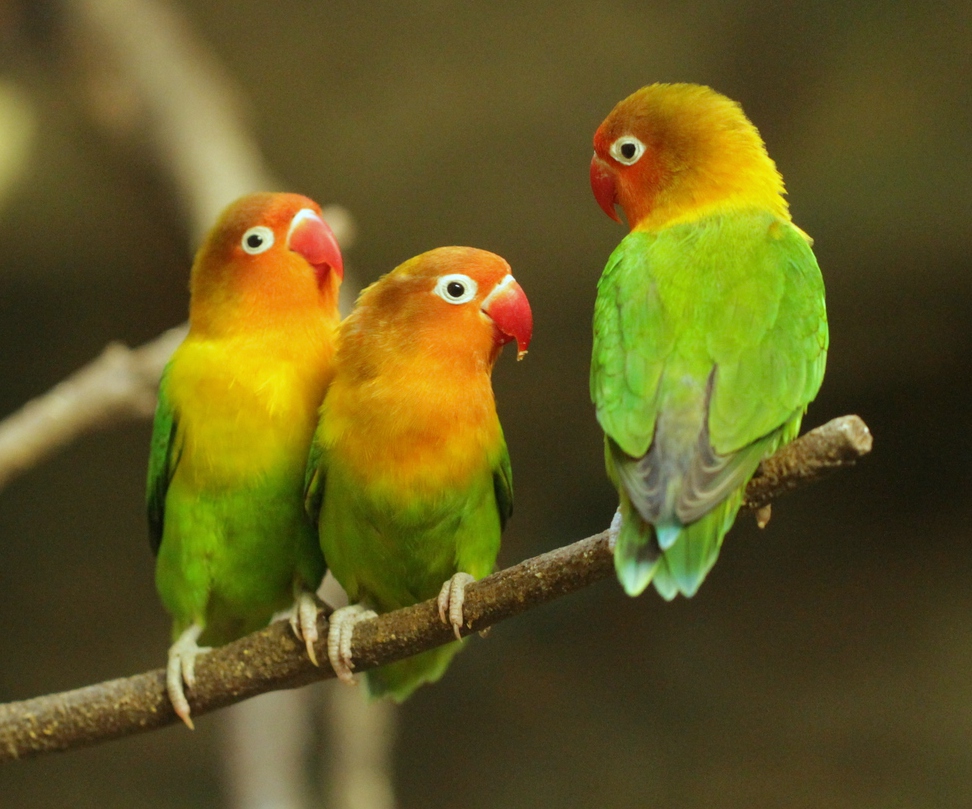
- Adults have a bright green back, wings, and upper breast. The lower breast and abdomen are yellow, transitioning to orange on the upper breast and throat. The head is orange-red, fading to olive-green on the crown. A prominent white eye-ring encircles the dark brown eyes. The rump is bright blue. The tail feathers are green with blue tips and a red band near the base.
- Beak shape
- Strong, hooked, and conical. Red-orange in color.
- Eye color
- Dark brown with a distinct white periophthalmic ring (eye-ring).
- Leg color
- Grey
- Distinguishing features
- The combination of the orange-red head, yellow-orange breast, green body, blue rump, and prominent white eye-ring are key distinguishing features. The red beak is also characteristic.
- Juvenile appearance
- Juveniles resemble adults but have duller plumage, particularly on the head and breast, which are less intensely orange. The beak may have a blackish mark at the base, which fades with maturity.
- Seasonal changes
- No significant seasonal plumage changes.
- Sexual dimorphism
- Fischer's Lovebirds are monomorphic, meaning males and females have identical plumage. Sexing typically requires DNA testing or surgical sexing.
How to identify
- 1
Head and Breast Coloration
Look for the distinctive orange-red head that transitions to a yellow-orange breast. This is a key field mark.
- 2
Eye-ring
The prominent white eye-ring around dark eyes is a crucial identifier, distinguishing it from several other lovebird species.
- 3
Rump Color
Observe the bright blue rump, which contrasts with the green back and wings.
- 4
Beak Color
Note the bright red-orange, hooked beak.
- 5
Vocalizations
Listen for their characteristic loud, high-pitched, chattering, and screeching calls, especially when in flight or in flocks.
- 6
Social Behavior
They are almost always seen in pairs or flocks, rarely solitary. Observing their social interactions can aid identification.
Habitat & range
- Biomes
- Savanna, grassland, woodland, and cultivated areas.
- Geographic range
- Native to east-central Africa, specifically south of Lake Victoria in northern Tanzania. Feral populations exist in various parts of the world, including Florida (USA) and parts of Europe, due to escapes from captivity.
- Elevation range
- Typically found at elevations between 1,100 and 1,700 meters (3,600-5,600 feet).
- Preferred environments
- Arid and semi-arid regions with scattered trees (especially acacia and baobab), scrubland, and cultivated land, always in close proximity to water sources for drinking and bathing.
Behavior
- Activity time
- Diurnal, most active during the early morning and late afternoon.
- Feeding habits
- Primarily feed on seeds of grasses and cultivated crops (e.g., maize, millet), fruits (especially figs), berries, and occasionally insects. They forage in flocks, often on the ground or in trees and shrubs.
- Social behavior
- Highly social and gregarious birds, typically found in pairs or small family groups, but often congregating in large flocks of 20 to 100 individuals, especially when foraging or roosting. They are known for their strong pair bonds.
- Flight pattern
- Fast, direct, and undulating flight with rapid wing beats. They are agile fliers, especially when navigating through dense vegetation.
- Migration pattern
- Resident; they do not undertake long-distance migrations. However, local movements may occur in response to food availability or water scarcity.
- Territoriality
- While generally social, breeding pairs can be territorial around their nest sites.
Song & calls
- Song
- Fischer's Lovebirds do not have a complex song. Their vocalizations are primarily calls.
- Call
- They produce a variety of high-pitched, chattering, chirping, and screeching calls. Their calls are often described as loud, shrill, and incessant, especially when in flocks or when alarmed. They use contact calls to maintain cohesion within the flock and alarm calls to warn of predators.
- When they vocalize
- Vocalize frequently throughout the day, particularly when flying, feeding, or interacting with other birds in their flock.
Breeding & reproduction
- Breeding season
- Typically January to April and June to July in the wild, coinciding with the dry season when food is abundant. In captivity, they can breed year-round.
- Nesting habits
- Monogamous. They are cavity nesters, utilizing holes in trees (often baobabs or acacias), rock crevices, or even abandoned nests of other birds (e.g., weavers). The female constructs the nest using strips of bark, leaves, and other plant material, which she tucks into her rump feathers to carry to the nest site.
- Clutch size
- 3-8 eggs, typically 4-5.
- Egg description
- White, oval-shaped eggs.
- Incubation period
- Approximately 21-23 days, primarily by the female.
- Fledging period
- Young fledge (leave the nest) around 38-44 days after hatching. They remain dependent on their parents for a few weeks after fledging.
- Parental care
- Both parents participate in feeding the chicks after hatching, though the female does most of the incubation. The male feeds the female during incubation.
Where to find
National Parks and Reserves
Serengeti National Park, Tarangire National Park, and other protected areas in northern Tanzania are prime locations to observe them in their natural habitat.
Cultivated Areas
They often frequent agricultural lands where they can feed on cultivated grains, especially near water sources.
Areas with Acacia and Baobab Trees
These trees provide nesting cavities and foraging opportunities.
Water Sources
Look near rivers, lakes, and watering holes, as they require regular access to water.
Field tips
- Look for Flocks. Fischer's Lovebirds are highly social; spotting one usually means there are more nearby. Look for groups flying or feeding together.
- Listen for Calls. Their loud and distinctive calls often give away their presence before they are seen. Follow the sound.
- Observe Near Water. They visit water sources frequently, especially in arid regions. Waiting near a watering hole can be productive.
- Check Tree Cavities. During breeding season, look for activity around tree holes, which they use for nesting.
- Early Morning/Late Afternoon. These are their most active times for foraging and social interaction.
Similar species
Yellow-collared Lovebird
Agapornis personatus
Fischer's Lovebird has an orange-red head and a yellow-orange breast, whereas the Yellow-collared Lovebird (also known as Masked Lovebird) has a black head ('mask') and a bright yellow collar around its neck, with a green body and a red beak. Both have a white eye-ring.
Lilian's Lovebird
Agapornis lilianae
Lilian's Lovebird (Nyasa Lovebird) has a red-orange head that extends further down the breast, but lacks the distinct yellow-orange breast of Fischer's. Its overall body plumage is a lighter green, and the blue rump is less prominent. The white eye-ring is present in both.
Peach-faced Lovebird
Agapornis roseicollis
Peach-faced Lovebirds have a pinkish-red face and throat, a blue rump, and a green body. They lack the distinct white eye-ring present in Fischer's Lovebird, and their head coloration is distinctly different.
Quick facts
- Native Range:
- Northern Tanzania
- Social Structure:
- Highly gregarious, forms large flocks
- Diet:
- Seeds, fruits, berries
- Nesting:
- Cavity nester
- Conservation Status:
- Near Threatened (due to habitat loss and trapping for pet trade)
Fun facts
- Fischer's Lovebirds are named after Gustav Fischer, a German explorer who discovered them in the late 19th century.
- They are one of the 'white eye-ring' lovebird species, a group known for the distinct white ring around their eyes.
- Despite their small size, they are known for their strong pair bonds, often seen preening each other and staying close.
- In captivity, various color mutations have been selectively bred, including blue, yellow, and pied varieties, which are not found in the wild.
- Females are known to carry nesting material tucked into their rump feathers, a unique behavior among parrots.
Scientific classification
- Kingdom
- Animalia
- Phylum
- Chordata
- Class
- Aves
- Order
- Psittaciformes
- Family
- Psittaculidae
- Genus
- Agapornis
- Species
- Agapornis fischeri
Explore the Fischer's Lovebird
Identify birds anywhere
Free on iOS, Android, and Web. Photo & sound identification, full species database, and your personal life list.