
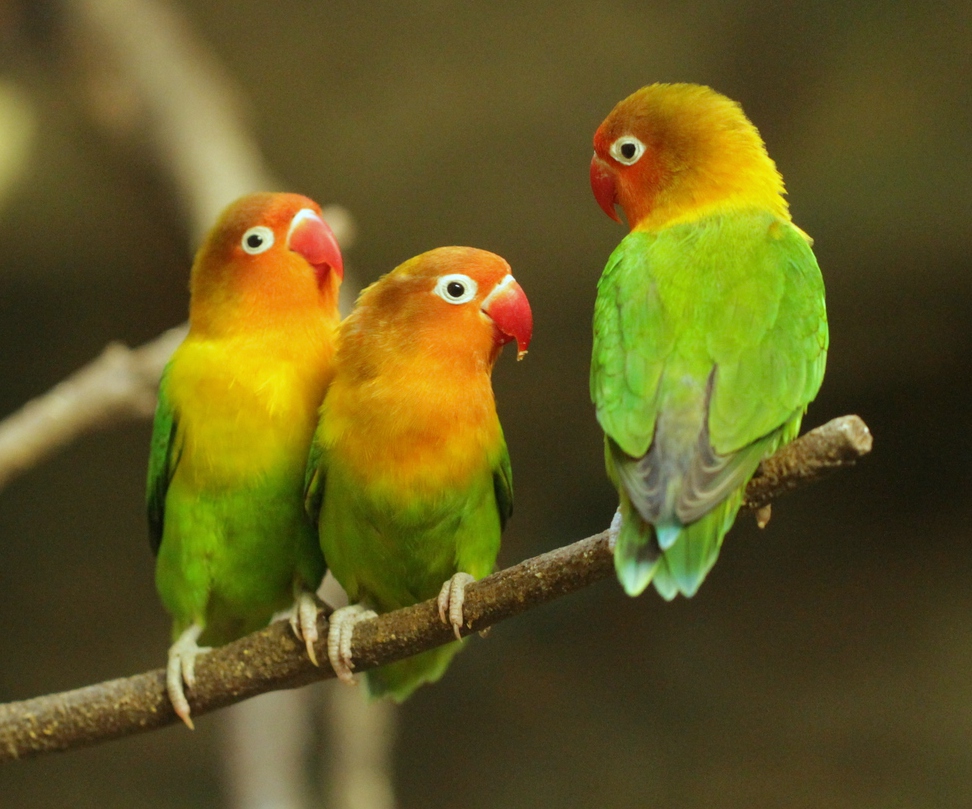
How to identify the Fischer's Lovebird
Agapornis fischeri
Spotted a bird? Identify it instantly with the Birdby app
Open the appTo correctly identify the Fischer's Lovebird (Agapornis fischeri), check each of these features. Birds can be tricky: habit, habitat, and call often confirm a sighting that a single photo cannot.
Size at a glance
- Length
- 14-15 cm (5.5-6 inches)
- Wingspan
- Approximately 25-28 cm (10-11 inches)
- Weight
- 42-58 g (1.5-2.0 oz)
Physical features to check
- 1
Plumage
Overall feather coloration and pattern.
Adults have a bright green back, wings, and upper breast. The lower breast and abdomen are yellow, transitioning to orange on the upper breast and throat. The head is orange-red, fading to olive-green on the crown. A prominent white eye-ring encircles the dark brown eyes. The rump is bright blue. The tail feathers are green with blue tips and a red band near the base.
- 2
Beak shape
Shape and color of the bill: a key field mark.
Strong, hooked, and conical. Red-orange in color.
- 3
Eye color
Iris color and any distinctive eye markings.
Dark brown with a distinct white periophthalmic ring (eye-ring).
- 4
Leg color
Leg and foot color.
Grey
- 5
Distinguishing features
Standout features that separate this species.
The combination of the orange-red head, yellow-orange breast, green body, blue rump, and prominent white eye-ring are key distinguishing features. The red beak is also characteristic.
- 6
Juvenile appearance
How young birds differ from adults.
Juveniles resemble adults but have duller plumage, particularly on the head and breast, which are less intensely orange. The beak may have a blackish mark at the base, which fades with maturity.
- 7
Seasonal changes
Plumage variation between breeding and non-breeding seasons.
No significant seasonal plumage changes.
- 8
Sexual dimorphism
How males and females differ.
Fischer's Lovebirds are monomorphic, meaning males and females have identical plumage. Sexing typically requires DNA testing or surgical sexing.
Key field marks
- Head and Breast Coloration. Look for the distinctive orange-red head that transitions to a yellow-orange breast. This is a key field mark.
- Eye-ring. The prominent white eye-ring around dark eyes is a crucial identifier, distinguishing it from several other lovebird species.
- Rump Color. Observe the bright blue rump, which contrasts with the green back and wings.
- Beak Color. Note the bright red-orange, hooked beak.
- Vocalizations. Listen for their characteristic loud, high-pitched, chattering, and screeching calls, especially when in flight or in flocks.
- Social Behavior. They are almost always seen in pairs or flocks, rarely solitary. Observing their social interactions can aid identification.
Explore the Fischer's Lovebird
Identify birds anywhere
Free on iOS, Android, and Web. Photo & sound identification, full species database, and your personal life list.