
Spotted a bird? Identify it instantly with the Birdby app
Open the appAbout
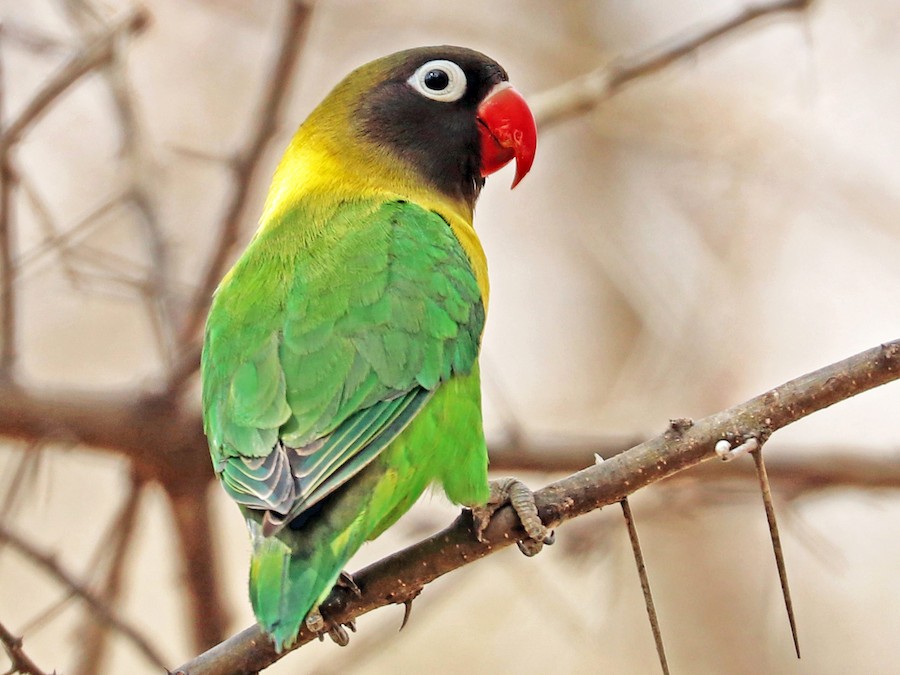
The Yellow-collared Lovebird, also known as Masked Lovebird, is a small, stocky parrot characterized by its distinctive black head, white eye-rings, and a prominent yellow collar. It is native to the arid and semi-arid regions of north-eastern Tanzania.
Size & lifespan
- Length
- 14-15 cm
- Wingspan
- 24-26 cm
- Weight
- 40-60 g
- Lifespan
- 5-10 years (wild), up to 15-20 years (captivity)
- Diet
- Herbivore (primarily granivorous and frugivorous)
Physical characteristics
- Plumage
- Adults have a striking black head, a bright yellow collar around the neck and upper breast, and a green body. The rump is blue, and the tail feathers are green with orange and black markings. The underparts are generally lighter green. There are several color mutations in captivity, but in the wild, the described coloration is standard.
- Beak shape
- Strong, hooked, and reddish-orange in color.
- Eye color
- Dark brown with a prominent white periophthalmic ring (eye-ring).
- Leg color
- Greyish-pink to grey.
- Distinguishing features
- The combination of a black head, white eye-rings, and a yellow collar is unique among wild lovebird species. The blue rump is also a key field mark.
- Juvenile appearance
- Juveniles resemble adults but have duller plumage, a less intense black on the head, and a paler yellow collar. The beak may have a blackish base or markings that fade with maturity.
- Seasonal changes
- No significant seasonal plumage changes.
- Sexual dimorphism
- Monorphic; males and females are visually identical. Sexing typically requires DNA testing or endoscopic examination.
How to identify
- 1
Head and Eye-ring
Look for the distinctive black 'mask' covering the face and forehead, sharply contrasted by bright white eye-rings.
- 2
Collar Color
Observe the prominent bright yellow band around the neck and upper breast, which gives the bird its common name.
- 3
Body Plumage
Note the vibrant green plumage on the back, wings, and underparts, with a contrasting blue rump.
- 4
Beak Color
Identify the strong, hooked, reddish-orange beak.
- 5
Vocalizations
Listen for their characteristic high-pitched, chattering, and screeching calls, often given in flight or when in a flock.
Habitat & range
- Biomes
- Savanna, dry bushland, cultivated areas, and open woodlands.
- Geographic range
- Native to north-eastern Tanzania, particularly around the Serengeti National Park and the coastal regions. Feral populations exist in various urban areas worldwide due to escapes from captivity.
- Elevation range
- Typically found at elevations between 1,100 and 1,700 meters above sea level.
- Preferred environments
- Prefers areas with scattered acacia trees, baobabs, and other large trees for nesting and roosting, often near water sources. They adapt well to human-modified landscapes, including gardens and agricultural fields.
Behavior
- Activity time
- Diurnal. Most active during the early morning and late afternoon, resting during the hottest parts of the day.
- Feeding habits
- Feeds primarily on seeds of grasses and acacia, fruits (especially figs), berries, and occasionally insects or their larvae. They forage in flocks, often on the ground or in trees and shrubs.
- Social behavior
- Highly social birds, typically found in pairs or small flocks outside the breeding season. During the breeding season, they form larger colonies, especially around communal nesting sites. They are known for their strong pair bonds.
- Flight pattern
- Fast, direct, and often undulating flight with rapid wing beats. They are agile flyers, especially when navigating through dense vegetation.
- Migration pattern
- Resident; generally non-migratory, but may undertake local movements in search of food and water, especially during dry seasons.
- Territoriality
- Pairs are territorial around their nest site during the breeding season, but foraging flocks are generally cooperative.
Song & calls
- Song
- Does not have a complex song. Vocalizations are primarily calls.
- Call
- Produces a variety of high-pitched, chattering, and screeching calls. Their calls are often described as 'cheep-cheep' or 'scree-scree', delivered rapidly and repeatedly, especially when in flight or communicating within a flock. They can be quite noisy.
- When they vocalize
- Vocalizes frequently throughout the day, particularly when flying, feeding, or interacting with other lovebirds.
Breeding & reproduction
- Breeding season
- Typically occurs during the dry season, from March to May and July to September, but can vary depending on local rainfall and food availability.
- Nesting habits
- Nests communally in tree cavities, often in baobab or acacia trees. They are also known to utilize old weaver bird nests or even man-made structures. The female builds the nest using strips of bark, leaves, and other plant material, which she tucks into her rump feathers to carry to the nest site.
- Clutch size
- 3-8 eggs, typically 4-6.
- Egg description
- White, oval-shaped eggs.
- Incubation period
- Approximately 22-24 days, primarily by the female.
- Fledging period
- Chicks fledge around 42-45 days after hatching.
- Parental care
- Both parents participate in feeding the chicks after hatching, though the female does most of the incubation. Young are dependent on parents for a period after fledging.
Where to find
Savanna and Bushland
Search in the dry savanna and bushland regions of north-eastern Tanzania, particularly areas with acacia and baobab trees.
Cultivated Areas and Gardens
They can often be found in agricultural fields, gardens, and suburban areas where food and nesting sites are available, especially in their native range and where feral populations exist.
Near Water Sources
Look for them near rivers, lakes, and other water bodies, as they require regular access to water.
Field tips
- Listen for Calls. Their loud, chattering calls often give away their presence before they are seen. Listen for these distinctive vocalizations, especially in the morning and late afternoon.
- Observe Flocks. Yellow-collared Lovebirds are highly social. Look for small to medium-sized flocks feeding on the ground or perched in trees.
- Check Tree Cavities. During the breeding season, observe tree cavities, especially in large acacia or baobab trees, as these are preferred nesting sites.
- Visit Waterholes. They visit waterholes regularly, especially during dry periods. Waiting near a water source can increase your chances of spotting them.
Similar species
Fischer's Lovebird
Agapornis fischeri
Fischer's Lovebird has an orange head that fades to yellow on the neck, a green body, and a blue rump. It lacks the distinct black mask and yellow collar of the Yellow-collared Lovebird. The eye-ring is also white, but the head coloration is the primary distinguishing feature.
Lilian's Lovebird
Agapornis lilianae
Lilian's Lovebird (Nyasa Lovebird) has a red-orange head and throat, fading to yellow on the neck, and a green body. It lacks the black mask and prominent yellow collar of the Yellow-collared Lovebird. Its overall coloration is generally paler.
Quick facts
- Common Name:
- Yellow-collared Lovebird (Masked Lovebird)
- Scientific Name:
- Agapornis personatus
- Native Range:
- North-eastern Tanzania
- Diet:
- Seeds, fruits, berries
- Conservation Status:
- Least Concern
- Social Behavior:
- Highly social, forms pairs and flocks
Fun facts
- The 'personatus' in its scientific name refers to its 'masked' appearance, derived from the Latin word 'persona' meaning mask.
- Yellow-collared Lovebirds are popular cage birds, leading to the establishment of feral populations in various parts of the world, including Florida (USA) and parts of Europe.
- Like other lovebirds, they are known for their strong pair bonds, often seen preening each other and staying close together.
- Females have a unique method of carrying nesting material by tucking strips of bark or leaves into their rump feathers.
Scientific classification
- Kingdom
- Animalia
- Phylum
- Chordata
- Class
- Aves
- Order
- Psittaciformes
- Family
- Psittaculidae
- Genus
- Agapornis
- Species
- Agapornis personatus
Explore the Yellow-collared Lovebird
Identify birds anywhere
Free on iOS, Android, and Web. Photo & sound identification, full species database, and your personal life list.