
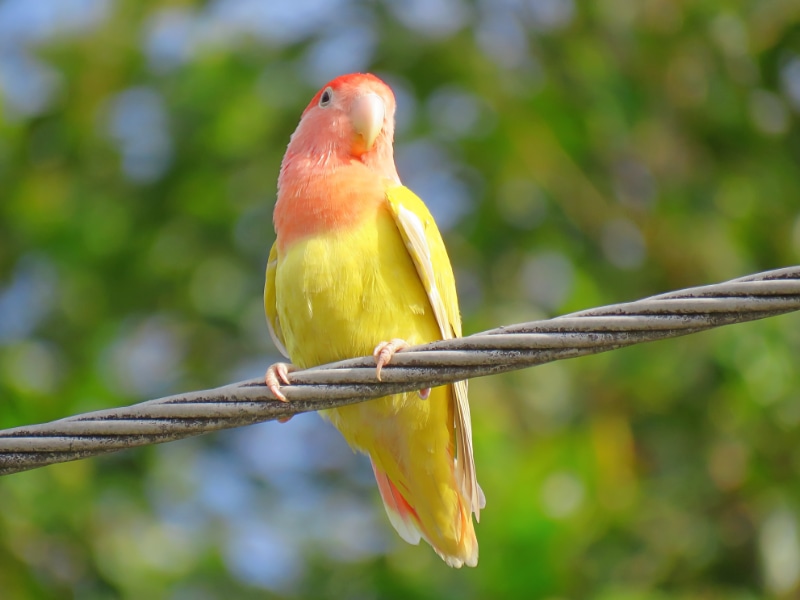
Where does the Peach-faced Lovebird live?
Agapornis roseicollis
Spotted a bird? Identify it instantly with the Birdby app
Open the appThe Peach-faced Lovebird lives in specific habitats and regions. Knowing where, and when, to look improves your chances of a successful sighting.
Biomes
Arid and semi-arid scrublands, savannas, woodlands, and riverine forests.
Geographic range
Native to southwestern Africa, primarily found in Namibia, Angola, and parts of South Africa (Northern Cape province). Feral populations exist in various urban areas worldwide due to escapes from captivity.
Preferred environments
Prefers dry, open country with scattered trees (especially Acacia and Mopane), rocky outcrops, and a reliable water source. They often inhabit areas near rivers, dams, and agricultural lands where food is abundant.
Elevation range
Typically found from sea level up to 1,600 meters (5,250 feet).
Where to look
Arid and Semi-arid Regions
Focus on areas with sparse vegetation, rocky outcrops, and scattered trees in southwestern Africa.
Near Water Sources
They are often found close to rivers, dams, and waterholes, especially during dry periods, as they need to drink regularly.
Agricultural Areas
Sometimes found in cultivated lands where they can feed on crop seeds.
Urban Feral Populations
In some parts of the world (e.g., Phoenix, Arizona, USA; parts of Europe), escaped captive birds have established breeding populations in urban parks and gardens.
Field tips
- Listen for Calls. Their noisy vocalizations often give away their presence before they are seen. Listen for their high-pitched chattering.
- Look for Flocks. They are highly social and almost always found in groups. Scan trees and open areas for flocks.
- Visit Waterholes. During hot periods, stake out water sources in their native range, as they will come to drink.
- Observe Feeding Behavior. Watch for them foraging on the ground for seeds or in trees for fruits and buds.
- Check Roosting Sites. Large flocks often gather at communal roosting sites in trees or on cliffs at dusk.
Migration
Resident throughout their range, but may undertake local nomadic movements in response to food and water availability, particularly during dry seasons.
Explore the Peach-faced Lovebird
Identify birds anywhere
Free on iOS, Android, and Web. Photo & sound identification, full species database, and your personal life list.