
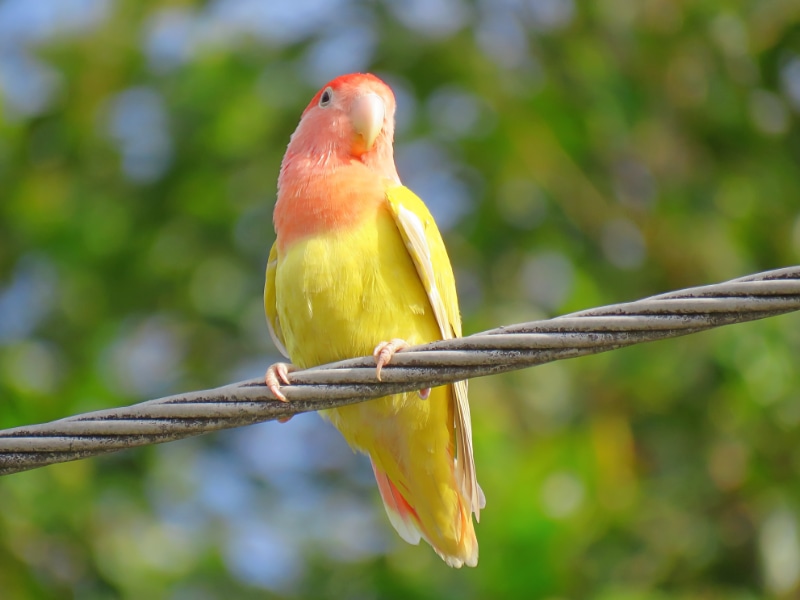
How to identify the Peach-faced Lovebird
Agapornis roseicollis
Spotted a bird? Identify it instantly with the Birdby app
Open the appTo correctly identify the Peach-faced Lovebird (Agapornis roseicollis), check each of these features. Birds can be tricky: habit, habitat, and call often confirm a sighting that a single photo cannot.
Size at a glance
- Length
- 15-18 cm (6-7 inches)
- Wingspan
- 25-30 cm (10-12 inches)
- Weight
- 45-60 g (1.6-2.1 oz)
Physical features to check
- 1
Plumage
Overall feather coloration and pattern.
Adults are predominantly bright green on the body, with a distinctive rosy-pink to peach-colored face and throat, extending to the upper breast. The rump is bright blue. The flight feathers are dark green to blackish, and the tail feathers are green with blue tips and black subterminal bands, often with red or orange markings near the base. The underparts are lighter green.
- 2
Beak shape
Shape and color of the bill: a key field mark.
Strong, hooked, and relatively large for its size; horn-colored or yellowish-white with a reddish tinge at the base.
- 3
Eye color
Iris color and any distinctive eye markings.
Dark brown with a prominent white periophthalmic ring (bare skin around the eye).
- 4
Leg color
Leg and foot color.
Greyish-pink to grey
- 5
Distinguishing features
Standout features that separate this species.
The combination of the bright green body, peach-colored face, and blue rump is highly distinctive. The white eye-ring is also a key field mark.
- 6
Juvenile appearance
How young birds differ from adults.
Juveniles resemble adults but have duller plumage. The peach coloration on the face is less intense, often appearing paler pink or even whitish. The blue rump may be less vibrant, and the beak may have a darker, brownish-black base that lightens with age.
- 7
Seasonal changes
Plumage variation between breeding and non-breeding seasons.
No significant seasonal plumage changes. Plumage remains consistent year-round.
- 8
Sexual dimorphism
How males and females differ.
Visually, there is no significant sexual dimorphism in plumage. Males and females look identical. Sexing typically requires DNA testing or behavioral observation during breeding.
Key field marks
- Face Coloration. Look for the distinctive rosy-pink to peach-colored face and throat. This is the most prominent field mark.
- Body Plumage. Observe the bright green body plumage, which contrasts sharply with the facial coloration.
- Rump Color. Note the bright blue rump, visible in flight or when perched with wings slightly open.
- Eye-ring. Identify the prominent white bare skin ring around the dark brown eye.
- Vocalizations. Listen for their characteristic high-pitched, chattering, and screeching calls, especially when in flocks.
- Flight Pattern. Observe their swift, direct flight, often in tight, undulating flocks.
Explore the Peach-faced Lovebird
Identify birds anywhere
Free on iOS, Android, and Web. Photo & sound identification, full species database, and your personal life list.