
Spotted a bird? Identify it instantly with the Birdby app
Open the appAbout
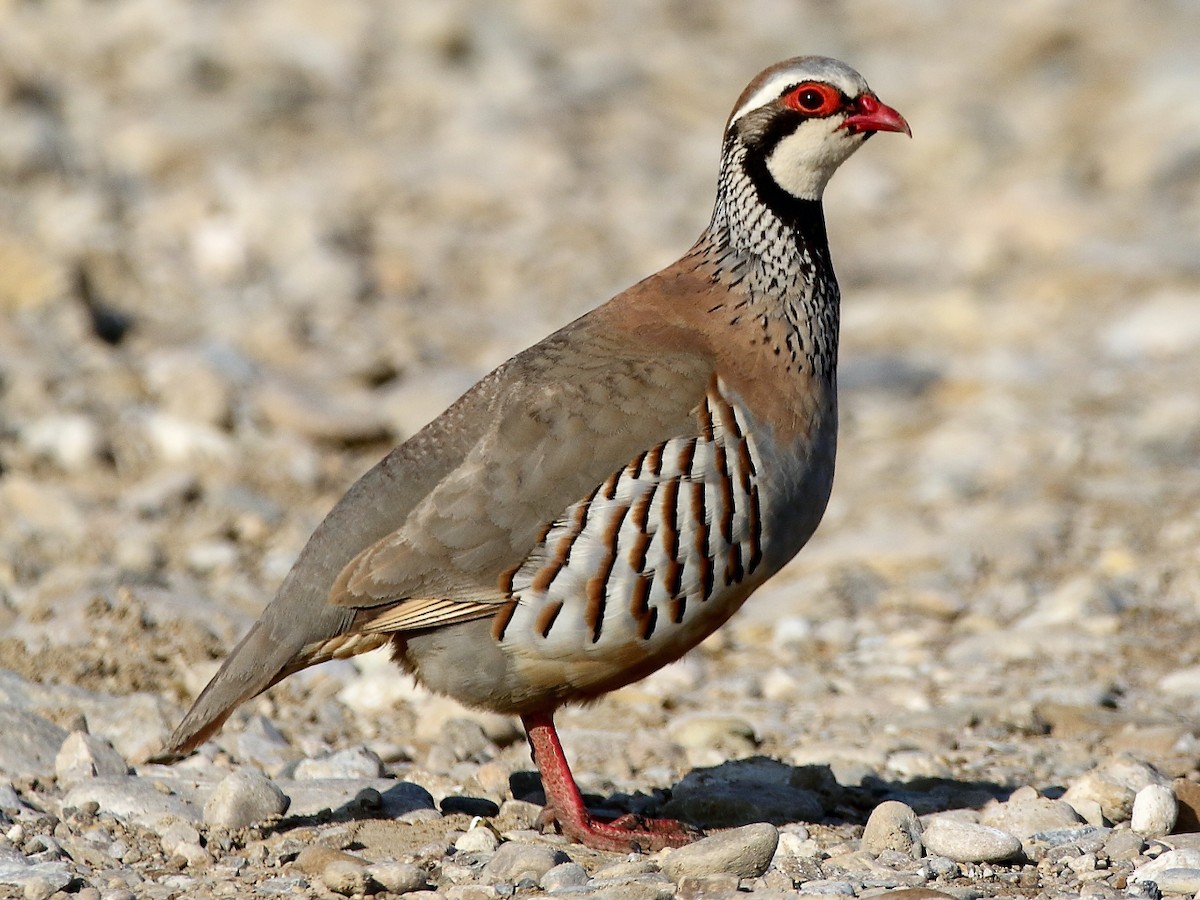
The Red-legged Partridge is a medium-sized game bird native to southwestern Europe. It is characterized by its distinctive red legs and beak, a white throat bordered by a black gorget, and barred flanks. It is a popular game bird and has been widely introduced outside its native range.
Size & lifespan
- Length
- 32-35 cm (12.6-13.8 in)
- Wingspan
- 47-50 cm (18.5-19.7 in)
- Weight
- 390-550 g (13.8-19.4 oz)
- Lifespan
- 3-5 years in the wild, up to 10 years in captivity
- Diet
- Omnivore (primarily herbivorous)
Physical characteristics
- Plumage
- Adults have a pale brown back, grey breast, and buff belly. The most striking features are the white throat patch, bordered by a bold black gorget that extends into a black eye-stripe. The flanks are conspicuously barred with black, white, and chestnut stripes. The crown is brown, and there is a white supercilium. The undertail coverts are rufous.
- Beak shape
- Short, stout, and conical, bright red.
- Eye color
- Dark brown, surrounded by a red orbital ring.
- Leg color
- Bright red.
- Distinguishing features
- Bright red legs and beak, white throat with a prominent black gorget, and distinctive black, white, and chestnut barring on the flanks.
- Juvenile appearance
- Juveniles are duller and lack the distinctive facial markings and flank barring of adults. They have a more uniform brownish-grey plumage, with faint barring on the flanks and a less defined throat patch. Their legs and beak are duller, becoming redder with age.
- Seasonal changes
- No significant seasonal plumage changes. Plumage remains consistent throughout the year.
- Sexual dimorphism
- Males and females are largely similar in plumage. Males tend to be slightly larger and heavier, and often have a small, blunt spur on the tarsus, which is usually absent or much smaller in females. This spur is not always present or easily visible.
How to identify
- 1
Red Legs and Beak
Look for the bright coral-red legs and beak, a key distinguishing feature.
- 2
Head and Throat Pattern
Observe the prominent white throat patch bordered by a bold black gorget that extends as a black stripe through the eye. A white supercilium is also present.
- 3
Flank Barring
Note the distinctive black, white, and chestnut barring on the flanks. This pattern is unique among similar partridges.
- 4
Overall Plumage
The general coloration is pale brown on the back, grey on the breast, and buff on the belly.
- 5
Call
Listen for its characteristic harsh, chattering 'chuk-chuk-chuk-churrr' call, especially at dawn and dusk.
- 6
Behavior
Watch for its tendency to run rather than fly when disturbed, and its rapid, whirring flight over short distances if it does take to the air.
Habitat & range
- Biomes
- Mediterranean scrubland, agricultural land, open woodlands, grasslands, heathlands.
- Geographic range
- Native to France, Spain, Portugal, and northwest Italy. Widely introduced to the United Kingdom (especially England) and other parts of Europe, as well as some oceanic islands.
- Elevation range
- Typically found from sea level up to 2,000 meters (6,500 ft), though usually below 1,000 meters (3,300 ft).
- Preferred environments
- Prefers dry, open habitats with scattered scrub, hedges, and cultivated fields. It thrives in areas with a mosaic of cover for shelter and open ground for foraging, such as arable land, vineyards, olive groves, and heathland.
Behavior
- Activity time
- Diurnal, most active during early morning and late afternoon, often resting during the hottest parts of the day.
- Feeding habits
- Primarily herbivorous, feeding on seeds, leaves, shoots, roots, and fruits of various plants, including cereals, grasses, and weeds. They also consume insects, especially during the breeding season when protein is needed for chick development. Forages on the ground, often scratching with their feet.
- Social behavior
- Highly social outside the breeding season, forming coveys (flocks) of up to 30-50 individuals. During the breeding season, pairs become territorial. Coveys often consist of family groups.
- Flight pattern
- Flies with rapid, whirring wingbeats, typically low to the ground over short distances. When flushed, it often runs first before taking flight. Glides on stiffly held wings after an initial burst of flight.
- Migration pattern
- Sedentary; Red-legged Partridges are non-migratory residents throughout their range.
- Territoriality
- Pairs establish and defend breeding territories during the nesting season. Outside of this period, they are less territorial and form coveys.
Song & calls
- Song
- The 'song' is a distinctive, often repeated, harsh, chattering call, typically described as 'chuk-chuk-chuk-churrr' or 'ka-ka-ka-ka-kerrr'. It can be quite loud and carries well.
- Call
- Various calls include a sharp 'kek-kek-kek' alarm call when disturbed, and softer clucking sounds within the covey. The most characteristic call is the 'chuk-chuk-chuk-churrr' which serves both as a contact call and a territorial advertisement.
- When they vocalize
- Most vocal at dawn and dusk, and throughout the day during the breeding season. Calls can be heard year-round, especially when coveys are communicating.
Breeding & reproduction
- Breeding season
- Typically from March to July, with peak egg-laying in April-May.
- Nesting habits
- The nest is a shallow scrape on the ground, often concealed under a bush, tussock of grass, or in dense vegetation. It is lined with leaves, grass, and feathers.
- Clutch size
- Typically 10-16 eggs, though clutches can range from 8 to 20. Double-brooding is rare but can occur.
- Egg description
- Eggs are pale buff or yellowish-white, often speckled or spotted with reddish-brown or grey. They are oval-shaped.
- Incubation period
- 23-24 days. Primarily incubated by the female, though males may assist.
- Fledging period
- Chicks are precocial and leave the nest shortly after hatching. They can fly short distances at about 10-12 days old and are fully independent by 6-8 weeks.
- Parental care
- Both parents care for the chicks, leading them to foraging areas and protecting them from predators. The male often takes over care of the first brood if the female attempts a second clutch.
Where to find
Agricultural Land
Look in cultivated fields, especially those with cereal crops, vineyards, and olive groves.
Heathland and Scrubland
Check open, dry areas with scattered bushes, gorse, and heather.
Open Woodlands and Edges
Can be found in the fringes of woodlands, particularly those with a good understory.
Roadsides and Field Margins
Often seen foraging along the edges of roads and fields, especially in early morning or late afternoon.
Field tips
- Listen for Calls. Their distinctive chattering call is often the first indication of their presence. Listen for it at dawn and dusk.
- Look for Coveys. Outside the breeding season, they are usually found in coveys. Scan open areas for groups of birds foraging on the ground.
- Observe Movement. They prefer to run rather than fly. If you spot movement in the undergrowth, it might be a partridge. If flushed, they fly low and fast.
- Use Optics. Binoculars are essential for observing their detailed plumage markings, especially the head pattern and flank barring, which are crucial for identification.
- Be Patient and Quiet. Red-legged Partridges can be wary. Approach quietly and patiently to avoid flushing them prematurely.
Similar species
Chukar Partridge
Alectoris chukar
The Chukar has a similar black gorget, but it is narrower and does not extend into an eye-stripe. Its flanks have more uniform black barring without the distinct chestnut. The Chukar also lacks the white supercilium and has a greyish-brown crown, contrasting with the Red-legged Partridge's brown crown. The Chukar's call is also distinct, a more rhythmic 'chuk-chuk-chukar'.
Rock Partridge
Alectoris graeca
The Rock Partridge has a grey throat and a narrower black gorget that does not extend to the eye. Its flanks have less distinct barring, often with a more rufous wash. It also has a grey crown and a white supercilium that is less prominent than in the Red-legged Partridge. Found in higher, rockier habitats.
Barbary Partridge
Alectoris barbara
The Barbary Partridge has a chestnut collar and a grey throat with fine black speckling, rather than a solid black gorget. Its crown is grey, and it has a prominent chestnut patch on the sides of the head. Its flank barring is also different, typically broader and less defined.
Quick facts
- Native Range:
- Southwestern Europe (France, Spain, Portugal, NW Italy)
- Introduced Range:
- United Kingdom, other parts of Europe
- Social Structure:
- Coveys outside breeding season, pairs during breeding
- Flight:
- Short, fast, whirring flights; prefers running
- Dietary Preference:
- Seeds, leaves, insects
- Nest Type:
- Ground scrape
Fun facts
- The Red-legged Partridge is a popular game bird and is extensively reared and released for hunting purposes, particularly in the United Kingdom, where it is not native.
- It is sometimes referred to as the 'French Partridge' in the UK to distinguish it from the native Grey Partridge (Perdix perdix).
- Hybridization can occur between Red-legged Partridges and Chukar Partridges where their introduced ranges overlap, leading to identification challenges.
- Chicks are precocial, meaning they are born relatively mature and mobile, able to feed themselves and follow their parents shortly after hatching.
Scientific classification
- Kingdom
- Animalia
- Phylum
- Chordata
- Class
- Aves
- Order
- Galliformes
- Family
- Phasianidae
- Genus
- Alectoris
- Species
- Alectoris rufa
Explore the Red-legged Partridge
Identify birds anywhere
Free on iOS, Android, and Web. Photo & sound identification, full species database, and your personal life list.