
How to identify the Red-legged Partridge
Alectoris rufa
Spotted a bird? Identify it instantly with the Birdby app
Open the appTo correctly identify the Red-legged Partridge (Alectoris rufa), check each of these features. Birds can be tricky: habit, habitat, and call often confirm a sighting that a single photo cannot.
Size at a glance
- Length
- 32-35 cm (12.6-13.8 in)
- Wingspan
- 47-50 cm (18.5-19.7 in)
- Weight
- 390-550 g (13.8-19.4 oz)
Physical features to check
- 1
Plumage
Overall feather coloration and pattern.
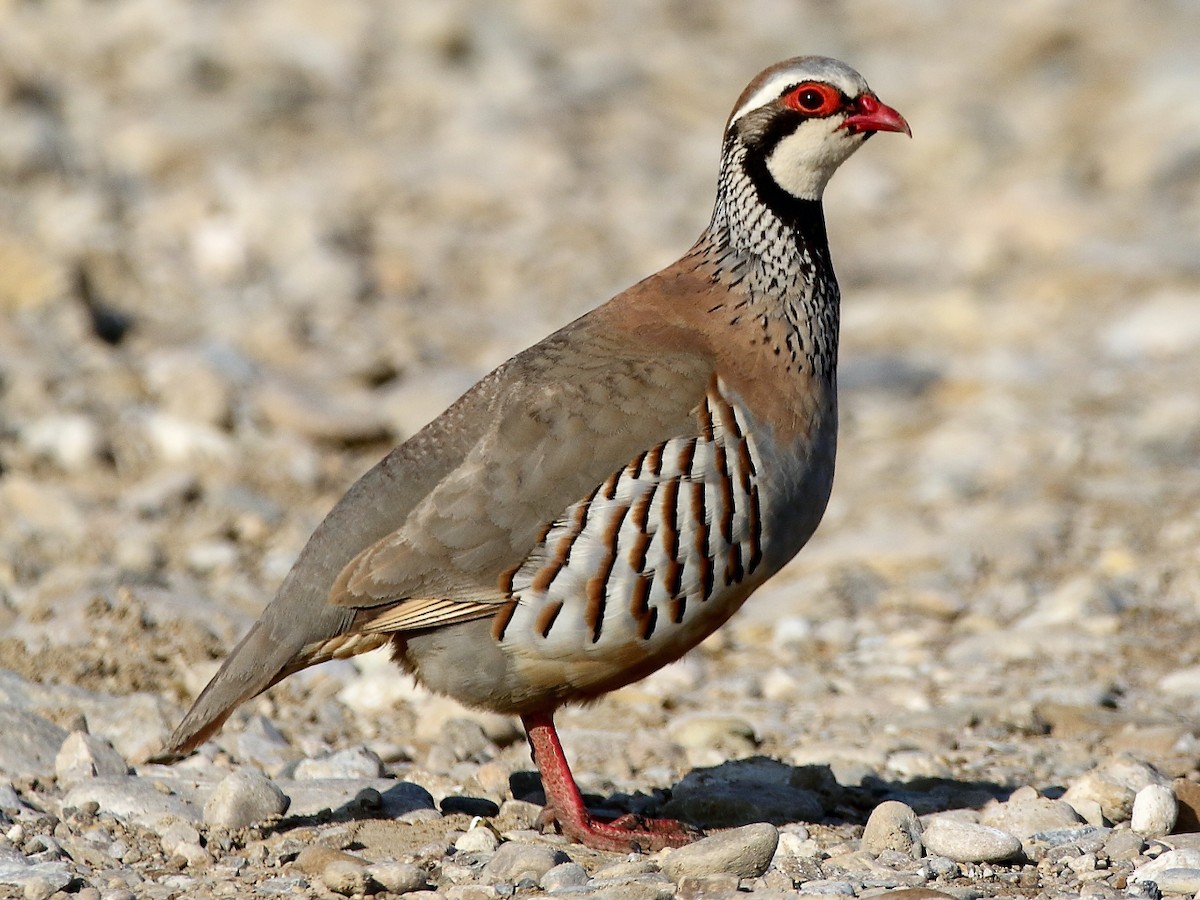
Adults have a pale brown back, grey breast, and buff belly. The most striking features are the white throat patch, bordered by a bold black gorget that extends into a black eye-stripe. The flanks are conspicuously barred with black, white, and chestnut stripes. The crown is brown, and there is a white supercilium. The undertail coverts are rufous.
- 2
Beak shape
Shape and color of the bill: a key field mark.
Short, stout, and conical, bright red.
- 3
Eye color
Iris color and any distinctive eye markings.
Dark brown, surrounded by a red orbital ring.
- 4
Leg color
Leg and foot color.
Bright red.
- 5
Distinguishing features
Standout features that separate this species.
Bright red legs and beak, white throat with a prominent black gorget, and distinctive black, white, and chestnut barring on the flanks.
- 6
Juvenile appearance
How young birds differ from adults.
Juveniles are duller and lack the distinctive facial markings and flank barring of adults. They have a more uniform brownish-grey plumage, with faint barring on the flanks and a less defined throat patch. Their legs and beak are duller, becoming redder with age.
- 7
Seasonal changes
Plumage variation between breeding and non-breeding seasons.
No significant seasonal plumage changes. Plumage remains consistent throughout the year.
- 8
Sexual dimorphism
How males and females differ.
Males and females are largely similar in plumage. Males tend to be slightly larger and heavier, and often have a small, blunt spur on the tarsus, which is usually absent or much smaller in females. This spur is not always present or easily visible.
Key field marks
- Red Legs and Beak. Look for the bright coral-red legs and beak, a key distinguishing feature.
- Head and Throat Pattern. Observe the prominent white throat patch bordered by a bold black gorget that extends as a black stripe through the eye. A white supercilium is also present.
- Flank Barring. Note the distinctive black, white, and chestnut barring on the flanks. This pattern is unique among similar partridges.
- Overall Plumage. The general coloration is pale brown on the back, grey on the breast, and buff on the belly.
- Call. Listen for its characteristic harsh, chattering 'chuk-chuk-chuk-churrr' call, especially at dawn and dusk.
- Behavior. Watch for its tendency to run rather than fly when disturbed, and its rapid, whirring flight over short distances if it does take to the air.
Explore the Red-legged Partridge
Identify birds anywhere
Free on iOS, Android, and Web. Photo & sound identification, full species database, and your personal life list.