
Spotted a bird? Identify it instantly with the Birdby app
Open the appAbout
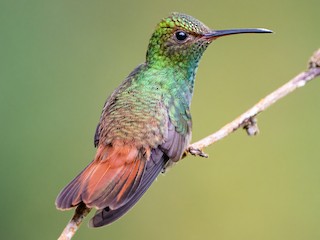
The Rufous-tailed Hummingbird (Amazilia tzacatl) is a medium-sized, iridescent hummingbird found in a wide range of habitats from Mexico to northern South America. It is characterized by its bright green plumage, rufous (reddish-brown) tail, and bicolored bill. It is a common and conspicuous species, often seen in gardens and forest edges.
Size & lifespan
- Length
- 9-11 cm (3.5-4.3 in)
- Wingspan
- 11-13 cm (4.3-5.1 in)
- Weight
- 4.5-5.5 g (0.16-0.19 oz)
- Lifespan
- 3-5 years in the wild, up to 7-8 years recorded
- Diet
- Nectarivore, primarily feeding on nectar from a wide variety of flowering plants. Also consumes small insects and spiders for protein.
Physical characteristics
- Plumage
- Adults have iridescent green plumage on the crown, back, and flanks, transitioning to a duller, bronzy-green on the rump. The throat and upper breast are brilliant iridescent green. The belly is grayish-white, often with a green wash on the sides. The most distinctive feature is the rufous (reddish-brown) tail, which is slightly forked, with the central rectrices (tail feathers) sometimes having a bronzy-green wash. The undertail coverts are also rufous.
- Beak shape
- Straight, medium-length bill. The upper mandible is black, and the lower mandible is reddish-pink or orange with a black tip.
- Eye color
- Dark brown
- Leg color
- Dark gray to black
- Distinguishing features
- The combination of iridescent green upperparts, brilliant green throat, grayish belly, and a prominent rufous tail with a bicolored bill (reddish lower mandible with a black tip) are key identification marks.
- Juvenile appearance
- Juveniles resemble adult females but have duller plumage, often with buffy or rufous edgings on the feathers of the head and back, giving them a somewhat scaly appearance. The bill coloration may be less vibrant, with the reddish lower mandible being paler or more orange.
- Seasonal changes
- No significant seasonal plumage changes. Plumage remains consistent throughout the year.
- Sexual dimorphism
- Males and females are very similar in plumage. Females may be slightly duller overall, with less extensive iridescent green on the throat and a slightly more grayish belly, but these differences are subtle and often not reliable for field identification.
How to identify
- 1
Tail Color
Look for the prominent rufous (reddish-brown) tail. This is the most distinctive field mark and gives the bird its common name.
- 2
Plumage Coloration
Observe the brilliant iridescent green on the throat and upper breast, contrasting with the grayish-white belly. The back and crown are also iridescent green.
- 3
Bill Color
Note the bicolored bill: black upper mandible and a reddish-pink or orange lower mandible with a black tip.
- 4
Size and Shape
It's a medium-sized hummingbird with a relatively straight bill and a slightly forked tail.
- 5
Vocalizations
Listen for its characteristic sharp 'chip' calls and squeaky, chattering songs, especially when it's agitated or defending territory.
Habitat & range
- Biomes
- Tropical and subtropical moist broadleaf forests, forest edges, secondary growth, plantations, gardens, and urban areas.
- Geographic range
- Extends from southeastern Mexico (Veracruz, Oaxaca, Chiapas) through Central America (Belize, Guatemala, El Salvador, Honduras, Nicaragua, Costa Rica, Panama) and into northern South America (Colombia, Venezuela, western Ecuador, and extreme northern Peru).
- Elevation range
- Typically found from sea level up to 1,800 meters (5,900 feet), occasionally higher, up to 2,500 meters (8,200 feet) in some areas.
- Preferred environments
- Highly adaptable, preferring semi-open areas with abundant flowering plants. Common in coffee plantations, suburban gardens, parks, and the edges of humid evergreen and deciduous forests.
Behavior
- Activity time
- Diurnal, most active during daylight hours, particularly in the morning and late afternoon.
- Feeding habits
- Feeds primarily on nectar, hovering in front of flowers and extending its long tongue to extract nectar. It is an opportunistic feeder, visiting a wide variety of flowering plants. Also catches small insects and spiders on the wing or gleans them from foliage, especially important for protein during breeding. Often defends rich feeding territories against other hummingbirds and insects.
- Social behavior
- Generally solitary, especially when foraging, but may gather at abundant food sources. Males are territorial, particularly during the breeding season, defending prime feeding areas and nesting sites.
- Flight pattern
- Characterized by rapid, agile flight, typical of hummingbirds. Capable of hovering, flying backward, and darting quickly between flowers. Wings beat at a very high frequency, producing a distinct humming sound.
- Migration pattern
- Mostly resident throughout its range, with no significant migratory movements. Local altitudinal movements may occur in some areas in response to flowering cycles.
- Territoriality
- Highly territorial, especially males. They aggressively defend feeding patches and nesting areas from other hummingbirds, insects, and even larger birds, often engaging in aerial chases and vocalizations.
Song & calls
- Song
- The song is a series of high-pitched, squeaky, and often jumbled notes, sometimes described as a 'squeaky-toy' sound. It can be a rapid, chattering series of 'tchip-tchip-tchip' notes or a more complex, varied warble.
- Call
- Common calls include a sharp, metallic 'chip' or 'tchip' note, often given repeatedly when agitated or defending territory. Also produces a rapid, chattering 'chi-chi-chi-chi' or 'tzzzzzt' sound during chases or interactions.
- When they vocalize
- Vocalizes throughout the day, particularly when foraging, defending territory, or during courtship displays. Calls are more frequent during the breeding season.
Breeding & reproduction
- Breeding season
- Varies geographically, but generally year-round in tropical regions, with peaks during periods of abundant flowering. In Central America, it often breeds from February to July.
- Nesting habits
- The female builds a small, cup-shaped nest, typically 1-3 meters (3-10 feet) above the ground, often on a thin, downward-sloping branch or fork. The nest is constructed from plant fibers, mosses, and spider silk, which gives it elasticity to expand as the chicks grow. The exterior is often camouflaged with lichens and bits of bark.
- Clutch size
- 2 eggs
- Egg description
- Typically lays two small, white, elliptical eggs.
- Incubation period
- 16-19 days, incubated solely by the female.
- Fledging period
- 18-22 days after hatching. The young are fed by the female.
- Parental care
- Only the female is involved in nest building, incubation, and raising the young. Males do not participate in parental care.
Where to find
Gardens and Parks
Common in suburban and urban gardens, parks, and botanical gardens with abundant flowering plants.
Forest Edges and Clearings
Frequently found at the edges of humid forests, clearings, and secondary growth areas.
Coffee Plantations
Often seen in coffee plantations, especially those with shade trees and diverse flowering undergrowth.
Riparian Zones
Can be found along rivers and streams where flowering vegetation is present.
Field tips
- Look for Movement. Hummingbirds are constantly active. Look for rapid, darting movements and hovering near flowers.
- Listen for Calls. Their sharp 'chip' calls are often the first indication of their presence, especially when they are chasing rivals.
- Visit Flowering Plants. Focus your search on areas with a variety of blooming flowers, particularly those with tubular shapes that hummingbirds prefer.
- Use Hummingbird Feeders. In areas where they are common, setting up a hummingbird feeder with sugar water can attract them to your viewing area.
- Observe Territorial Behavior. Watch for aggressive interactions between hummingbirds at feeders or flower patches, as this is a common behavior for Rufous-tailed Hummingbirds.
Similar species
Steely-vented Hummingbird
Amazilia saucerottei
The Steely-vented Hummingbird has a blue-green or violet-blue rump and uppertail coverts, contrasting with its green back, and a dark, steel-blue tail. The Rufous-tailed Hummingbird has a bronzy-green rump and a rufous tail. The bill coloration is similar, but the tail color is the most reliable distinction.
Cinnamon Hummingbird
Amazilia rutila
The Cinnamon Hummingbird has entirely cinnamon-rufous underparts and a cinnamon-rufous tail, contrasting with its green upperparts. The Rufous-tailed Hummingbird has a grayish-white belly and only a rufous tail.
Azure-crowned Hummingbird
Amazilia cyanocephala
The Azure-crowned Hummingbird has a distinctive iridescent blue crown and a white belly, but its tail is dark, not rufous. Its bill is also entirely black or mostly black.
Quick facts
- Diet:
- Nectar and small insects
- Habitat:
- Forest edges, gardens, plantations
- Tail Color:
- Rufous (reddish-brown)
- Bill Color:
- Bicolored (black upper, reddish lower with black tip)
- Conservation Status:
- Least Concern
Fun facts
- The Rufous-tailed Hummingbird is one of the most widespread and common hummingbirds in its range, often being the first hummingbird species encountered by visitors to Central and northern South America.
- Despite its small size, it is known for its aggressive territorial defense, often chasing away much larger birds and even insects from its feeding patches.
- Like all hummingbirds, it has an extremely high metabolism and must feed frequently throughout the day to sustain itself.
- Its rapid wing beats can create a distinct humming sound, which is how hummingbirds got their name.
Scientific classification
- Kingdom
- Animalia
- Phylum
- Chordata
- Class
- Aves
- Order
- Apodiformes
- Family
- Trochilidae
- Genus
- Amazilia
- Species
- Amazilia tzacatl
Explore the Rufous-tailed Hummingbird
Identify birds anywhere
Free on iOS, Android, and Web. Photo & sound identification, full species database, and your personal life list.