
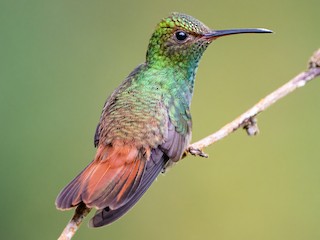
Where does the Rufous-tailed Hummingbird live?
Amazilia tzacatl
Spotted a bird? Identify it instantly with the Birdby app
Open the appThe Rufous-tailed Hummingbird lives in specific habitats and regions. Knowing where, and when, to look improves your chances of a successful sighting.
Biomes
Tropical and subtropical moist broadleaf forests, forest edges, secondary growth, plantations, gardens, and urban areas.
Geographic range
Extends from southeastern Mexico (Veracruz, Oaxaca, Chiapas) through Central America (Belize, Guatemala, El Salvador, Honduras, Nicaragua, Costa Rica, Panama) and into northern South America (Colombia, Venezuela, western Ecuador, and extreme northern Peru).
Preferred environments
Highly adaptable, preferring semi-open areas with abundant flowering plants. Common in coffee plantations, suburban gardens, parks, and the edges of humid evergreen and deciduous forests.
Elevation range
Typically found from sea level up to 1,800 meters (5,900 feet), occasionally higher, up to 2,500 meters (8,200 feet) in some areas.
Where to look
Gardens and Parks
Common in suburban and urban gardens, parks, and botanical gardens with abundant flowering plants.
Forest Edges and Clearings
Frequently found at the edges of humid forests, clearings, and secondary growth areas.
Coffee Plantations
Often seen in coffee plantations, especially those with shade trees and diverse flowering undergrowth.
Riparian Zones
Can be found along rivers and streams where flowering vegetation is present.
Field tips
- Look for Movement. Hummingbirds are constantly active. Look for rapid, darting movements and hovering near flowers.
- Listen for Calls. Their sharp 'chip' calls are often the first indication of their presence, especially when they are chasing rivals.
- Visit Flowering Plants. Focus your search on areas with a variety of blooming flowers, particularly those with tubular shapes that hummingbirds prefer.
- Use Hummingbird Feeders. In areas where they are common, setting up a hummingbird feeder with sugar water can attract them to your viewing area.
- Observe Territorial Behavior. Watch for aggressive interactions between hummingbirds at feeders or flower patches, as this is a common behavior for Rufous-tailed Hummingbirds.
Migration
Mostly resident throughout its range, with no significant migratory movements. Local altitudinal movements may occur in some areas in response to flowering cycles.
Explore the Rufous-tailed Hummingbird
Identify birds anywhere
Free on iOS, Android, and Web. Photo & sound identification, full species database, and your personal life list.