
Spotted a bird? Identify it instantly with the Birdby app
Open the appAbout
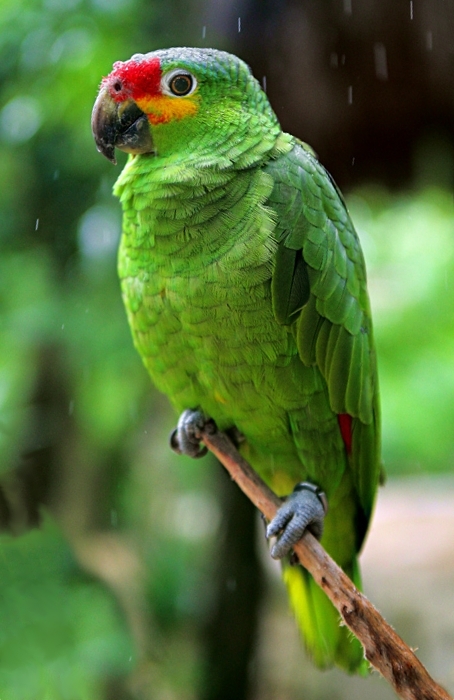
The Red-lored Amazon is a medium-sized, predominantly green parrot native to tropical regions of the Americas. It is known for its distinctive red forehead and yellow cheeks, and its ability to mimic human speech, making it a popular pet. In the wild, it is a social bird, often seen in pairs or small flocks, feeding on fruits, seeds, and nuts in the forest canopy.
Size & lifespan
- Length
- 32-35 cm (12.5-13.8 in)
- Wingspan
- 58-66 cm (23-26 in)
- Weight
- 310-480 g (10.9-16.9 oz)
- Lifespan
- Up to 50-60 years in captivity, likely shorter in the wild (20-30 years estimated)
- Diet
- Herbivore (frugivore, granivore, nectarivore)
Physical characteristics
- Plumage
- Predominantly bright green plumage. The forehead and lores (area between the eye and bill) are bright red. The cheeks and ear coverts are yellow, often with a variable amount of orange. The crown is blue-violet, fading to green on the nape. The bend of the wing is red, and the primary coverts are blue. The outer webs of the flight feathers are blue-violet, and the tail feathers are green with red at the base of the outer feathers and yellowish tips.
- Beak shape
- Strong, hooked, greyish-horn colored beak, often with a darker tip.
- Eye color
- Orange-red iris with a pale periophthalmic ring.
- Leg color
- Greyish-pink to grey.
- Distinguishing features
- The combination of a bright red forehead, yellow cheeks, and blue-violet crown is diagnostic. The red patch at the bend of the wing is also a key field mark.
- Juvenile appearance
- Juveniles resemble adults but have duller plumage, less extensive red on the forehead, paler yellow on the cheeks, and a brownish iris. The blue on the crown may be less pronounced.
- Seasonal changes
- No significant seasonal plumage changes.
- Sexual dimorphism
- None visually apparent; males and females are monomorphic in plumage.
How to identify
- 1
Head Pattern
Look for the bright red forehead and lores, combined with prominent yellow cheeks and a blue-violet crown. This specific combination is unique to the Red-lored Amazon.
- 2
Plumage Color
Overall bright green body plumage. Note the red patch at the bend of the wing and blue primary coverts, which are visible in flight or when perched with wings slightly open.
- 3
Vocalizations
Listen for its loud, harsh, rolling squawks and screeches. These distinctive calls are often heard before the bird is seen, especially when flocks are flying to or from roosts.
- 4
Flight Style
Observe its strong, direct flight with rapid wing beats. Often flies in pairs or small groups, making it easier to spot against the sky.
Habitat & range
- Biomes
- Tropical and subtropical moist broadleaf forests, gallery forests, semi-open woodlands, and cultivated areas with scattered trees.
- Geographic range
- From eastern Mexico south through Central America to northern Colombia and northwestern Venezuela. Also found on some Caribbean islands as an introduced species.
- Elevation range
- Sea level up to 1,200 meters (3,900 ft), occasionally higher.
- Preferred environments
- Prefers areas with tall trees for roosting and nesting, often near water sources. Adapts well to disturbed habitats and agricultural landscapes as long as suitable trees are present.
Behavior
- Activity time
- Diurnal, most active during early morning and late afternoon.
- Feeding habits
- Feeds primarily on a variety of fruits, seeds, nuts, berries, and flowers. Often forages in the canopy of trees, sometimes descending to lower branches or the ground. Known to feed on cultivated crops, leading to conflict with farmers.
- Social behavior
- Highly social, typically seen in pairs or small family groups during the day. Gathers in larger, sometimes very large, communal roosts at night.
- Flight pattern
- Strong, direct flight with rapid wing beats. Often flies in pairs or small, noisy flocks, especially at dawn and dusk when moving to and from roosting sites.
- Migration pattern
- Resident throughout its range; no significant migratory movements, though local movements may occur in response to food availability.
- Territoriality
- Breeding pairs are territorial around their nest site, but flocks are generally tolerant of each other in feeding and roosting areas.
Song & calls
- Song
- Does not have a complex song. Vocalizations are primarily calls.
- Call
- A variety of loud, raucous, rolling squawks and screeches. Common calls include a harsh 'kraa-aah' or 'kree-ee-ee', often repeated. Also produces softer chattering and whistling sounds, especially when perched. Known for its ability to mimic sounds and human speech.
- When they vocalize
- Most vocal at dawn and dusk, during flight, and when disturbed or interacting within a flock.
Breeding & reproduction
- Breeding season
- Varies geographically, typically from February to May in Mexico and Central America, and later in the year in South America.
- Nesting habits
- Nests in tree cavities, often in dead palms or large deciduous trees. Both parents inspect potential nest sites.
- Clutch size
- 2-4 eggs, typically 3.
- Egg description
- White, elliptical eggs.
- Incubation period
- Approximately 25-28 days.
- Fledging period
- Chicks fledge (leave the nest) around 56-60 days after hatching.
- Parental care
- Both parents participate in incubation and feeding of the young. Young remain dependent on parents for several weeks after fledging.
Where to find
Tropical and Subtropical Forests
Primary habitat, particularly in areas with mature trees for nesting and roosting. Look along forest edges and clearings.
Gallery Forests
Forests lining rivers and streams, providing essential water and food sources.
Agricultural Areas with Scattered Trees
Can be found in cultivated lands, orchards, and plantations where suitable large trees remain for shelter and nesting.
Urban and Suburban Parks
In some parts of its range, particularly where introduced, it can adapt to urban environments with mature trees.
Field tips
- Listen for Calls. Red-lored Amazons are often heard before they are seen. Their loud, distinctive calls are a good indicator of their presence, especially at dawn and dusk.
- Scan Tree Canopies. They spend much of their time foraging in the upper canopy of trees. Use binoculars to scan the tops of fruiting trees.
- Visit Roosting Sites. Locate communal roosting sites, often large trees, where many individuals gather at dusk and disperse at dawn. These can be excellent places for observation.
- Look for Feeding Activity. Observe trees with ripe fruits or seeds. Parrots are often quite messy eaters, and discarded fruit parts or shells can indicate their presence.
- Be Patient and Quiet. Like many parrots, they can be wary. Approach quietly and observe from a distance to avoid disturbing them.
Similar species
Yellow-naped Amazon
Amazona auropalliata
Lacks the red forehead and yellow cheeks of the Red-lored Amazon. Instead, it has a prominent yellow patch on the nape of the neck. Its overall green plumage is similar, but the head markings are distinct.
Yellow-headed Amazon
Amazona oratrix
Distinguished by its entirely yellow head (forehead, crown, and nape), which is much more extensive than the yellow cheeks and blue crown of the Red-lored Amazon. Also lacks the red lores.
White-fronted Amazon
Amazona albifrons
Smaller in size. Has a white forehead, blue crown, and red around the eyes. The red lores are present, but the white forehead and blue crown are key differentiators from the Red-lored Amazon's red forehead and blue-violet crown.
Quick facts
- Common Name:
- Red-lored Amazon
- Scientific Name:
- Amazona autumnalis
- Family:
- Psittacidae
- Size:
- Medium (32-35 cm)
- Diet:
- Fruits, seeds, nuts, flowers
- Habitat:
- Tropical forests, woodlands, cultivated areas
- Conservation Status:
- Least Concern
- Distinguishing Feature:
- Red forehead, yellow cheeks, blue crown
Fun facts
- The Red-lored Amazon is a popular pet bird due to its intelligence and ability to mimic human speech, though wild birds are not typically kept as pets.
- They are known to form large, noisy communal roosts, sometimes numbering in the hundreds or even thousands of individuals.
- Their diet includes a wide variety of plant matter, making them important seed dispersers in their native ecosystems.
- The species name 'autumnalis' refers to the autumn-like colors (red and yellow) on its head, though it is found in tropical regions year-round.
Scientific classification
- Kingdom
- Animalia
- Phylum
- Chordata
- Class
- Aves
- Order
- Psittaciformes
- Family
- Psittacidae
- Genus
- Amazona
- Species
- Amazona autumnalis
Explore the Red-lored Amazon
Identify birds anywhere
Free on iOS, Android, and Web. Photo & sound identification, full species database, and your personal life list.