
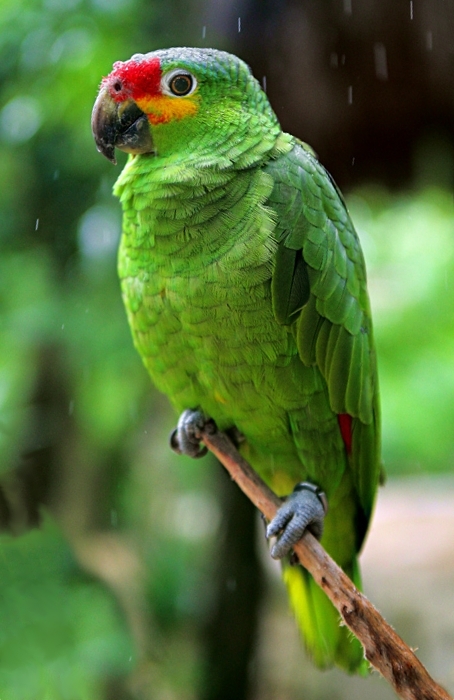
Where does the Red-lored Amazon live?
Amazona autumnalis
Spotted a bird? Identify it instantly with the Birdby app
Open the appThe Red-lored Amazon lives in specific habitats and regions. Knowing where, and when, to look improves your chances of a successful sighting.
Biomes
Tropical and subtropical moist broadleaf forests, gallery forests, semi-open woodlands, and cultivated areas with scattered trees.
Geographic range
From eastern Mexico south through Central America to northern Colombia and northwestern Venezuela. Also found on some Caribbean islands as an introduced species.
Preferred environments
Prefers areas with tall trees for roosting and nesting, often near water sources. Adapts well to disturbed habitats and agricultural landscapes as long as suitable trees are present.
Elevation range
Sea level up to 1,200 meters (3,900 ft), occasionally higher.
Where to look
Tropical and Subtropical Forests
Primary habitat, particularly in areas with mature trees for nesting and roosting. Look along forest edges and clearings.
Gallery Forests
Forests lining rivers and streams, providing essential water and food sources.
Agricultural Areas with Scattered Trees
Can be found in cultivated lands, orchards, and plantations where suitable large trees remain for shelter and nesting.
Urban and Suburban Parks
In some parts of its range, particularly where introduced, it can adapt to urban environments with mature trees.
Field tips
- Listen for Calls. Red-lored Amazons are often heard before they are seen. Their loud, distinctive calls are a good indicator of their presence, especially at dawn and dusk.
- Scan Tree Canopies. They spend much of their time foraging in the upper canopy of trees. Use binoculars to scan the tops of fruiting trees.
- Visit Roosting Sites. Locate communal roosting sites, often large trees, where many individuals gather at dusk and disperse at dawn. These can be excellent places for observation.
- Look for Feeding Activity. Observe trees with ripe fruits or seeds. Parrots are often quite messy eaters, and discarded fruit parts or shells can indicate their presence.
- Be Patient and Quiet. Like many parrots, they can be wary. Approach quietly and observe from a distance to avoid disturbing them.
Migration
Resident throughout its range; no significant migratory movements, though local movements may occur in response to food availability.
Explore the Red-lored Amazon
Identify birds anywhere
Free on iOS, Android, and Web. Photo & sound identification, full species database, and your personal life list.