
Spotted a bird? Identify it instantly with the Birdby app
Open the appAbout
The Eurasian Teal, often simply called Teal in Europe, is a small dabbling duck. It is the smallest extant dabbling duck in the world. Known for its swift, agile flight and distinctive calls, it is a common and widespread species across much of Eurasia.
Size & lifespan
- Length
- 34-38 cm (13-15 in)
- Wingspan
- 53-59 cm (21-23 in)
- Weight
- 200-450 g (7.1-15.9 oz)
- Lifespan
- Typically 5-10 years in the wild, with records up to 20 years.
- Diet
- Omnivore
Physical characteristics
- Plumage
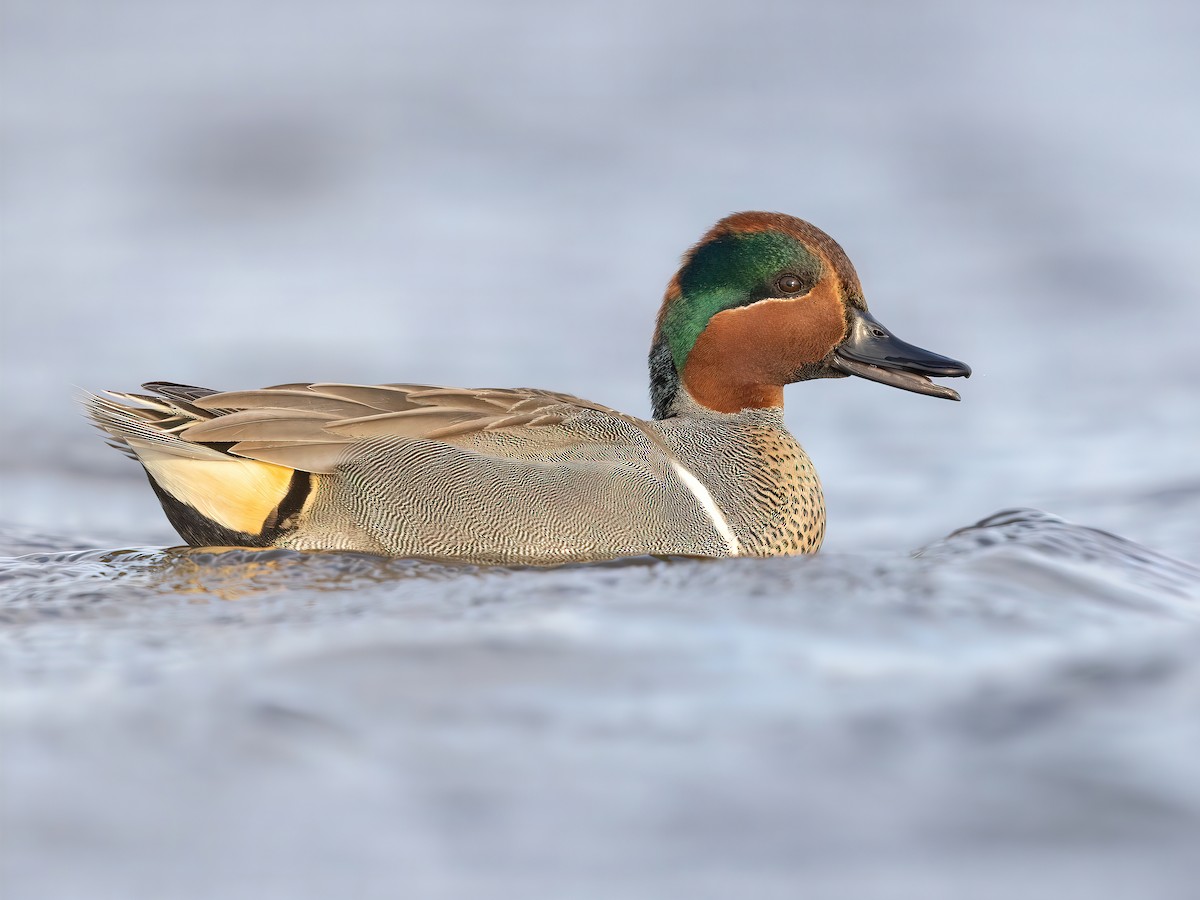
- Males in breeding plumage have a chestnut head with a broad, iridescent green patch extending from the eye to the nape, bordered by a thin creamy-white line. The breast is buff with dark spots, flanks are grey with a white horizontal stripe, and the back is grey with fine vermiculations. A prominent white stripe runs along the scapulars. The undertail coverts are yellow, bordered by black. Females are mottled brown and buff overall, with a darker crown and eye-stripe. Both sexes have a metallic green speculum, bordered by white, visible in flight and at rest.
- Beak shape
- Small, dark grey to black, spatulate bill, typical of dabbling ducks.
- Eye color
- Dark brown.
- Leg color
- Greyish-green to dark grey.
- Distinguishing features
- Small size, iridescent green speculum bordered by white, and the male's distinctive head pattern. The yellow undertail patch of the male is also a key field mark.
- Juvenile appearance
- Juveniles resemble adult females but are generally duller, with less distinct markings and often more streaking on the underparts. The speculum is less vibrant.
- Seasonal changes
- Males undergo an eclipse plumage from late summer to early autumn, resembling females but often retaining some hints of their breeding plumage, such as a darker head and a less distinct green eye-patch. They regain their full breeding plumage by late autumn/early winter.
- Sexual dimorphism
- Pronounced. Males are much more brightly colored, especially during breeding season, with distinctive head markings. Females are cryptically patterned in mottled browns.
How to identify
- 1
Size and Shape
Look for a very small, compact dabbling duck with a relatively short neck and small bill. It's noticeably smaller than a Mallard.
- 2
Male Breeding Plumage
The most striking feature is the chestnut head with the iridescent green eye-patch bordered by a thin creamy-white line. The yellow undertail patch bordered by black is also diagnostic.
- 3
Female Plumage
Mottled brown overall. Look for the small size, dark eye-stripe, and especially the metallic green speculum (wing patch) bordered by white, which is visible both in flight and when the bird is resting with wings folded.
- 4
Flight
Observe its rapid, agile flight, often in tight flocks. The green speculum is very prominent in flight.
- 5
Vocalization
Listen for the male's distinctive, high-pitched 'krick-krick' call, which is often the first clue to its presence.
Habitat & range
- Biomes
- Wetlands, marshes, shallow lakes, slow-moving rivers, estuaries, coastal lagoons, and flooded grasslands.
- Geographic range
- Widespread across the Palearctic, breeding from Iceland and Western Europe across northern Asia to the Pacific. Winters in Western and Southern Europe, North Africa, the Middle East, and South Asia.
- Elevation range
- Primarily lowlands, but can be found at moderate elevations in suitable wetland habitats.
- Preferred environments
- Shallow freshwater or brackish wetlands with dense emergent vegetation for cover and abundant aquatic invertebrates and seeds. Prefers areas with muddy edges for dabbling.
Behavior
- Activity time
- Diurnal, though may feed at night during migration or in areas with disturbance.
- Feeding habits
- Primarily a dabbling duck, feeding by tipping its head and forepart of its body into shallow water to reach submerged vegetation and invertebrates. Also grazes on land and filters food from the surface. Diet consists of seeds, aquatic plants, insects, larvae, mollusks, and crustaceans.
- Social behavior
- Highly gregarious outside the breeding season, forming large flocks, sometimes numbering thousands, especially during migration and in wintering grounds. During breeding, pairs are more solitary or found in loose groups.
- Flight pattern
- Very fast and agile flight, often in tight, rapidly changing flocks. Wings beat quickly, producing a characteristic 'whirring' sound. Takes off almost vertically from water.
- Migration pattern
- Strongly migratory across most of its range. Northern populations move south for the winter, often covering long distances. Southern populations may be resident or undertake shorter movements. Arrives at breeding grounds in early spring and departs for wintering grounds in late summer/early autumn.
- Territoriality
- Males defend a small territory around the female during the breeding season, but not a large nesting territory. Nests are typically well-hidden.
Song & calls
- Song
- The male's call is a distinctive, high-pitched, clear 'krick-krick' or 'cree-cree', often repeated. This is the origin of its common name in many languages.
- Call
- Females have a softer, quacking 'quack' or 'rraap' call, similar to a Mallard but much weaker and higher-pitched. Both sexes emit alarm calls when startled.
- When they vocalize
- Males call frequently during courtship and throughout the breeding season. Females call more often when disturbed or with young. Calls can be heard year-round, but are most prominent in spring.
Breeding & reproduction
- Breeding season
- Typically April to July, varying geographically.
- Nesting habits
- Nests are built on the ground, usually well-hidden in dense vegetation (grasses, sedges, reeds) near water. The nest is a shallow scrape lined with grass, leaves, and down plucked from the female's breast.
- Clutch size
- 6-12 eggs.
- Egg description
- 6-12 eggs, typically 8-10. Eggs are pale buff to creamy-white, sometimes with a greenish tinge, and unspotted. Average size is about 45 x 33 mm.
- Incubation period
- 21-23 days, primarily by the female.
- Fledging period
- 25-30 days. Ducklings are precocial and leave the nest shortly after hatching, able to feed themselves.
- Parental care
- Only the female cares for the ducklings. Males typically leave the female shortly after incubation begins.
Where to find
Shallow Wetlands
Look in shallow freshwater or brackish marshes, ponds, and slow-moving rivers with abundant emergent vegetation.
Coastal Lagoons and Estuaries
During migration and winter, they can be found in coastal areas, especially those with muddy flats and sheltered waters.
Flooded Fields
In winter, they often utilize flooded agricultural fields for feeding.
Field tips
- Scan the edges of water bodies. Teal often feed in the shallows, close to cover. Use binoculars to scan vegetated edges.
- Listen for calls. The male's 'krick-krick' call is very distinctive and can help locate hidden birds.
- Observe flight patterns. Their fast, erratic flight is characteristic. Look for small, rapidly moving flocks.
- Visit during migration. Spring and autumn migration periods offer the best chances to see large numbers, especially at traditional staging areas.
Similar species
Green-winged Teal
Anas carolinensis
The Green-winged Teal (formerly considered a subspecies of Eurasian Teal) is found in North America. Males differ by having a vertical white stripe on the side of the breast (absent in Eurasian Teal) and a less prominent white border to the green eye-patch. Females are virtually indistinguishable in the field without very close observation or genetic analysis.
Garganey
Spatula querquedula
Garganey males have a prominent white supercilium (eyebrow stripe) and a grey body, lacking the green head patch of the Teal. Females are more similar to female Teal but generally have a more distinct pale supercilium and a darker eye-stripe. Garganey also have a larger, greyer bill.
Mallard (female)
Anas platyrhynchos
Female Mallards are significantly larger than Teal. While also mottled brown, they lack the distinct green speculum bordered by white (Mallard speculum is blue-purple with white borders) and have a larger, orange-tinged bill.
Quick facts
- Smallest Dabbling Duck:
- The Eurasian Teal is the smallest dabbling duck species.
- Distinctive Male Call:
- Males have a unique 'krick-krick' call.
- Fast Flier:
- Known for its incredibly swift and agile flight.
- Green Speculum:
- Both sexes display a prominent metallic green wing patch bordered by white.
- Widespread Migrant:
- Undertakes long-distance migrations across Eurasia.
Fun facts
- The name 'Teal' is thought to derive from Middle English 'tele', possibly related to the Dutch 'taling', referring to its small size.
- Despite its small size, the Eurasian Teal is a strong flyer and can cover vast distances during migration, often flying at considerable altitudes.
- The iridescent green speculum is not due to pigment but rather the structural properties of the feathers, which reflect light in a specific way.
- In some parts of its range, the Eurasian Teal is a popular quarry for wildfowlers due to its abundance and challenging flight.
Scientific classification
- Kingdom
- Animalia
- Phylum
- Chordata
- Class
- Aves
- Order
- Anseriformes
- Family
- Anatidae
- Genus
- Anas
- Species
- Anas crecca
Explore the Eurasian Teal
Identify birds anywhere
Free on iOS, Android, and Web. Photo & sound identification, full species database, and your personal life list.