
Spotted a bird? Identify it instantly with the Birdby app
Open the appAbout
The Demoiselle Crane is the smallest and second most numerous crane species globally. It is renowned for its elegant appearance, distinctive black and white head and neck plumage, and long, drooping white ear tufts. These cranes are highly migratory, undertaking long journeys between their breeding grounds in Eurasia and their wintering grounds in Africa and India. They are often seen in large flocks, especially during migration.
Size & lifespan
- Length
- 76-85 cm (30-33 in)
- Wingspan
- 155-180 cm (61-71 in)
- Weight
- 2-3 kg (4.4-6.6 lbs)
- Lifespan
- Up to 20-25 years in the wild, longer in captivity
- Diet
- Omnivore
Physical characteristics
- Plumage
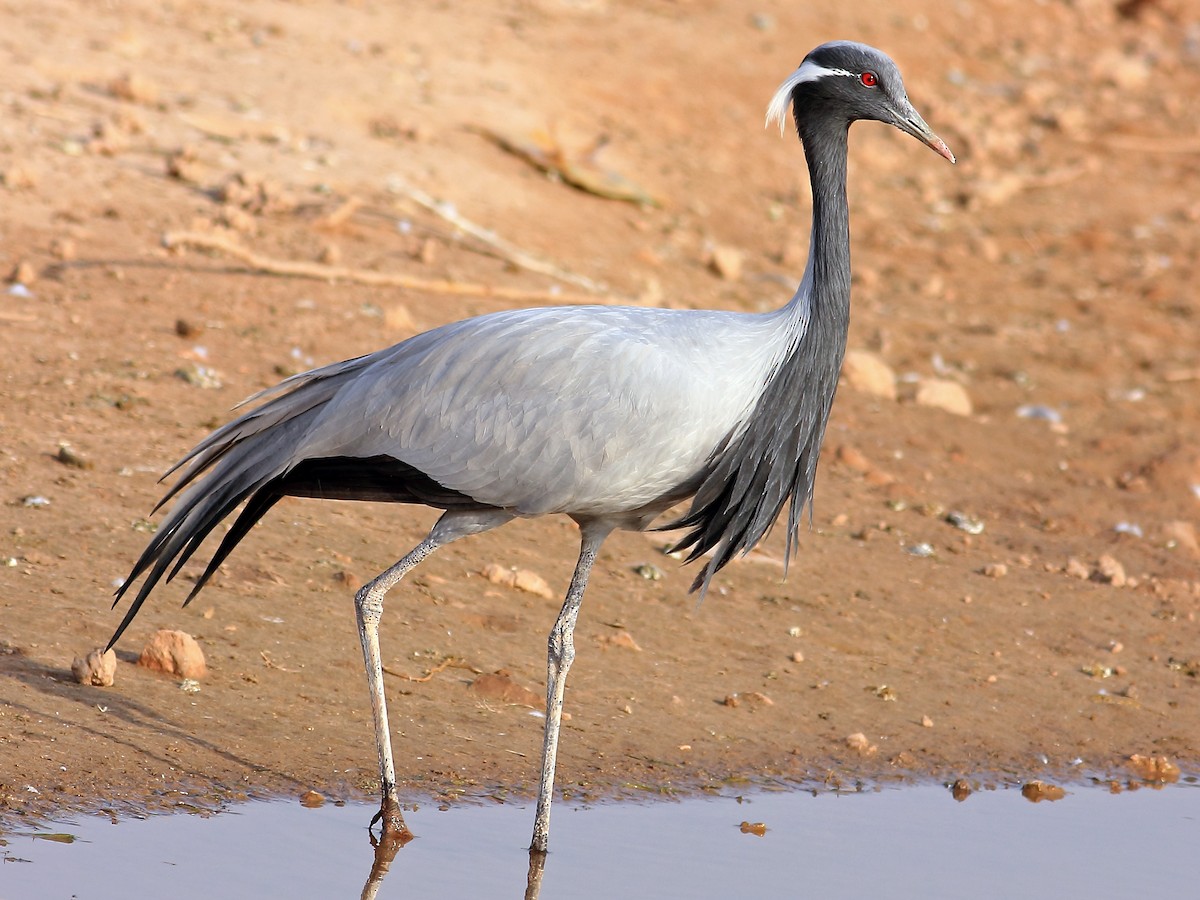
- Adults have a predominantly slate-grey body plumage. The head, neck, and upper breast are black, contrasting sharply with a white stripe extending from behind the eye to the back of the head, forming long, delicate white ear tufts. The primary and secondary flight feathers are black, while the tertials are elongated and droop over the tail, also black. The underparts are grey.
- Beak shape
- Short, stout, and yellowish-orange with a reddish tip.
- Eye color
- Red.
- Leg color
- Blackish-grey.
- Distinguishing features
- The most distinctive features are the long, white ear tufts, the black head and neck with a contrasting white stripe, and its relatively small size compared to other cranes. In flight, the black primaries and secondaries are prominent.
- Juvenile appearance
- Juveniles are duller overall, with a paler grey body and a less distinct black and white pattern on the head and neck. The white ear tufts are shorter and less prominent, and the eyes are brownish. The head and neck are more greyish-brown rather than solid black.
- Seasonal changes
- No significant seasonal plumage changes. Breeding and non-breeding plumages are essentially the same.
- Sexual dimorphism
- Males and females are generally monomorphic in plumage, though males may be slightly larger on average. During courtship, males often display more vigorously.
How to identify
- 1
Size and Shape
Smallest crane species, with a relatively compact body and long legs and neck. Look for its elegant, upright posture.
- 2
Head and Neck Pattern
Distinctive black head and neck with a prominent white stripe extending from behind the eye, forming long, drooping white ear tufts. This is the most reliable field mark.
- 3
Plumage Color
Overall slate-grey body plumage, contrasting with the black head and neck. Black primary and secondary flight feathers are visible in flight.
- 4
Legs and Beak
Blackish-grey legs and a short, yellowish-orange beak with a reddish tip.
- 5
Vocalization
Listen for its loud, trumpeting, rattling call, which is higher-pitched than that of the Common Crane.
- 6
Behavior
Observe its graceful courtship dances, which involve bowing, jumping, and tossing objects. In flight, look for large V-formations during migration.
Habitat & range
- Biomes
- Grasslands, steppes, semi-deserts, agricultural fields, and open wetlands.
- Geographic range
- Breeds across a wide band of Eurasia, from the Black Sea region and Turkey east through Central Asia to Mongolia and northeastern China. Winters in sub-Saharan Africa (primarily Sudan, Ethiopia, and Chad) and the Indian subcontinent.
- Elevation range
- Typically found in lowlands and plains, but can be observed at higher altitudes during migration, crossing mountain ranges like the Himalayas (up to 8,000 meters).
- Preferred environments
- Prefers open, dry grasslands, steppes, and cultivated areas near water sources for drinking and roosting. Avoids dense forests and extensive wetlands, favoring more arid or semi-arid environments than many other crane species.
Behavior
- Activity time
- Diurnal. Most active during daylight hours for foraging and social interactions.
- Feeding habits
- Primarily granivorous, feeding on grains (wheat, barley, millet, rice) and seeds. Also consumes insects (locusts, grasshoppers), small reptiles, worms, and occasionally small rodents. Forages by walking slowly, picking food from the ground.
- Social behavior
- Highly social, especially outside the breeding season. Forms large flocks during migration and in wintering grounds, sometimes numbering in the thousands. During breeding, they are typically found in pairs or small family groups.
- Flight pattern
- Strong, direct flight with powerful, deep wing beats. Flies with neck and legs outstretched. Often forms large V-formations or long lines during migration, utilizing thermals to gain altitude. Known for its spectacular, acrobatic courtship dances.
- Migration pattern
- Long-distance migratory. Western populations migrate from breeding grounds in Eastern Europe and Central Asia to wintering grounds in Africa. Eastern populations migrate from Central Asia and Mongolia to winter in India. They undertake one of the most arduous migrations of any bird, crossing high mountain ranges like the Himalayas.
- Territoriality
- During the breeding season, pairs establish and defend a breeding territory, though they are less aggressively territorial than some other crane species. Outside of breeding, they are gregarious.
Song & calls
- Song
- The 'song' or unison call is a loud, trumpeting, rattling call, often described as 'krrooo-krrooo' or 'gar-oo-gar-oo'. It is a complex series of resonant notes, typically given by both sexes in a duet, especially during courtship or territorial displays.
- Call
- Various calls include a sharp 'krr' alarm call, softer contact calls within flocks, and a distinctive 'purring' sound during pre-flight rituals. The trumpeting call is the most characteristic and can be heard over long distances.
- When they vocalize
- Most vocal during the breeding season for territorial defense and pair bonding. Also vocal during migration, especially when flying in flocks, and at roosting sites.
Breeding & reproduction
- Breeding season
- Typically April to July, varying geographically.
- Nesting habits
- Nests are usually simple scrapes on the ground, often unlined or sparsely lined with pebbles, small sticks, or grass. They are typically located in open areas, often near water, but sometimes in dry steppes or agricultural fields. Both parents participate in nest site selection and construction.
- Clutch size
- 1-3 eggs, typically 2.
- Egg description
- Usually 1-3 (most commonly 2) eggs. Eggs are olive-brown to buff, often speckled or blotched with darker brown or purplish markings. They are oval-shaped.
- Incubation period
- 27-31 days. Both parents share incubation duties, though the female often incubates more.
- Fledging period
- Chicks are precocial and can walk and feed shortly after hatching. They fledge (become capable of sustained flight) at around 55-65 days old.
- Parental care
- Both parents are highly involved in raising the young, from incubation to brooding, feeding, and protecting the chicks until they fledge and often beyond, accompanying them on their first migration.
Where to find
Steppes and Grasslands
Look in open, dry, or semi-arid grasslands and steppes across its breeding range in Eurasia.
Agricultural Fields
Often found foraging in cultivated fields, especially those growing grains like wheat, barley, or millet, particularly during migration and in wintering areas.
Near Water Bodies
While preferring drier habitats, they will often be found near rivers, lakes, or ponds for drinking and roosting, especially during hot periods.
Migration Stopovers
During migration, they can be seen in large numbers at traditional stopover sites, often in open plains or agricultural areas.
Field tips
- Scan Open Landscapes. Demoiselle Cranes prefer open habitats, so use binoculars or a scope to scan wide expanses of grassland, steppe, or agricultural fields.
- Listen for Calls. Their loud, trumpeting calls can carry over long distances, often alerting you to their presence before you see them.
- Observe Migration Routes. If you are in a known migration corridor (e.g., parts of Central Asia, the Middle East, or India), look for large flocks flying in V-formations, especially during spring and autumn.
- Visit Wintering Grounds. In wintering areas like India or parts of Africa, they gather in large numbers, making them easier to find in suitable habitats.
- Look for Dancing Displays. During the breeding season, observe their elaborate courtship dances, which are a spectacular sight and a clear indicator of their presence.
Similar species
Common Crane
Grus grus
The Common Crane is significantly larger than the Demoiselle Crane. It has a grey body, but lacks the prominent white ear tufts and the distinct black and white head pattern of the Demoiselle. Instead, it has a black face and foreneck with a broad white stripe running from behind the eye down the side of the neck, and a red patch on the crown (which is often hard to see). Its call is also deeper and more resonant.
Blue Crane
Anthropoides paradisea
The Blue Crane (also known as Stanley Crane) is closely related and shares the genus Anthropoides. It is larger and has a uniform pale blue-grey plumage, lacking the black and white head pattern and white ear tufts of the Demoiselle. Its elongated tertial feathers are much longer, almost reaching the ground, giving it a distinctive 'bustle' appearance. Its range is restricted to southern Africa.
Quick facts
- Smallest Crane:
- The Demoiselle Crane is the smallest of all 15 crane species.
- Migration Challenge:
- Undertakes one of the most challenging migrations, crossing the Himalayas at altitudes up to 8,000 meters.
- Distinctive Head:
- Easily identified by its black head and neck with prominent white ear tufts.
- Social Bird:
- Highly gregarious, forming large flocks outside the breeding season.
- Omnivorous Diet:
- Feeds on a variety of grains, seeds, insects, and small animals.
Fun facts
- The name 'Demoiselle' comes from the French word for 'maiden' or 'young lady,' referring to its delicate and graceful appearance.
- In India, the Demoiselle Crane is known as 'Koonj' and holds cultural significance, often featured in folklore and poetry.
- They are known for their elaborate and beautiful courtship dances, which involve bowing, jumping, and tossing small objects into the air.
- Demoiselle Cranes are one of the few bird species known to cross the formidable Himalayan mountain range during their annual migration, a feat requiring incredible endurance and adaptation to extreme altitudes.
- Despite their relatively small size for a crane, they are very hardy and adaptable, thriving in a wide range of open habitats.
Scientific classification
- Kingdom
- Animalia
- Phylum
- Chordata
- Class
- Aves
- Order
- Gruiformes
- Family
- Gruidae
- Genus
- Anthropoides
- Species
- Anthropoides virgo
Explore the Demoiselle Crane
Identify birds anywhere
Free on iOS, Android, and Web. Photo & sound identification, full species database, and your personal life list.