
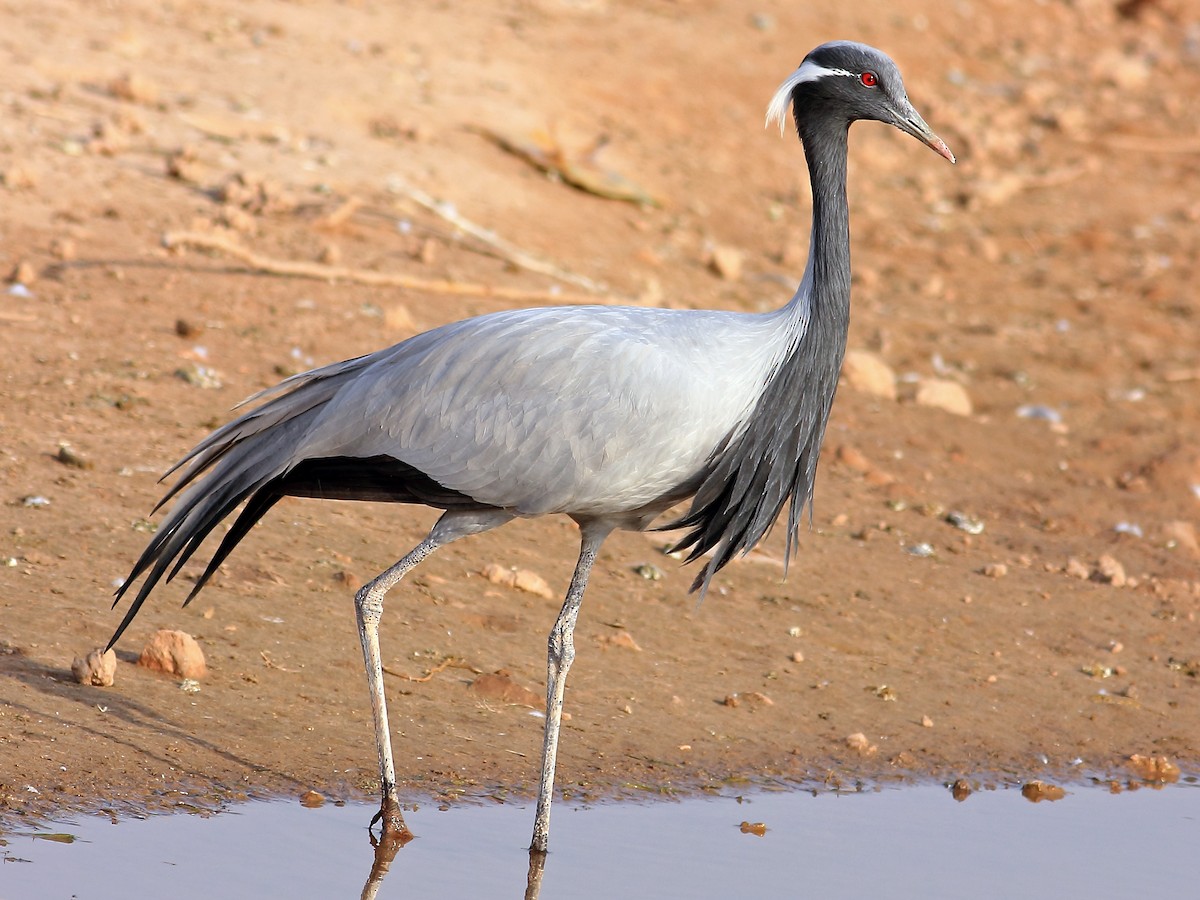
Where does the Demoiselle Crane live?
Anthropoides virgo
Spotted a bird? Identify it instantly with the Birdby app
Open the appThe Demoiselle Crane lives in specific habitats and regions. Knowing where, and when, to look improves your chances of a successful sighting.
Biomes
Grasslands, steppes, semi-deserts, agricultural fields, and open wetlands.
Geographic range
Breeds across a wide band of Eurasia, from the Black Sea region and Turkey east through Central Asia to Mongolia and northeastern China. Winters in sub-Saharan Africa (primarily Sudan, Ethiopia, and Chad) and the Indian subcontinent.
Preferred environments
Prefers open, dry grasslands, steppes, and cultivated areas near water sources for drinking and roosting. Avoids dense forests and extensive wetlands, favoring more arid or semi-arid environments than many other crane species.
Elevation range
Typically found in lowlands and plains, but can be observed at higher altitudes during migration, crossing mountain ranges like the Himalayas (up to 8,000 meters).
Where to look
Steppes and Grasslands
Look in open, dry, or semi-arid grasslands and steppes across its breeding range in Eurasia.
Agricultural Fields
Often found foraging in cultivated fields, especially those growing grains like wheat, barley, or millet, particularly during migration and in wintering areas.
Near Water Bodies
While preferring drier habitats, they will often be found near rivers, lakes, or ponds for drinking and roosting, especially during hot periods.
Migration Stopovers
During migration, they can be seen in large numbers at traditional stopover sites, often in open plains or agricultural areas.
Field tips
- Scan Open Landscapes. Demoiselle Cranes prefer open habitats, so use binoculars or a scope to scan wide expanses of grassland, steppe, or agricultural fields.
- Listen for Calls. Their loud, trumpeting calls can carry over long distances, often alerting you to their presence before you see them.
- Observe Migration Routes. If you are in a known migration corridor (e.g., parts of Central Asia, the Middle East, or India), look for large flocks flying in V-formations, especially during spring and autumn.
- Visit Wintering Grounds. In wintering areas like India or parts of Africa, they gather in large numbers, making them easier to find in suitable habitats.
- Look for Dancing Displays. During the breeding season, observe their elaborate courtship dances, which are a spectacular sight and a clear indicator of their presence.
Migration
Long-distance migratory. Western populations migrate from breeding grounds in Eastern Europe and Central Asia to wintering grounds in Africa. Eastern populations migrate from Central Asia and Mongolia to winter in India. They undertake one of the most arduous migrations of any bird, crossing high mountain ranges like the Himalayas.
Explore the Demoiselle Crane
Identify birds anywhere
Free on iOS, Android, and Web. Photo & sound identification, full species database, and your personal life list.