
Spotted a bird? Identify it instantly with the Birdby app
Open the appAbout
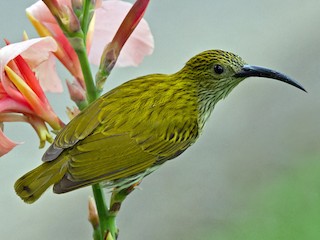
The Streaked Spiderhunter is a medium-sized passerine bird characterized by its olive-green plumage heavily streaked with yellow or pale whitish markings, particularly on its underparts. It possesses a long, decurved bill perfectly adapted for probing into flowers for nectar and extracting spiders and insects from crevices. This species is known for its active foraging behavior and distinctive calls within its forest habitats.
Size & lifespan
- Length
- 16-20 cm
- Wingspan
- 25-30 cm
- Weight
- 25-40 g
- Lifespan
- Typically 5-7 years in the wild
- Diet
- Primarily nectar, supplemented with spiders, small insects, and occasional small fruits or berries.
Physical characteristics
- Plumage
- Adults have an olive-green back, wings, and tail. The head, nape, and especially the underparts (throat, breast, flanks, belly) are heavily streaked with yellow to pale whitish. The streaking is most prominent on the breast and belly, giving the bird its common name. The primary and secondary flight feathers are dusky with olive-green edges. The undertail coverts are plain yellow. Some subspecies may show variations in the intensity and color of streaking.
- Beak shape
- Long, slender, and strongly decurved (downward-curving) black bill, adapted for probing deep into flowers.
- Eye color
- Dark brown, often appearing black.
- Leg color
- Dusky greenish-black to dark grey.
- Distinguishing features
- The prominent yellow-to-whitish streaking on the olive-green underparts is the key diagnostic feature. Its long, curved bill and relatively large size for a spiderhunter also help in identification.
- Juvenile appearance
- Juveniles resemble adults but often have duller plumage, less distinct streaking on the underparts, and sometimes a slightly paler bill. The streaking becomes more defined with maturity.
- Seasonal changes
- No significant seasonal changes in plumage are observed.
- Sexual dimorphism
- Males and females are generally monomorphic in plumage, with no significant visual differences.
How to identify
- 1
Plumage
Look for the olive-green upperparts and the diagnostic heavy yellow-to-whitish streaking on the throat, breast, and belly against a paler green or yellowish background.
- 2
Bill
Observe the long, slender, and strongly decurved black bill, which is a key characteristic of all spiderhunters but particularly prominent in this species.
- 3
Size
Note its relatively large size for a spiderhunter (16-20 cm), which helps differentiate it from smaller species like the Little Spiderhunter.
- 4
Vocalizations
Listen for its loud, rapid, metallic 'chip-chip-chip' song or sharp 'chink' calls, which are quite distinct and often given from within dense foliage.
- 5
Behavior
Watch for its active foraging style, probing deep into flowers or gleaning insects from leaves, often hanging acrobatically.
Habitat & range
- Biomes
- Subtropical or tropical moist lowland forests, subtropical or tropical moist montane forests, and heavily degraded former forests.
- Geographic range
- Found across the Himalayan foothills from Nepal eastward through Northeast India, Bangladesh, Myanmar, Thailand, Laos, Vietnam, and into parts of southern China (Yunnan, Guangxi).
- Elevation range
- Typically found at elevations ranging from 300 to 2,000 meters above sea level, occasionally lower or higher depending on the region.
- Preferred environments
- Primary and secondary evergreen broadleaf forests, mixed deciduous forests, bamboo thickets, forest edges, and areas with abundant flowering plants, especially those with large blossoms like banana flowers (Musa spp.). They are also found in mature gardens and plantations bordering forested areas.
Behavior
- Activity time
- Diurnal, most active during the cooler parts of the morning and late afternoon.
- Feeding habits
- Highly active and acrobatic foragers, moving rapidly through vegetation. They use their long, curved bills to probe into flowers for nectar, often hanging upside down. They also glean spiders and insects from leaves, branches, bark crevices, and spiderwebs. They are particularly attracted to banana flowers and large-flowered gingers and heliconias.
- Social behavior
- Usually solitary or found in pairs. Occasionally joins mixed-species foraging flocks, particularly in areas with abundant food sources. Can be aggressive towards other nectar-feeding birds at rich flower patches.
- Flight pattern
- Direct and fast, often with rapid wingbeats. They move swiftly between flowering plants or forest patches.
- Migration pattern
- Generally resident throughout its range, undertaking only local or altitudinal movements in response to food availability, rather than long-distance migration.
- Territoriality
- Shows some territorial behavior, especially around prime feeding sites like large flowering plants, where they may actively defend against conspecifics or other nectarivores.
Song & calls
- Song
- The song is a distinctive, loud, and rapid series of metallic, high-pitched notes often described as 'chip-chip-chip-chip' or 'twee-twee-twee-twee', delivered in a fast, rhythmic manner. It can be quite insistent and carries well through the forest.
- Call
- Common calls include sharp, metallic 'chink' or 'tchip' notes, often given when agitated or in flight. Also, a softer 'swee-swee' or 'tsip-tsip' call. Alarm calls are typically harsher and more rapid.
- When they vocalize
- Vocalizes throughout the day, particularly prominent during the early morning and late afternoon. Calls and songs are heard most frequently during the breeding season.
Breeding & reproduction
- Breeding season
- Breeding season varies geographically, but generally occurs from March to August. For example, March-July in India, and April-July in Southeast Asia.
- Nesting habits
- Nests are typically solitary, constructed by both sexes. The nest is a hanging, elongated cup-shaped structure, often suspended from the underside of a large leaf (e.g., banana or ginger leaf), well-camouflaged. It is made of fine plant fibers, moss, and spiderweb, often decorated with dry leaves or lichen on the exterior.
- Clutch size
- Typically 2-3 eggs.
- Egg description
- Usually 2-3 eggs, pale whitish to creamy or greenish-white, often speckled or blotched with reddish-brown or purplish-grey markings, particularly at the larger end.
- Incubation period
- Approximately 13-15 days.
- Fledging period
- Chicks fledge around 14-18 days after hatching. Both parents participate in feeding the young.
- Parental care
- Both male and female share incubation duties and extensively participate in feeding and caring for the nestlings and fledglings.
Where to find
Forest Understory
Often found in the mid-story and understory of primary and secondary evergreen broadleaf forests.
Forest Edges
Frequently seen along the edges of forests, especially where there are flowering plants.
Flowering Plants
Actively seeks out areas with large, nectar-rich flowers such as banana plants (Musa spp.), gingers, and heliconias.
Mountainous Regions
Common in montane forests within its geographic range, usually between 300-2000m elevation.
Field tips
- Listen for calls. Their loud, metallic songs and calls are often the first indication of their presence, even when hidden by dense foliage. Learn to recognize their distinctive vocalizations.
- Target flowering plants. Focus your search on areas with abundant large, tubular flowers. They are particularly fond of banana flowers and will spend considerable time feeding there.
- Scan the mid-canopy and understory. They typically forage in the middle to lower strata of the forest, often clinging to leaves or stems. Look carefully among dense foliage.
- Watch for movement. Streaked Spiderhunters are very active foragers. Look for quick, darting movements among vegetation, and then use binoculars to confirm identity.
- Visit appropriate habitats. Birdwatch in well-preserved tropical and subtropical montane forests or mature forest edge habitats within its known range.
Similar species
Little Spiderhunter
Arachnothera longirostra
The Little Spiderhunter is significantly smaller (13-16 cm) and lacks the prominent streaking on the underparts, having a mostly plain yellowish-green belly. Its bill is also long and curved but proportionally shorter compared to its body size than the Streaked Spiderhunter.
Grey-breasted Spiderhunter
Arachnothera modesta
The Grey-breasted Spiderhunter is similar in size but has a duller, more uniform greyish wash on its breast and flanks, and lacks the strong yellow-streaking of the Streaked Spiderhunter. Its undertail coverts are typically yellow, but the overall underpart appearance is distinctly different.
Yellow-eared Spiderhunter
Arachnothera chrysogenys
The Yellow-eared Spiderhunter is very similar in overall plumage but can be distinguished by the prominent yellow ear-coverts, which are absent in the Streaked Spiderhunter. Its streaking may also be less pronounced.
Quick facts
- Distinctive Feature:
- Heavy yellow/white streaking on underparts
- Bill Type:
- Long, slender, strongly decurved
- Diet Specialty:
- Nectar and spiders
- Habitat Preference:
- Montane and lowland tropical forests with large flowers
- Conservation Status:
- Least Concern
Fun facts
- The Streaked Spiderhunter is one of the larger species within the spiderhunter genus, making its streaked pattern quite noticeable.
- Its specialized long, curved bill is a perfect example of co-evolution with certain flower types, allowing it to access nectar unavailable to other birds.
- Despite its name, its diet is not solely spiders; nectar often forms a significant, if not primary, part of its intake, especially from large, pendulous flowers.
- They are known to be quite bold and inquisitive, sometimes allowing close approaches if they are focused on a rich food source.
Scientific classification
- Kingdom
- Animalia
- Phylum
- Chordata
- Class
- Aves
- Order
- Passeriformes
- Family
- Nectariniidae
- Genus
- Arachnothera
- Species
- Arachnothera magna
Explore the Streaked Spiderhunter
Identify birds anywhere
Free on iOS, Android, and Web. Photo & sound identification, full species database, and your personal life list.