
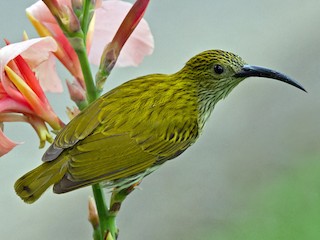
Where does the Streaked Spiderhunter live?
Arachnothera magna
Spotted a bird? Identify it instantly with the Birdby app
Open the appThe Streaked Spiderhunter lives in specific habitats and regions. Knowing where, and when, to look improves your chances of a successful sighting.
Biomes
Subtropical or tropical moist lowland forests, subtropical or tropical moist montane forests, and heavily degraded former forests.
Geographic range
Found across the Himalayan foothills from Nepal eastward through Northeast India, Bangladesh, Myanmar, Thailand, Laos, Vietnam, and into parts of southern China (Yunnan, Guangxi).
Preferred environments
Primary and secondary evergreen broadleaf forests, mixed deciduous forests, bamboo thickets, forest edges, and areas with abundant flowering plants, especially those with large blossoms like banana flowers (Musa spp.). They are also found in mature gardens and plantations bordering forested areas.
Elevation range
Typically found at elevations ranging from 300 to 2,000 meters above sea level, occasionally lower or higher depending on the region.
Where to look
Forest Understory
Often found in the mid-story and understory of primary and secondary evergreen broadleaf forests.
Forest Edges
Frequently seen along the edges of forests, especially where there are flowering plants.
Flowering Plants
Actively seeks out areas with large, nectar-rich flowers such as banana plants (Musa spp.), gingers, and heliconias.
Mountainous Regions
Common in montane forests within its geographic range, usually between 300-2000m elevation.
Field tips
- Listen for calls. Their loud, metallic songs and calls are often the first indication of their presence, even when hidden by dense foliage. Learn to recognize their distinctive vocalizations.
- Target flowering plants. Focus your search on areas with abundant large, tubular flowers. They are particularly fond of banana flowers and will spend considerable time feeding there.
- Scan the mid-canopy and understory. They typically forage in the middle to lower strata of the forest, often clinging to leaves or stems. Look carefully among dense foliage.
- Watch for movement. Streaked Spiderhunters are very active foragers. Look for quick, darting movements among vegetation, and then use binoculars to confirm identity.
- Visit appropriate habitats. Birdwatch in well-preserved tropical and subtropical montane forests or mature forest edge habitats within its known range.
Migration
Generally resident throughout its range, undertaking only local or altitudinal movements in response to food availability, rather than long-distance migration.
Explore the Streaked Spiderhunter
Identify birds anywhere
Free on iOS, Android, and Web. Photo & sound identification, full species database, and your personal life list.