
Spotted a bird? Identify it instantly with the Birdby app
Open the appAbout
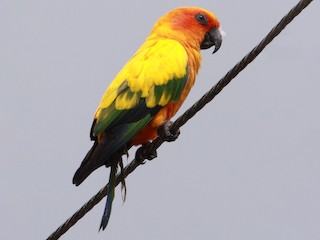
The Sun Conure is a medium-sized, vibrantly colored parrot native to northeastern South America. Renowned for its striking yellow and orange plumage, it is a highly social and vocal species, often found in flocks. Its beauty and intelligence have made it a popular pet, but in the wild, it faces significant conservation challenges.
Size & lifespan
- Length
- 30 cm (12 in)
- Wingspan
- 15-17 cm (6-7 in) (wing chord)
- Weight
- 100-130 g (3.5-4.6 oz)
- Lifespan
- 15-30 years (in the wild, often longer in captivity)
- Diet
- Omnivore (primarily frugivore/granivore)
Physical characteristics
- Plumage
- Adults are predominantly bright golden-yellow on the head, neck, mantle, and underparts. The back, upperwing coverts, and rump are also yellow. The primary and secondary flight feathers are green with blue tips, visible in flight. The tail is olive-green, becoming bluish towards the tip. Some individuals may show orange flushing on the face and belly, particularly males or during breeding season, though this is not a reliable sexing characteristic.
- Beak shape
- Strong, hooked, dark grey to black beak, typical of parrots, adapted for cracking seeds and nuts.
- Eye color
- Dark brown iris surrounded by a prominent white, featherless periophthalmic ring (eye-ring).
- Leg color
- Greyish-black.
- Distinguishing features
- The brilliant golden-yellow plumage contrasting with green and blue flight feathers and tail, along with the white eye-ring, are key distinguishing features. Its relatively small size for such vibrant coloration is also notable.
- Juvenile appearance
- Juveniles are duller than adults, with a predominantly green plumage, especially on the head, back, and wings. They have less yellow and orange, which gradually develops over the first one to two years of life, with full adult coloration typically achieved by 18-24 months.
- Seasonal changes
- No significant seasonal plumage changes. The intensity of orange flushing may vary slightly with age, diet, and hormonal state, but not in a predictable seasonal pattern.
- Sexual dimorphism
- Visually, there is no reliable sexual dimorphism in plumage or size. Males and females are identical in appearance. Sexing typically requires DNA testing or surgical sexing.
How to identify
- 1
Overall Plumage Color
Look for the striking, almost entirely golden-yellow body, head, and upperparts. This is the most defining feature of an adult Sun Conure.
- 2
Wing and Tail Coloration
Observe the green primary and secondary flight feathers with blue tips, which are particularly noticeable in flight. The tail is olive-green with a bluish tip.
- 3
Eye-ring
Note the prominent, bare white skin around the dark brown eye. This contrasts sharply with the bright head plumage.
- 4
Vocalizations
Listen for their extremely loud, piercing, and high-pitched screeches and squawks. They are often heard before they are seen.
- 5
Social Behavior
They are almost always seen in pairs or flocks, rarely solitary. Their gregarious nature and constant vocal contact are good indicators.
Habitat & range
- Biomes
- Tropical and subtropical dry forests, savannas, coastal forests, and palm groves.
- Geographic range
- Northeastern South America, specifically in a restricted area of northern Brazil (Roraima, Amapá, Pará) and Guyana. Historically, its range was more extensive, including parts of French Guiana and Suriname, but populations there are now largely extirpated or highly fragmented.
- Elevation range
- Primarily lowlands, typically below 1,200 meters (3,900 feet) above sea level.
- Preferred environments
- Prefers open, semi-deciduous woodlands, gallery forests along rivers, and areas with scattered trees and palms. They often forage in agricultural areas and clearings adjacent to forests.
Behavior
- Activity time
- Diurnal. Most active during early morning and late afternoon, foraging and vocalizing. They typically rest during the hottest parts of the day.
- Feeding habits
- Feeds primarily on fruits, berries, seeds, nuts, and flowers. They are opportunistic feeders and will also consume insects and their larvae, especially during breeding season to supplement protein intake. They forage in the canopy and mid-story of trees.
- Social behavior
- Highly social birds, typically found in pairs or small family groups, but often congregating in large flocks of 20-30 individuals, sometimes up to 100 or more, especially outside the breeding season or at communal roosts. They are very vocal and maintain constant contact with flock members.
- Flight pattern
- Strong, direct, and swift flight, often in tight flocks. They fly with rapid wing beats, producing a characteristic whirring sound. Their bright colors are particularly striking against the green foliage when in flight.
- Migration pattern
- Resident throughout its range, with no significant migratory movements. They may undertake local movements in search of food resources.
- Territoriality
- While not strictly territorial in the traditional sense, breeding pairs will defend their nest site. Flocks generally share foraging areas, but may exhibit some aggression towards other species at prime feeding locations.
Song & calls
- Song
- Sun Conures do not have a complex song. Their vocalizations are primarily calls.
- Call
- Known for their extremely loud, piercing, and high-pitched calls. They produce a variety of screeches, squawks, and chattering sounds. Common calls include a sharp 'screee-screee-screee' or 'kra-kra-kra' often repeated rapidly, used for contact, alarm, and during flight. Their calls can carry over long distances.
- When they vocalize
- Most vocal during dawn and dusk, when leaving and returning to roosts, and throughout the day while foraging or in flight. They are particularly noisy when excited or alarmed.
Breeding & reproduction
- Breeding season
- Typically from February to July, varying slightly with geographic location and rainfall patterns.
- Nesting habits
- Nest in tree cavities, often old woodpecker holes or natural hollows in dead or living trees. They do not add nesting material, laying eggs directly on the wood dust or debris at the bottom of the cavity.
- Clutch size
- Usually 3-5 eggs, occasionally up to 7.
- Egg description
- White, elliptical to oval-shaped eggs. Average size is approximately 26 x 21 mm.
- Incubation period
- Approximately 23-27 days, primarily by the female.
- Fledging period
- Chicks fledge (leave the nest) around 7-8 weeks (50-60 days) after hatching.
- Parental care
- Both parents participate in feeding the chicks after hatching. The male often feeds the incubating female. Young birds remain with their parents for some time after fledging, forming family groups within the larger flock.
Where to find
Tropical Dry Forests
Areas with open canopy and scattered trees, often near water sources.
Savannas and Palm Groves
Open grasslands with isolated trees or clusters of palms, which provide both food and nesting sites.
Gallery Forests
Forest strips along rivers and streams, offering denser cover and diverse food sources.
Agricultural Areas (adjacent to forests)
They may forage in cultivated lands for fruits and seeds, especially if natural food sources are scarce.
Field tips
- Listen First. Their loud calls are often the first indication of their presence. Follow the sound to locate the flock.
- Scan Tree Canopies. They spend most of their time in the upper canopy of trees, foraging or resting. Use binoculars to scan for movement and color.
- Look for Flocks. Sun Conures are rarely alone. Look for groups of brightly colored birds flying together or perched in trees.
- Visit Roosting Sites. At dawn and dusk, they gather at communal roosting sites, which can be large trees or palms. These are excellent times for observation.
- Patience and Stealth. While vocal, they can be wary. Approach quietly and observe from a distance to avoid disturbing them.
Similar species
Jandaya Conure
Aratinga jandaya
The Jandaya Conure has a green back and wings, contrasting with its yellow head and orange belly. Sun Conures are almost entirely yellow on the back and wings, with green only on the flight feathers. Jandayas also have a more extensive orange wash on the head and breast.
Golden-capped Conure
Aratinga auricapilla
Golden-capped Conures have a green body with a distinctive orange-red forehead and crown, and a red patch on the belly. Sun Conures are predominantly yellow with orange flushing, lacking the distinct red cap and belly patch.
Sulphur-breasted Parakeet
Aratinga maculata
Formerly considered a subspecies of Sun Conure, the Sulphur-breasted Parakeet is very similar but generally has a paler yellow plumage, less intense orange, and more extensive green on the wings and back. Its range is also more restricted to the lower Amazon basin.
Quick facts
- Conservation Status:
- Endangered (IUCN Red List)
- Primary Habitat:
- Tropical dry forests, savannas
- Diet:
- Fruits, seeds, nuts, flowers, some insects
- Social Structure:
- Highly social, found in flocks
- Vocalization:
- Extremely loud, piercing screeches and squawks
Fun facts
- The 'Sun' in their name refers to their brilliant golden-yellow plumage, reminiscent of the sun.
- Despite their small size, Sun Conures are known for their incredibly loud vocalizations, which can be heard from a great distance.
- They are highly intelligent and can be taught to mimic sounds and words, making them popular companion birds.
- Their wild populations have declined dramatically due to habitat loss and illegal pet trade, leading to their 'Endangered' status.
- Juvenile Sun Conures are predominantly green, gradually acquiring their vibrant yellow and orange adult plumage over their first two years.
Scientific classification
- Kingdom
- Animalia
- Phylum
- Chordata
- Class
- Aves
- Order
- Psittaciformes
- Family
- Psittacidae
- Genus
- Aratinga
- Species
- Aratinga solstitialis
Explore the Sun Conure
Identify birds anywhere
Free on iOS, Android, and Web. Photo & sound identification, full species database, and your personal life list.