
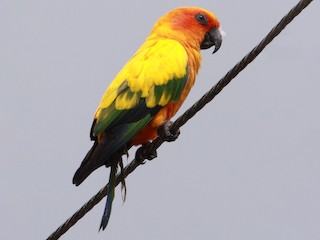
Where does the Sun Conure live?
Aratinga solstitialis
Spotted a bird? Identify it instantly with the Birdby app
Open the appThe Sun Conure lives in specific habitats and regions. Knowing where, and when, to look improves your chances of a successful sighting.
Biomes
Tropical and subtropical dry forests, savannas, coastal forests, and palm groves.
Geographic range
Northeastern South America, specifically in a restricted area of northern Brazil (Roraima, Amapá, Pará) and Guyana. Historically, its range was more extensive, including parts of French Guiana and Suriname, but populations there are now largely extirpated or highly fragmented.
Preferred environments
Prefers open, semi-deciduous woodlands, gallery forests along rivers, and areas with scattered trees and palms. They often forage in agricultural areas and clearings adjacent to forests.
Elevation range
Primarily lowlands, typically below 1,200 meters (3,900 feet) above sea level.
Where to look
Tropical Dry Forests
Areas with open canopy and scattered trees, often near water sources.
Savannas and Palm Groves
Open grasslands with isolated trees or clusters of palms, which provide both food and nesting sites.
Gallery Forests
Forest strips along rivers and streams, offering denser cover and diverse food sources.
Agricultural Areas (adjacent to forests)
They may forage in cultivated lands for fruits and seeds, especially if natural food sources are scarce.
Field tips
- Listen First. Their loud calls are often the first indication of their presence. Follow the sound to locate the flock.
- Scan Tree Canopies. They spend most of their time in the upper canopy of trees, foraging or resting. Use binoculars to scan for movement and color.
- Look for Flocks. Sun Conures are rarely alone. Look for groups of brightly colored birds flying together or perched in trees.
- Visit Roosting Sites. At dawn and dusk, they gather at communal roosting sites, which can be large trees or palms. These are excellent times for observation.
- Patience and Stealth. While vocal, they can be wary. Approach quietly and observe from a distance to avoid disturbing them.
Migration
Resident throughout its range, with no significant migratory movements. They may undertake local movements in search of food resources.
Explore the Sun Conure
Identify birds anywhere
Free on iOS, Android, and Web. Photo & sound identification, full species database, and your personal life list.