
Spotted a bird? Identify it instantly with the Birdby app
Open the appAbout
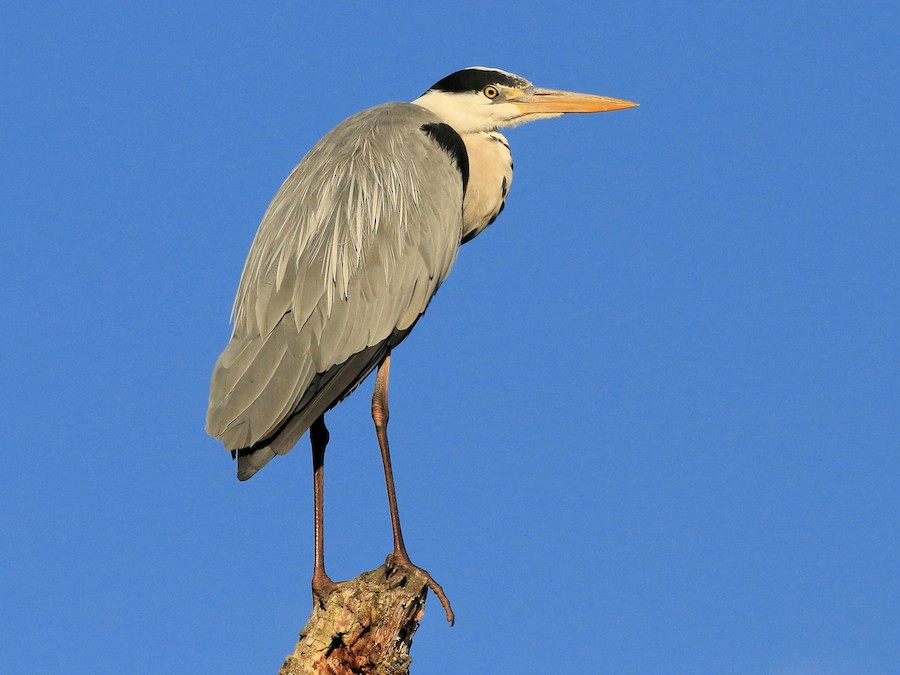
The Grey Heron is a large, long-legged, and long-necked wading bird, common across temperate Europe, Asia, and parts of Africa. It is a highly adaptable species, often seen standing motionless in shallow water, patiently waiting to ambush prey. Its distinctive 'S'-shaped neck in flight and harsh call are characteristic.
Size & lifespan
- Length
- 90-100 cm (35-39 in)
- Wingspan
- 175-195 cm (69-77 in)
- Weight
- 1.0-2.1 kg (2.2-4.6 lb)
- Lifespan
- Approximately 5 years in the wild, with records up to 23 years.
- Diet
- Carnivore, primarily piscivorous (fish-eating), but highly opportunistic.
Physical characteristics
- Plumage
- Adults have a largely grey back and wings, with white underparts and a streaky grey-black breast. The head is white with a broad black stripe extending from the eye to form a crest. The flight feathers are black, contrasting with the grey upperwing coverts. Breeding adults develop long, ornamental plumes on the back and breast.
- Beak shape
- Long, strong, dagger-like, yellowish-pink to dull orange, becoming brighter orange during breeding season.
- Eye color
- Yellowish-orange with a pale yellow iris.
- Leg color
- Long, greenish-grey to brownish-grey legs and feet, becoming reddish during breeding season.
- Distinguishing features
- Large size, grey and white plumage, 'S'-shaped neck in flight, long black crest stripe, and dagger-like bill. In flight, the slow, deep wingbeats and hunched neck are characteristic.
- Juvenile appearance
- Juveniles are duller overall, with a greyish head and neck, lacking the distinct white head and black crest stripe of adults. Their crown is dark grey, and their plumage is generally browner with less distinct streaking on the neck and breast. The bill is duller, often greyish-yellow.
- Seasonal changes
- During the breeding season, adults develop longer, finer ornamental plumes on the back and breast. The bill and legs become brighter, often taking on a more reddish or orange hue. The black crest stripe becomes more prominent.
- Sexual dimorphism
- Males and females are generally monomorphic in plumage, though males may be slightly larger and have slightly longer ornamental plumes during breeding.
How to identify
- 1
Size and Shape
Look for a very large, tall bird with long legs, a long neck, and a dagger-like bill. In flight, the neck is retracted into an 'S' shape, and the legs trail behind.
- 2
Plumage
Adults are predominantly grey on the back and wings, with white underparts and a white head. A prominent black stripe runs from the eye to the back of the head, forming a crest. Juveniles are duller and greyer-headed.
- 3
Bill and Legs
The bill is yellowish-pink to orange, and the legs are greenish-grey, becoming brighter during breeding.
- 4
Flight
Observe its slow, deep wingbeats and the characteristic 'S'-shaped neck. This distinguishes it from storks or cranes, which fly with their necks outstretched.
- 5
Call
Listen for its distinctive, harsh, guttural 'fraaank' call, often given when disturbed or in flight.
- 6
Behavior
Look for it standing motionless in shallow water, patiently waiting to strike at prey, or walking slowly along the water's edge.
Habitat & range
- Biomes
- Wetlands, freshwater and brackish water bodies, coastal areas, estuaries, rivers, lakes, ponds, marshes, flooded meadows, and even urban parks with suitable water features.
- Geographic range
- Widespread across Europe, Asia (from the Middle East to Japan), and parts of Africa (south of the Sahara).
- Elevation range
- Typically found from sea level up to 1,000 meters, occasionally higher in some parts of its range.
- Preferred environments
- Shallow, calm waters with abundant fish and amphibians, often with nearby trees for nesting. They tolerate human disturbance well and can be found in suburban and urban environments.
Behavior
- Activity time
- Primarily diurnal, but will also forage at night, especially during full moon or when feeding young.
- Feeding habits
- A patient ambush predator. It stands motionless in shallow water, or walks slowly, waiting for prey to come within striking distance. It then spears its prey with a rapid thrust of its neck and bill. Diet includes fish, amphibians, reptiles, small mammals (voles, shrews), large insects, and occasionally small birds.
- Social behavior
- Generally solitary when foraging, but highly colonial when breeding, forming 'heronries' in trees. Outside the breeding season, they may gather in small groups at rich feeding grounds or roost communally.
- Flight pattern
- Slow, deliberate wingbeats with the neck retracted into an 'S' shape and legs trailing straight behind. Appears large and somewhat ungainly in flight.
- Migration pattern
- Northern populations are migratory, moving south for the winter. Southern and western European populations are largely resident or undertake short-distance dispersal. African populations are generally resident. Migration occurs mainly at night.
- Territoriality
- Foraging individuals maintain a personal space, but are not strictly territorial over feeding grounds. Breeding pairs defend their nest site within the colony.
Song & calls
- Song
- Grey Herons do not have a true song. Their vocalizations are primarily calls.
- Call
- The most common call is a harsh, loud, guttural 'fraaank' or 'kraaak', often given in flight or when disturbed. At the nest, a variety of croaking, squawking, and clattering sounds are made, especially by chicks and during courtship.
- When they vocalize
- Calls are given throughout the day, particularly when disturbed, in flight, or during interactions at the colony. Nesting calls are most frequent during the breeding season.
Breeding & reproduction
- Breeding season
- Varies geographically, typically February to June in temperate regions. Can be year-round in tropical areas.
- Nesting habits
- Nests colonially in 'heronries', usually in tall trees, often near water. Nests are large, bulky platforms made of sticks, lined with smaller twigs, grass, or reeds. Both parents contribute to nest building.
- Clutch size
- 3-5 eggs
- Egg description
- 3-5 (occasionally 2-7) pale blue-green, unmarked eggs. Oval to sub-elliptical shape.
- Incubation period
- 23-28 days, primarily by the female, but both parents share duties.
- Fledging period
- 42-55 days. Young begin to clamber out of the nest onto nearby branches before taking their first flights.
- Parental care
- Both parents share incubation and feeding duties. Chicks are fed by regurgitation. Parental care continues for several weeks after fledging.
Where to find
Rivers and Lakes
Look along the banks of slow-moving rivers, large lakes, and reservoirs, especially in areas with reeds or overhanging vegetation.
Ponds and Marshes
Small ponds, marshy areas, and flooded fields are prime feeding grounds.
Coastal Areas
Estuaries, mudflats, and sheltered coastal lagoons are also frequented, especially outside the breeding season.
Urban Parks
Surprisingly common in urban and suburban parks with ornamental ponds or lakes, often becoming quite habituated to human presence.
Field tips
- Patience is Key. Grey Herons are often very still when hunting. Scan the water's edge carefully, looking for their upright, statuesque form.
- Look for Movement. If you see a heron, watch for the sudden, rapid strike of its neck and bill as it catches prey.
- Check Heronries. During the breeding season, locate known heronries (colonies) in tall trees, often near water. The activity and noise will be obvious.
- Listen for Calls. Their harsh 'fraaank' call is often the first indication of their presence, especially when they take flight.
- Dawn and Dusk. While primarily diurnal, they can be active at dawn and dusk, and even at night, especially when feeding young.
Similar species
Great Blue Heron
Ardea herodias
Found in North and Central America. Generally larger, with a more bluish-grey plumage, a rufous neck, and often a more prominent black cap and crest. The Grey Heron has a whiter head and neck with a distinct black stripe.
Purple Heron
Ardea purpurea
Smaller and more slender than the Grey Heron, with a darker, more rufous-purple plumage, especially on the neck and underparts. It has a more snake-like neck and a more secretive nature, preferring dense reedbeds. The Grey Heron is paler and more robust.
Goliath Heron
Ardea goliath
Much larger than the Grey Heron, found in Africa. Distinctive rufous neck and underparts, and a massive bill. The Grey Heron is predominantly grey and white.
Quick facts
- Diet:
- Fish, amphibians, small mammals, insects
- Habitat:
- Wetlands, rivers, lakes, coastal areas
- Nesting:
- Colonial in trees (heronries)
- Flight:
- Slow wingbeats, neck retracted in 'S' shape
- Call:
- Harsh 'fraaank' or 'kraaak'
Fun facts
- The Grey Heron can stand motionless for incredibly long periods, sometimes over an hour, waiting for prey.
- They have specialized neck vertebrae that allow them to strike their prey with remarkable speed and precision.
- Grey Herons have a 'powder down' patch on their chest, which produces a fine powder used to clean fish slime and other oils from their feathers.
- In some cultures, the Grey Heron is seen as a symbol of patience and tranquility.
- Despite their large size, they are relatively light for their bulk, aiding in flight.
Scientific classification
- Kingdom
- Animalia
- Phylum
- Chordata
- Class
- Aves
- Order
- Pelecaniformes
- Family
- Ardeidae
- Genus
- Ardea
- Species
- Ardea cinerea
Explore the Grey Heron
Identify birds anywhere
Free on iOS, Android, and Web. Photo & sound identification, full species database, and your personal life list.