
Spotted a bird? Identify it instantly with the Birdby app
Open the appAbout
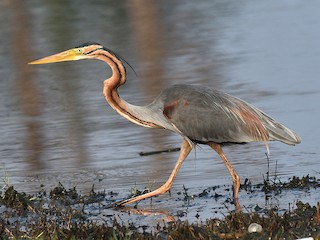
The Purple Heron is a medium-sized heron, slightly smaller than the Grey Heron, characterized by its rich rufous-purple plumage, slender build, and elongated neck. It is a secretive species, often found in dense reedbeds and emergent vegetation, making it challenging to observe. Its cryptic coloration provides excellent camouflage in its preferred marshy habitats.
Size & lifespan
- Length
- 78-90 cm (31-35 in)
- Wingspan
- 120-150 cm (47-59 in)
- Weight
- 0.5-1.3 kg (1.1-2.9 lbs)
- Lifespan
- Up to 20 years in the wild, typically 5-10 years.
- Diet
- Carnivore, primarily piscivorous. Feeds on fish, amphibians (frogs, newts), reptiles (snakes, lizards), large insects (dragonflies, grasshoppers), small mammals (voles), and occasionally small birds.
Physical characteristics
- Plumage
- Adults have a striking rufous-purple body plumage, darker on the back and wings, with a chestnut-red neck and breast streaked with black. The crown and long crest feathers are black. The belly is darker, often purplish-black. Underwing coverts are rufous.
- Beak shape
- Long, slender, dagger-like bill, yellowish-orange, becoming brighter orange-red at the base during breeding season.
- Eye color
- Yellow iris.
- Leg color
- Long, slender legs and feet are yellowish-brown, turning reddish during breeding.
- Distinguishing features
- Its overall dark, rufous-purple coloration, particularly the chestnut neck with black streaks, and its more slender, snake-like neck posture distinguish it from other herons. The long, drooping black crest feathers are also characteristic.
- Juvenile appearance
- Juveniles are duller and paler overall, with a more uniform brownish-rufous plumage, lacking the distinct black streaking on the neck and the dark crown of adults. Their crest is shorter, and their bill and legs are duller yellow-brown.
- Seasonal changes
- Breeding adults exhibit brighter bill and leg coloration (reddish-orange) and more prominent, elongated crest feathers. Non-breeding plumage is slightly duller, with less intense coloration on soft parts.
- Sexual dimorphism
- Males and females are generally similar in plumage, though males may be slightly larger and have more prominent crest feathers. During breeding, both sexes develop brighter leg and bill coloration.
How to identify
- 1
Overall Coloration
Look for the distinctive dark rufous-purple body and chestnut neck with prominent black streaks. This is the most immediate distinguishing feature.
- 2
Neck Posture
Observe its often elongated, snake-like neck, which it can stretch out or retract into an 'S' shape. It appears more slender and 'hunched' than a Grey Heron.
- 3
Crest
Note the long, drooping black crest feathers, especially visible on adults during the breeding season.
- 4
Habitat Preference
Its strong association with dense reedbeds and emergent vegetation is a key indicator. If you see a dark heron deep within reeds, it's likely a Purple Heron.
- 5
Flight Profile
In flight, it appears darker and more slender than a Grey Heron, with a more pronounced 'S' curve in its neck. The underwings are rufous.
Habitat & range
- Biomes
- Wetlands, marshes, swamps, reedbeds, lakes, slow-moving rivers, and coastal lagoons.
- Geographic range
- Widespread across Europe, Africa, and Asia. Breeding range extends from Western Europe and North Africa eastward through Central Asia to East Asia. Winters in tropical Africa and South Asia.
- Elevation range
- Typically found in lowlands, from sea level up to approximately 1,800 meters (6,000 ft), but usually below 500 meters.
- Preferred environments
- Dense stands of emergent vegetation, particularly extensive reedbeds (Phragmites australis), papyrus swamps, and other tall aquatic plants. Prefers shallow water with abundant cover for hunting and nesting.
Behavior
- Activity time
- Diurnal, primarily active during dawn and dusk, but will hunt throughout the day.
- Feeding habits
- A stealthy hunter, it typically stands motionless or walks slowly through shallow water or dense vegetation, waiting for prey. It uses its long neck and sharp bill to strike quickly. Often hunts in areas inaccessible to larger herons. It can also climb among reeds to ambush prey.
- Social behavior
- Generally solitary when foraging, but forms loose colonies (often mixed with other heron species) during the breeding season. Can be quite secretive and shy.
- Flight pattern
- Flies with slow, deliberate wingbeats, with its neck retracted into an 'S' shape and legs trailing behind, typical of herons. Appears darker and more slender in flight than Grey Heron. Often flies low over reedbeds.
- Migration pattern
- Most European and Asian populations are migratory, moving south to Africa and South Asia for the winter. African populations are largely resident or undertake local movements. Spring migration occurs from March to May, and autumn migration from August to October.
- Territoriality
- Defends a small foraging territory, especially during the breeding season, but nesting colonies are often close-knit.
Song & calls
- Song
- Not known for a complex song. Vocalizations are generally harsh and guttural.
- Call
- Common calls include a deep, croaking 'kraak' or 'karrk', often given in flight or when disturbed. Also produces a softer 'kwe-kwe-kwe' at the nest. Alarm calls are harsher and more abrupt.
- When they vocalize
- Most vocal during the breeding season, especially around the nest, and when disturbed.
Breeding & reproduction
- Breeding season
- Varies geographically: March-July in Europe, May-September in parts of Asia, and year-round in tropical Africa, often coinciding with rainy seasons.
- Nesting habits
- Nests colonially, often in mixed colonies with other heron species, but sometimes in single-species groups. Nests are typically built in dense reedbeds, bushes, or low trees over water, constructed from reeds, sticks, and other plant material. Both parents contribute to nest building.
- Clutch size
- 3-6 eggs.
- Egg description
- 3-6 (typically 4-5) pale blue-green, unmarked eggs. Oval to sub-elliptical shape.
- Incubation period
- 24-28 days, incubated by both parents.
- Fledging period
- Chicks fledge at around 50-60 days, but may leave the nest earlier (around 2-3 weeks) to clamber in surrounding vegetation, returning to the nest for feeding.
- Parental care
- Both parents share incubation duties and feed the young. Young are altricial, born helpless and requiring extensive parental care.
Where to find
Extensive Reedbeds
The primary habitat. Look for large, undisturbed areas of Phragmites reeds along lakes, rivers, and marshes.
Swamps and Marshes
Any freshwater or brackish wetland with dense emergent vegetation provides suitable habitat.
Coastal Lagoons
In some parts of its range, it can be found in coastal brackish water bodies with ample vegetation.
Field tips
- Patience and Stealth. Purple Herons are very secretive. Find a good vantage point overlooking a reedbed and wait patiently. Use binoculars or a scope.
- Dawn and Dusk. They are often most active and visible during the early morning and late evening hours when hunting.
- Listen for Calls. Their harsh 'kraak' call can sometimes betray their presence even when hidden in dense vegetation.
- Look for Movement in Reeds. Scan the edges of reedbeds for subtle movements or glimpses of their dark plumage as they stalk prey.
- Breeding Colonies. During the breeding season, they may be more concentrated and slightly more visible around nesting sites, though still often well-hidden.
Similar species
Grey Heron
Ardea cinerea
The Purple Heron is smaller, more slender, and has a distinctly rufous-purple plumage compared to the Grey Heron's grey and white. The Purple Heron's neck is chestnut with black streaks, and its flight appears darker and more hunched. Grey Herons have a white neck with a single black stripe and are generally paler.
Great Egret
Ardea alba
Great Egrets are entirely white with a yellow bill and black legs, making them easily distinguishable from the dark, rufous Purple Heron. Great Egrets are also generally larger and less secretive.
Squacco Heron
Ardeola ralloides
Squacco Herons are much smaller, stockier, and have a buffy-brown back with a white belly and wings (conspicuous in flight). Their head and neck are streaked buff and brown. The Purple Heron is significantly larger and has a distinct rufous-purple coloration.
Quick facts
- Scientific Name:
- Ardea purpurea
- Family:
- Ardeidae
- Diet:
- Fish, amphibians, reptiles, insects
- Habitat:
- Dense reedbeds, marshes, swamps
- Migration:
- Migratory in temperate regions, resident in tropics
- Conservation Status:
- Least Concern
Fun facts
- The Purple Heron is exceptionally well-camouflaged in its reedbed habitat, often standing motionless with its neck stretched vertically to blend in with the reeds.
- Unlike many herons that prefer open water, the Purple Heron specializes in hunting within dense vegetation, often climbing among reeds to find prey.
- Its scientific name 'Ardea purpurea' directly translates to 'purple heron', reflecting its most striking characteristic.
- Despite its widespread range, it is often considered a shy and elusive bird, making sightings a rewarding experience for birdwatchers.
Scientific classification
- Kingdom
- Animalia
- Phylum
- Chordata
- Class
- Aves
- Order
- Pelecaniformes
- Family
- Ardeidae
- Genus
- Ardea
- Species
- Ardea purpurea
Explore the Purple Heron
Identify birds anywhere
Free on iOS, Android, and Web. Photo & sound identification, full species database, and your personal life list.